

217
1,3-butadiene hydrogenation reaction. Particularly, acidic properties of the support,
heating rate of calcination, stirring speed, impregnation time, pH of the solution,
drying and calcination temperature were shown to play vital role in promoting the
selective hydrogenation of butadiene into butene.
It was worthwhile to emphasize that the selective 1,3-butadiene hydrogenation
can be significantly improved with palladium membrane.
2.5 Structure Sensitive and the Effect of Metal Dispersion
As discussed above, the 1,3-butadiene hydrogenation usually leads to the formation
of many different products and the desired product selectivity relied on these
molecules adsorption preferences towards metal sites. This structure sensitive
reaction was first confirmed by Silvestre-Albero et al. [65–67]. They found through
the kinetic measurements on Pd(110) and Pd(111) for their conversion and selectivity
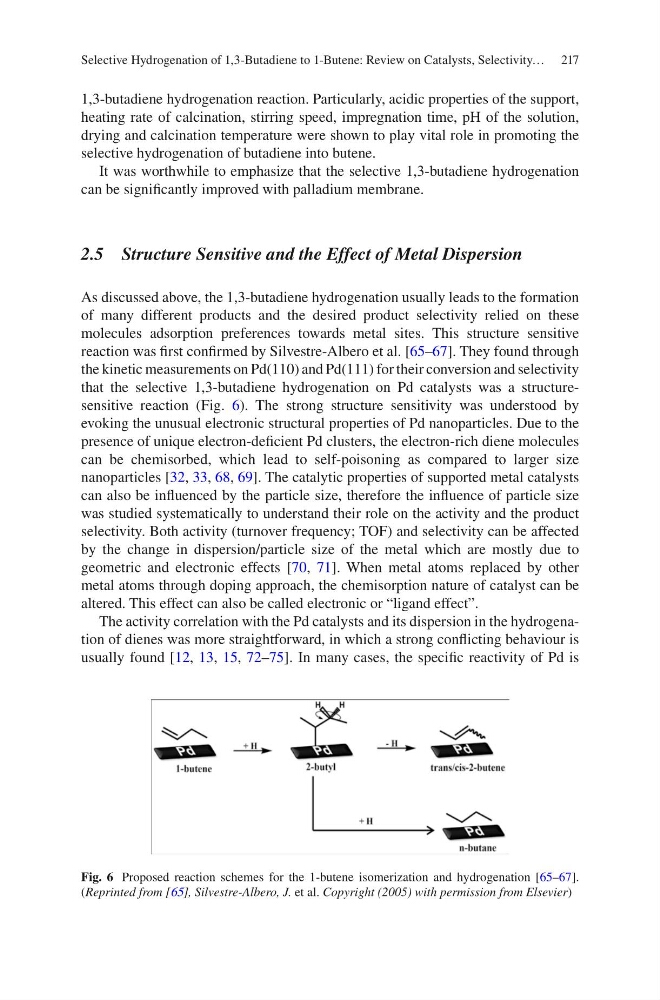
that the selective 1,3-butadiene hydrogenation on Pd catalysts was a structuresensitive reaction (Fig. 6). The strong structure sensitivity was understood by
evoking the unusual electronic structural properties of Pd nanoparticles. Due to the
presence of unique electron-deficient Pd clusters, the electron-rich diene molecules
can be chemisorbed, which lead to self-poisoning as compared to larger size
nanoparticles [32, 33, 68, 69]. The catalytic properties of supported metal catalysts
can also be influenced by the particle size, therefore the influence of particle size
was studied systematically to understand their role on the activity and the product
selectivity. Both activity (turnover frequency; TOF) and selectivity can be affected
by the change in dispersion/particle size of the metal which are mostly due to
geometric and electronic effects [70, 71]. When metal atoms replaced by other
metal atoms through doping approach, the chemisorption nature of catalyst can be
altered. This effect can also be called electronic or “ligand effect”.
The activity correlation with the Pd catalysts and its dispersion in the hydrogenation of dienes was more straightforward, in which a strong conflicting behaviour is
usually found [12, 13, 15, 72–75]. In many cases, the specific reactivity of Pd is
Fig. 6 Proposed reaction schemes for the 1-butene isomerization and hydrogenation [65–67].
(Reprinted from [65], Silvestre-Albero, J. et al. Copyright (2005) with permission from Elsevier)
Selective Hydrogenation of 1,3-Butadiene to 1-Butene: Review on Catalysts, Selectivity…
1,3-butadiene hydrogenation reaction. Particularly, acidic properties of the support,
heating rate of calcination, stirring speed, impregnation time, pH of the solution,
drying and calcination temperature were shown to play vital role in promoting the
selective hydrogenation of butadiene into butene.
It was worthwhile to emphasize that the selective 1,3-butadiene hydrogenation
can be significantly improved with palladium membrane.
2.5 Structure Sensitive and the Effect of Metal Dispersion
As discussed above, the 1,3-butadiene hydrogenation usually leads to the formation
of many different products and the desired product selectivity relied on these
molecules adsorption preferences towards metal sites. This structure sensitive
reaction was first confirmed by Silvestre-Albero et al. [65–67]. They found through
the kinetic measurements on Pd(110) and Pd(111) for their conversion and selectivity
that the selective 1,3-butadiene hydrogenation on Pd catalysts was a structuresensitive reaction (Fig. 6). The strong structure sensitivity was understood by
evoking the unusual electronic structural properties of Pd nanoparticles. Due to the
presence of unique electron-deficient Pd clusters, the electron-rich diene molecules
can be chemisorbed, which lead to self-poisoning as compared to larger size
nanoparticles [32, 33, 68, 69]. The catalytic properties of supported metal catalysts
can also be influenced by the particle size, therefore the influence of particle size
was studied systematically to understand their role on the activity and the product
selectivity. Both activity (turnover frequency; TOF) and selectivity can be affected
by the change in dispersion/particle size of the metal which are mostly due to
geometric and electronic effects [70, 71]. When metal atoms replaced by other
metal atoms through doping approach, the chemisorption nature of catalyst can be
altered. This effect can also be called electronic or “ligand effect”.
The activity correlation with the Pd catalysts and its dispersion in the hydrogenation of dienes was more straightforward, in which a strong conflicting behaviour is
usually found [12, 13, 15, 72–75]. In many cases, the specific reactivity of Pd is
Fig. 6 Proposed reaction schemes for the 1-butene isomerization and hydrogenation [65–67].
(Reprinted from [65], Silvestre-Albero, J. et al. Copyright (2005) with permission from Elsevier)
Selective Hydrogenation of 1,3-Butadiene to 1-Butene: Review on Catalysts, Selectivity…