

216
any significant changes in the activity. Several studies also claim that using porous
active site can influence the 1,3-butadiene hydrogenation process. It was explained
that the hydrogen porous membrane catalyst can provide an independent control of
the surface concentrations of hydrogen and other substances which can be readily
hydrogenated. That means the membrane can be Pd itself or it may act as support
material for the active species. Liu et al. [4] reported the use of mono- and bimetallic
hollow-fibre catalytic reactor for the purification of 1-butene. Interestingly, the
isomerization of 1-butene was significantly controlled due to the synergistic
interaction between bimetals. Moreover, Ciebien et al. [64] reported that Pd
nanoclusters membrane catalyst synthesized within microphase-separated di-block
copolymer films are active and selective catalysts for the selective hydrogenation of
1,3-butadiene, although the clusters were completely surrounded by a bulk polymer
matrix. It was observed that the selectivity was enhanced in case of Pd membranes
while compared to non-membranes. The increase in selectivity can be due to the
lower hydrogen pressure, which allowed steady-state concentration reactants away
from equilibrium and consequently suppressed the side-reactions over the working
catalyst. In summary, the above survey appraisal of variables makes evident that
there were many important variables involved in the preparation of catalysts for the
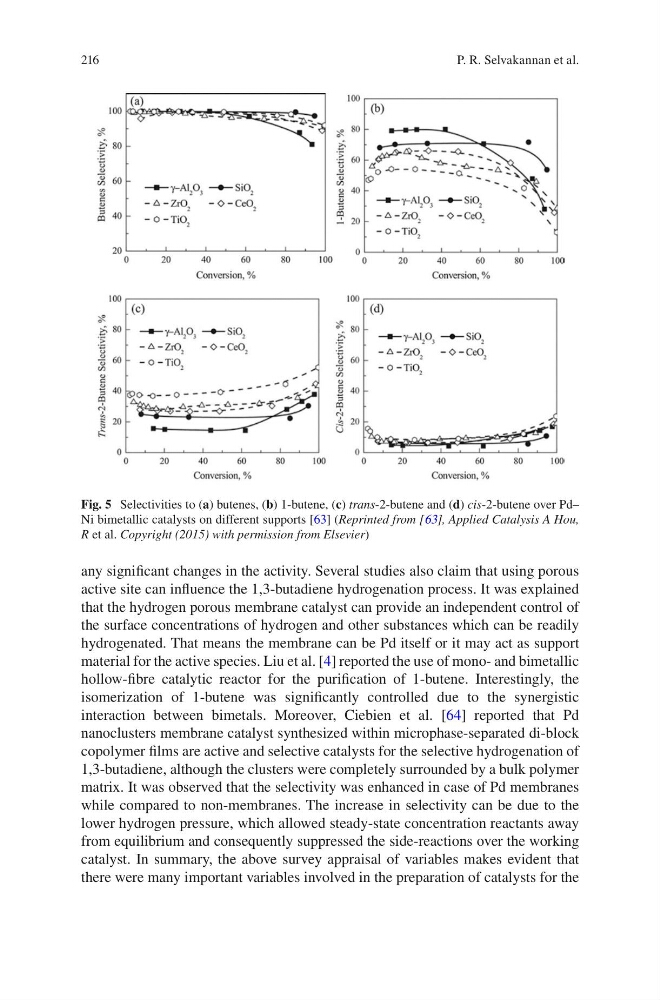
Fig. 5 Selectivities to (a) butenes, (b) 1-butene, (c) trans-2-butene and (d) cis-2-butene over Pd–
Ni bimetallic catalysts on different supports [63] (Reprinted from [63], Applied Catalysis A Hou,
R et al. Copyright (2015) with permission from Elsevier)
P. R. Selvakannan et al.
any significant changes in the activity. Several studies also claim that using porous
active site can influence the 1,3-butadiene hydrogenation process. It was explained
that the hydrogen porous membrane catalyst can provide an independent control of
the surface concentrations of hydrogen and other substances which can be readily
hydrogenated. That means the membrane can be Pd itself or it may act as support
material for the active species. Liu et al. [4] reported the use of mono- and bimetallic
hollow-fibre catalytic reactor for the purification of 1-butene. Interestingly, the
isomerization of 1-butene was significantly controlled due to the synergistic
interaction between bimetals. Moreover, Ciebien et al. [64] reported that Pd
nanoclusters membrane catalyst synthesized within microphase-separated di-block
copolymer films are active and selective catalysts for the selective hydrogenation of
1,3-butadiene, although the clusters were completely surrounded by a bulk polymer
matrix. It was observed that the selectivity was enhanced in case of Pd membranes
while compared to non-membranes. The increase in selectivity can be due to the
lower hydrogen pressure, which allowed steady-state concentration reactants away
from equilibrium and consequently suppressed the side-reactions over the working
catalyst. In summary, the above survey appraisal of variables makes evident that
there were many important variables involved in the preparation of catalysts for the
Fig. 5 Selectivities to (a) butenes, (b) 1-butene, (c) trans-2-butene and (d) cis-2-butene over Pd–
Ni bimetallic catalysts on different supports [63] (Reprinted from [63], Applied Catalysis A Hou,
R et al. Copyright (2015) with permission from Elsevier)
P. R. Selvakannan et al.