

208
selectivity aspects on various catalysts, because there are four probable reaction
products (1-butene, butane, cis- and trans-butene) [6].
In the case of 1,3-butadiene hydrogenation, selectivity can take mainly in the
forms of regio-selectivity, where the reduction of one C=C bond is favoured over
that of another in different surroundings (terminal C=C undergo faster reduction
compared to the internal one). Regio-selective hydrogenation of a 1,3-butadiene is
basically controlled by the same factors, which control the reactivity of alkenes,
when a competitive hydrogenation occurs in binary mixtures. Compared to other
substituted double bonds, a terminal C=C bond is preferentially hydrogenated on
the active site of the catalyst. However, another kind of selectivity can be observed
due to the competition between unreacted diene and intermediately formed monoene
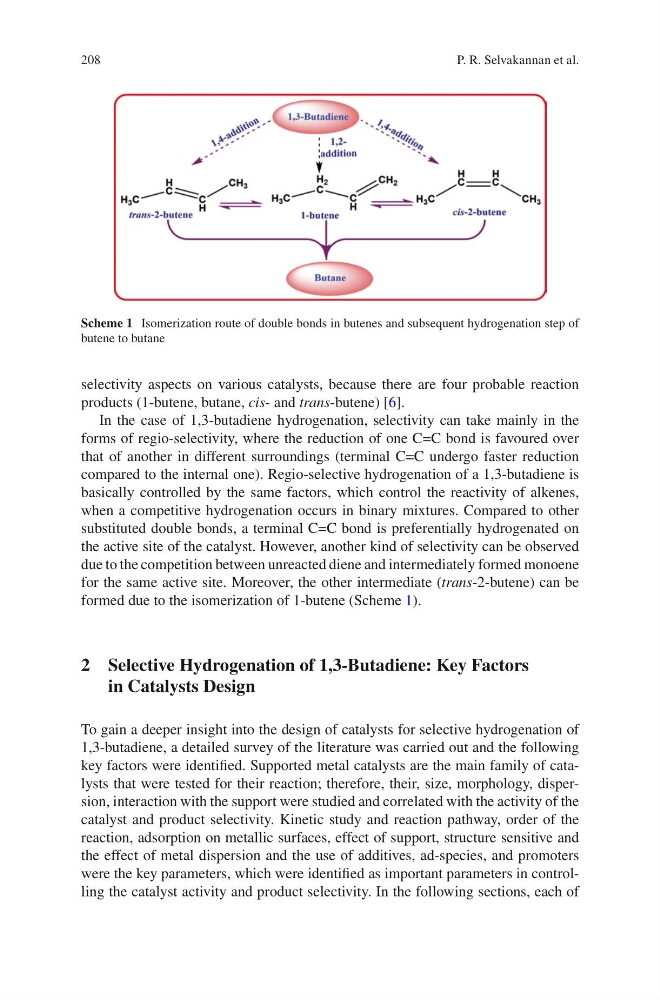
for the same active site. Moreover, the other intermediate (trans-2-butene) can be
formed due to the isomerization of 1-butene (Scheme 1).
2 Selective Hydrogenation of 1,3-Butadiene: Key Factors
in Catalysts Design
To gain a deeper insight into the design of catalysts for selective hydrogenation of
1,3-butadiene, a detailed survey of the literature was carried out and the following
key factors were identified. Supported metal catalysts are the main family of catalysts that were tested for their reaction; therefore, their, size, morphology, dispersion, interaction with the support were studied and correlated with the activity of the
catalyst and product selectivity. Kinetic study and reaction pathway, order of the
reaction, adsorption on metallic surfaces, effect of support, structure sensitive and
the effect of metal dispersion and the use of additives, ad-species, and promoters
were the key parameters, which were identified as important parameters in controlling the catalyst activity and product selectivity. In the following sections, each of
Scheme 1 Isomerization route of double bonds in butenes and subsequent hydrogenation step of
butene to butane
P. R. Selvakannan et al.
selectivity aspects on various catalysts, because there are four probable reaction
products (1-butene, butane, cis- and trans-butene) [6].
In the case of 1,3-butadiene hydrogenation, selectivity can take mainly in the
forms of regio-selectivity, where the reduction of one C=C bond is favoured over
that of another in different surroundings (terminal C=C undergo faster reduction
compared to the internal one). Regio-selective hydrogenation of a 1,3-butadiene is
basically controlled by the same factors, which control the reactivity of alkenes,
when a competitive hydrogenation occurs in binary mixtures. Compared to other
substituted double bonds, a terminal C=C bond is preferentially hydrogenated on
the active site of the catalyst. However, another kind of selectivity can be observed
due to the competition between unreacted diene and intermediately formed monoene
for the same active site. Moreover, the other intermediate (trans-2-butene) can be
formed due to the isomerization of 1-butene (Scheme 1).
2 Selective Hydrogenation of 1,3-Butadiene: Key Factors
in Catalysts Design
To gain a deeper insight into the design of catalysts for selective hydrogenation of
1,3-butadiene, a detailed survey of the literature was carried out and the following
key factors were identified. Supported metal catalysts are the main family of catalysts that were tested for their reaction; therefore, their, size, morphology, dispersion, interaction with the support were studied and correlated with the activity of the
catalyst and product selectivity. Kinetic study and reaction pathway, order of the
reaction, adsorption on metallic surfaces, effect of support, structure sensitive and
the effect of metal dispersion and the use of additives, ad-species, and promoters
were the key parameters, which were identified as important parameters in controlling the catalyst activity and product selectivity. In the following sections, each of
Scheme 1 Isomerization route of double bonds in butenes and subsequent hydrogenation step of
butene to butane
P. R. Selvakannan et al.