

207
that of other products and 1,3-butadiene. No other significant differences in physical
properties can be observed between the 1,3-butadiene and its products after
hydrogenation.
As mentioned in the introduction, the 1-butene-rich cut, also known as C4
alkenes cut, was available after butadiene and isobutene extraction at the downstream
operation of cracker unit in any petrochemical industries and refineries [1, 2].
Further, the process of the selective hydrogenation of 1,3-butadiene in C4 alkenes
cut could produce a linear low-density polyethylene (LLDPE) polymer [3]. 1-Butene
was mainly used as a co-monomer and a trace quantity of 1,3-butadiene present in
the feed, can adversely affect the polymerization (olefin) as well as durability of
catalysts and this process can reduce the rate of total polymer production. In
addition, 1-butene with 99 wt% purity and 1,3-butadiene residue (<10 ppm) are
required for an LLDPE co-monomer [4].
Therefore, selective conversion of 1,3-butadiene into 1-butene is a key issue during this hydrogenation process and this high selectivity is prominent for polymer
quality [5]. The high selectivity can be achieved if the process overcomes the
reaction steps of 1-butene isomerization (to form 2-butenes) and/or its subsequent
hydrogenation (to form n-butane). Moreover, selective butadiene hydrogenation is
an attractive model reaction, which permits investigation on both activity and
Table 1 Comparison of physical properties of reactants and products
Compound/
property
Formula
Molar mass (g/
mol)
Density (g/
cm
3 )
Melting point
(°C)
Boiling point
(°C)
1,3-Butadiene
C 4 H 6
54.09
0.614
−108.9
−4.4
1-Butene
C 4 H 8
56.11
0.620
−185.3
−6.4
Cis-2-butene
C 4 H 8
56.11
0.641
−138.9
3.7
Trans-2-butene
C 4 H 8
56.11
0.641
−138.9
3.7
Butane
C 4 H 10
58.12
2.480
−140.0
−1.0
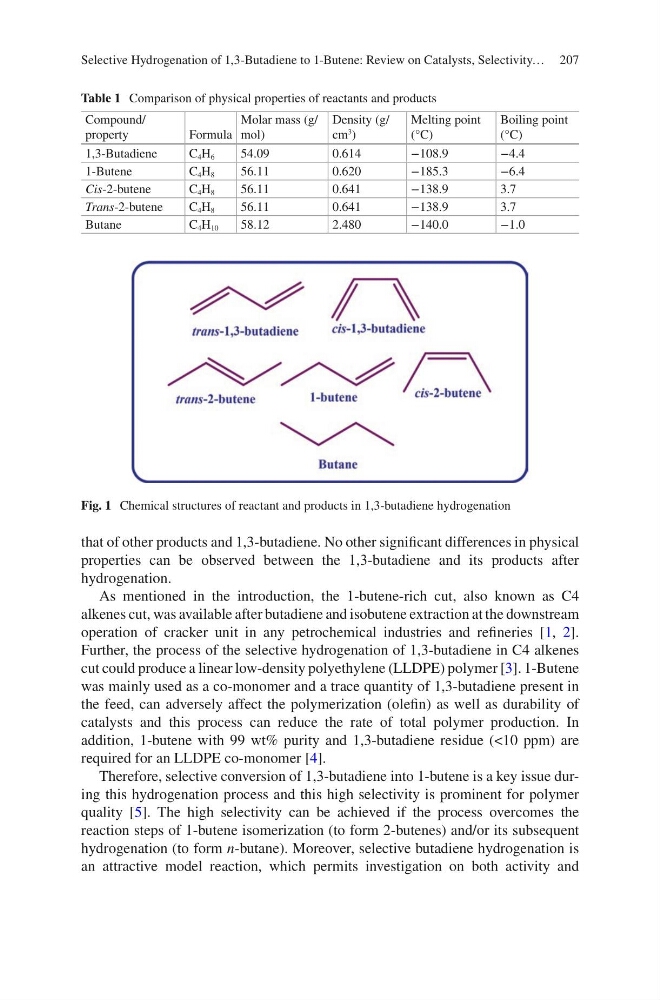
Fig. 1 Chemical structures of reactant and products in 1,3-butadiene hydrogenation
Selective Hydrogenation of 1,3-Butadiene to 1-Butene: Review on Catalysts, Selectivity…
that of other products and 1,3-butadiene. No other significant differences in physical
properties can be observed between the 1,3-butadiene and its products after
hydrogenation.
As mentioned in the introduction, the 1-butene-rich cut, also known as C4
alkenes cut, was available after butadiene and isobutene extraction at the downstream
operation of cracker unit in any petrochemical industries and refineries [1, 2].
Further, the process of the selective hydrogenation of 1,3-butadiene in C4 alkenes
cut could produce a linear low-density polyethylene (LLDPE) polymer [3]. 1-Butene
was mainly used as a co-monomer and a trace quantity of 1,3-butadiene present in
the feed, can adversely affect the polymerization (olefin) as well as durability of
catalysts and this process can reduce the rate of total polymer production. In
addition, 1-butene with 99 wt% purity and 1,3-butadiene residue (<10 ppm) are
required for an LLDPE co-monomer [4].
Therefore, selective conversion of 1,3-butadiene into 1-butene is a key issue during this hydrogenation process and this high selectivity is prominent for polymer
quality [5]. The high selectivity can be achieved if the process overcomes the
reaction steps of 1-butene isomerization (to form 2-butenes) and/or its subsequent
hydrogenation (to form n-butane). Moreover, selective butadiene hydrogenation is
an attractive model reaction, which permits investigation on both activity and
Table 1 Comparison of physical properties of reactants and products
Compound/
property
Formula
Molar mass (g/
mol)
Density (g/
cm
3 )
Melting point
(°C)
Boiling point
(°C)
1,3-Butadiene
C 4 H 6
54.09
0.614
−108.9
−4.4
1-Butene
C 4 H 8
56.11
0.620
−185.3
−6.4
Cis-2-butene
C 4 H 8
56.11
0.641
−138.9
3.7
Trans-2-butene
C 4 H 8
56.11
0.641
−138.9
3.7
Butane
C 4 H 10
58.12
2.480
−140.0
−1.0
Fig. 1 Chemical structures of reactant and products in 1,3-butadiene hydrogenation
Selective Hydrogenation of 1,3-Butadiene to 1-Butene: Review on Catalysts, Selectivity…