

188
Recently, a published article in futuristic research about acrylic acid production
described about the activation of inert propane CARENA (CAtalytic membrane
Reactors-based on New mAterials for C1-C4 valorization). It was an EU funded
project carried out between 2011 and 2015 (Fig. 16). In this process, Mo/Bi-based
mixed metal oxide was prepared by a sol-gel method which was employed for selective oxidation of propylene in a mixed propane feed with an increased catalytic
performance over the standard catalytic system. Additionally, a Pd-loaded zeolite
membrane catalyst was developed on the surface of 1 mm beads of γ-Al 2 O 3 support
for selective oxidation of CO in a propane-rich mixture.
By using this catalyst, a mild oxidation condition is achieved wherein selective
CO oxidation temperature is around 65 °C. Propylene oxidation was carried out
with pure oxygen in the presence of catalytic system in a pilot-scale unit (at a scale
of about 1–3 kg h
−1
) wherein 95% of propylene conversion and 85% of acrylic acid
yield were achieved.
Several other promising catalysts have been developed by inventors that provide
reasonably good propane or propylene conversion and selectivity to acrylic acid
(Table 12). Some of the catalyst system and its process technology are in commercial practice.
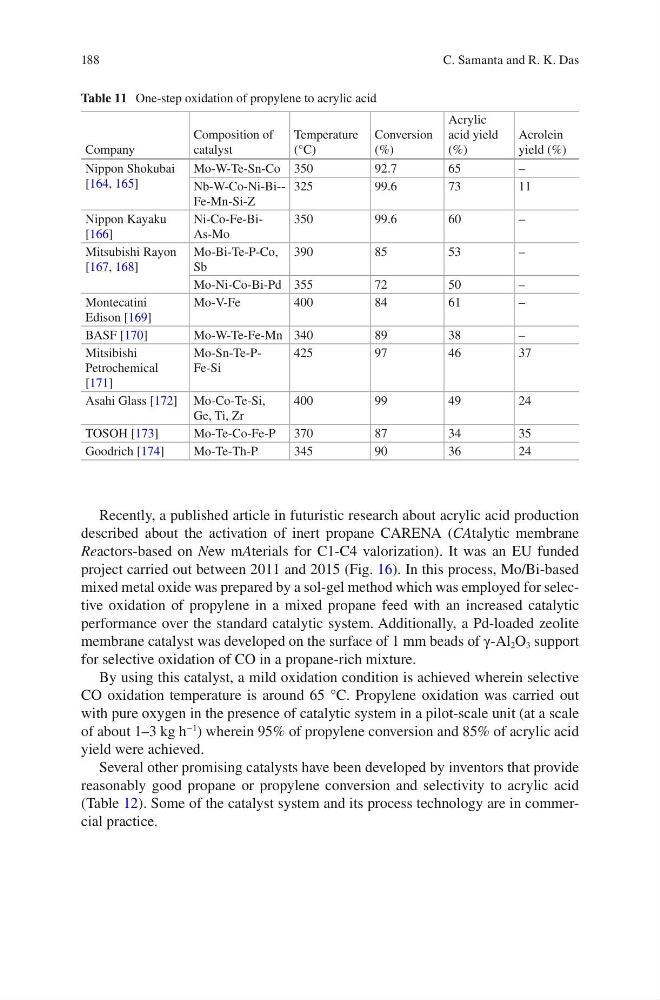
Table 11 One-step oxidation of propylene to acrylic acid
Company
Composition of
catalyst
Temperature
(°C)
Conversion
(%)
Acrylic
acid yield
(%)
Acrolein
yield (%)
Nippon Shokubai
[164, 165]
Mo-W-Te-Sn-Co 350
92.7
65
–
Nb-W-Co-Ni-Bi- -
Fe-Mn-Si-Z
325
99.6
73
11
Nippon Kayaku
[166]
Ni-Co-Fe-BiAs- Mo
350
99.6
60
–
Mitsubishi Rayon
[167, 168]
Mo-Bi-Te-P-Co,
Sb
390
85
53
–
Mo-Ni-Co-Bi-Pd 355
72
50
–
Montecatini
Edison [169]
Mo-V-Fe
400
84
61
–
BASF [170]
Mo-W-Te-Fe-Mn 340
89
38
–
Mitsibishi
Petrochemical
[171]
Mo-Sn-Te-PFe- Si
425
97
46
37
Asahi Glass [172] Mo-Co-Te-Si,
Ge, Ti, Zr
400
99
49
24
TOSOH [173]
Mo-Te-Co-Fe-P 370
87
34
35
Goodrich [174]
Mo-Te-Th-P
345
90
36
24
C. Samanta and R. K. Das
Recently, a published article in futuristic research about acrylic acid production
described about the activation of inert propane CARENA (CAtalytic membrane
Reactors-based on New mAterials for C1-C4 valorization). It was an EU funded
project carried out between 2011 and 2015 (Fig. 16). In this process, Mo/Bi-based
mixed metal oxide was prepared by a sol-gel method which was employed for selective oxidation of propylene in a mixed propane feed with an increased catalytic
performance over the standard catalytic system. Additionally, a Pd-loaded zeolite
membrane catalyst was developed on the surface of 1 mm beads of γ-Al 2 O 3 support
for selective oxidation of CO in a propane-rich mixture.
By using this catalyst, a mild oxidation condition is achieved wherein selective
CO oxidation temperature is around 65 °C. Propylene oxidation was carried out
with pure oxygen in the presence of catalytic system in a pilot-scale unit (at a scale
of about 1–3 kg h
−1
) wherein 95% of propylene conversion and 85% of acrylic acid
yield were achieved.
Several other promising catalysts have been developed by inventors that provide
reasonably good propane or propylene conversion and selectivity to acrylic acid
(Table 12). Some of the catalyst system and its process technology are in commercial practice.
Table 11 One-step oxidation of propylene to acrylic acid
Company
Composition of
catalyst
Temperature
(°C)
Conversion
(%)
Acrylic
acid yield
(%)
Acrolein
yield (%)
Nippon Shokubai
[164, 165]
Mo-W-Te-Sn-Co 350
92.7
65
–
Nb-W-Co-Ni-Bi- -
Fe-Mn-Si-Z
325
99.6
73
11
Nippon Kayaku
[166]
Ni-Co-Fe-BiAs- Mo
350
99.6
60
–
Mitsubishi Rayon
[167, 168]
Mo-Bi-Te-P-Co,
Sb
390
85
53
–
Mo-Ni-Co-Bi-Pd 355
72
50
–
Montecatini
Edison [169]
Mo-V-Fe
400
84
61
–
BASF [170]
Mo-W-Te-Fe-Mn 340
89
38
–
Mitsibishi
Petrochemical
[171]
Mo-Sn-Te-PFe- Si
425
97
46
37
Asahi Glass [172] Mo-Co-Te-Si,
Ge, Ti, Zr
400
99
49
24
TOSOH [173]
Mo-Te-Co-Fe-P 370
87
34
35
Goodrich [174]
Mo-Te-Th-P
345
90
36
24
C. Samanta and R. K. Das