

185
their performance in acrylic production for both one-step and two-step processes
are given in Tables 9, 10 and 11.
It is evident from Table 11 that single-step propylene conversion to acrylic acid
has a much lower yield as compared to two-step conversion process (Scheme 14).
Acrylic Acid from Propane
Since propylene is a synthetic molecule, the obvious economic choice for making
acrylic acid would be from naturally occurring propane than propylene. However,
propane (Δ f H° gas = −104.7 kJ/mol) is thermodynamically much stable molecule
than propylene (Δ f H° gas = 20.41 kJ/mol) and thus it has very low reactivity under
various reaction condition. It has very high C–H bond strength at the terminal
methyl position causing difficult to activate terminal position. The terminal C–H
bond is even stronger than C–C bond and thus there is quite a high chance to obtain
undesired side product while conducting partial propane oxidation to meaningful
products. However, technical challenges are needed to overcome considering lowcost propane availability and for utilizing this abundant source for high-value chemical production (Scheme 15).
Even though tremendous research effort has been put for the development of
one-step oxidation process for propane to acrylic acid production, the process is yet
to see commercial success. Several catalyst systems such as vanadium phosphate
[142], VPO/TiO 2 -SiO 2 , heteropolyacid compounds [175], and multicomponent
metal oxides [176] have been explored for the single-step conversion of propane to
acrylic acid. Among various catalyst systems, Mo-V-Te-Nb-O catalyst exhibits
promising activity, wherein 70–80% of propane conversion with 50–60% of acrylic
acid selectivity have been obtained.
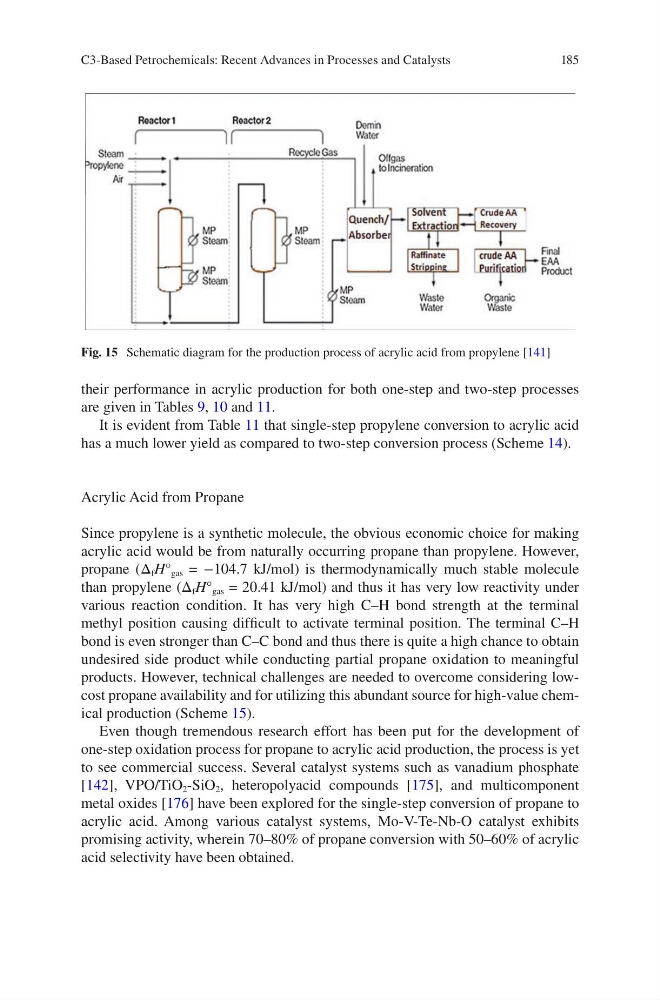
Fig. 15 Schematic diagram for the production process of acrylic acid from propylene [141]
C3-Based Petrochemicals: Recent Advances in Processes and Catalysts
their performance in acrylic production for both one-step and two-step processes
are given in Tables 9, 10 and 11.
It is evident from Table 11 that single-step propylene conversion to acrylic acid
has a much lower yield as compared to two-step conversion process (Scheme 14).
Acrylic Acid from Propane
Since propylene is a synthetic molecule, the obvious economic choice for making
acrylic acid would be from naturally occurring propane than propylene. However,
propane (Δ f H° gas = −104.7 kJ/mol) is thermodynamically much stable molecule
than propylene (Δ f H° gas = 20.41 kJ/mol) and thus it has very low reactivity under
various reaction condition. It has very high C–H bond strength at the terminal
methyl position causing difficult to activate terminal position. The terminal C–H
bond is even stronger than C–C bond and thus there is quite a high chance to obtain
undesired side product while conducting partial propane oxidation to meaningful
products. However, technical challenges are needed to overcome considering lowcost propane availability and for utilizing this abundant source for high-value chemical production (Scheme 15).
Even though tremendous research effort has been put for the development of
one-step oxidation process for propane to acrylic acid production, the process is yet
to see commercial success. Several catalyst systems such as vanadium phosphate
[142], VPO/TiO 2 -SiO 2 , heteropolyacid compounds [175], and multicomponent
metal oxides [176] have been explored for the single-step conversion of propane to
acrylic acid. Among various catalyst systems, Mo-V-Te-Nb-O catalyst exhibits
promising activity, wherein 70–80% of propane conversion with 50–60% of acrylic
acid selectivity have been obtained.
Fig. 15 Schematic diagram for the production process of acrylic acid from propylene [141]
C3-Based Petrochemicals: Recent Advances in Processes and Catalysts