

184
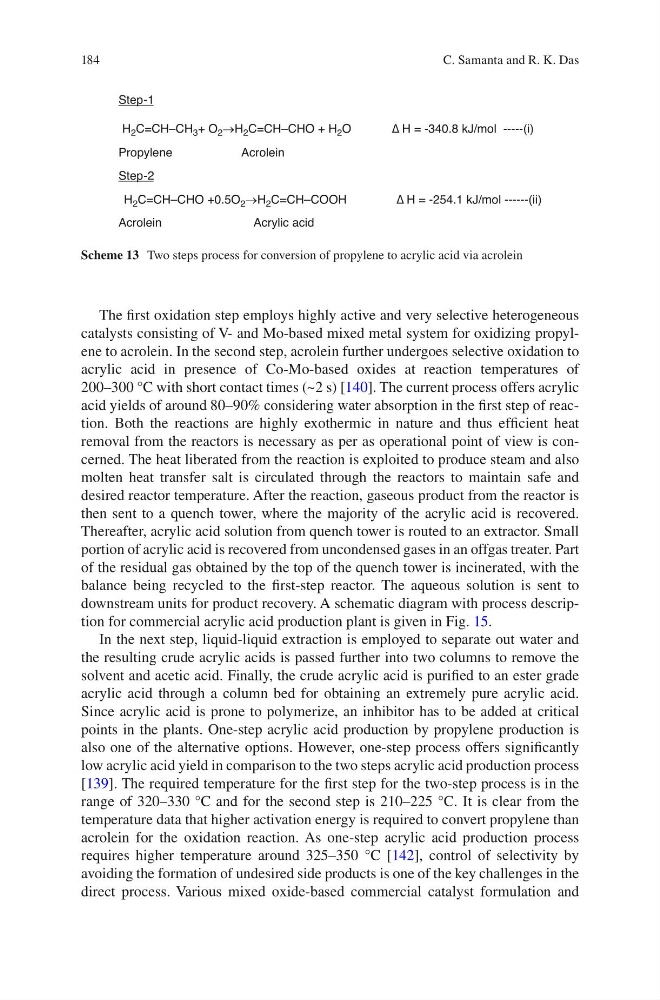
The first oxidation step employs highly active and very selective heterogeneous
catalysts consisting of V- and Mo-based mixed metal system for oxidizing propylene to acrolein. In the second step, acrolein further undergoes selective oxidation to
acrylic acid in presence of Co-Mo-based oxides at reaction temperatures of
200–300 °C with short contact times (~2 s) [140]. The current process offers acrylic
acid yields of around 80–90% considering water absorption in the first step of reaction. Both the reactions are highly exothermic in nature and thus efficient heat
removal from the reactors is necessary as per as operational point of view is concerned. The heat liberated from the reaction is exploited to produce steam and also
molten heat transfer salt is circulated through the reactors to maintain safe and
desired reactor temperature. After the reaction, gaseous product from the reactor is
then sent to a quench tower, where the majority of the acrylic acid is recovered.
Thereafter, acrylic acid solution from quench tower is routed to an extractor. Small
portion of acrylic acid is recovered from uncondensed gases in an offgas treater. Part
of the residual gas obtained by the top of the quench tower is incinerated, with the
balance being recycled to the first-step reactor. The aqueous solution is sent to
downstream units for product recovery. A schematic diagram with process description for commercial acrylic acid production plant is given in Fig. 15.
In the next step, liquid-liquid extraction is employed to separate out water and
the resulting crude acrylic acids is passed further into two columns to remove the
solvent and acetic acid. Finally, the crude acrylic acid is purified to an ester grade
acrylic acid through a column bed for obtaining an extremely pure acrylic acid.
Since acrylic acid is prone to polymerize, an inhibitor has to be added at critical
points in the plants. One-step acrylic acid production by propylene production is
also one of the alternative options. However, one-step process offers significantly
low acrylic acid yield in comparison to the two steps acrylic acid production process
[139]. The required temperature for the first step for the two-step process is in the
range of 320–330 °C and for the second step is 210–225 °C. It is clear from the
temperature data that higher activation energy is required to convert propylene than
acrolein for the oxidation reaction. As one-step acrylic acid production process
requires higher temperature around 325–350 °C [142], control of selectivity by
avoiding the formation of undesired side products is one of the key challenges in the
direct process. Various mixed oxide-based commercial catalyst formulation and
Step -1
Propylene
Acrolein
Step -2
Acrolein
Acrylic acid
∆ H = -340.8 kJ/mol -----(i)
∆ H = -254.1 kJ/mol ------(ii)
H 2 C=CH–CHO +0.5O 2 oH 2 C=CH–COOH
H 2 C=CH–CH 3 + O 2 oH 2 C=CH–CHO + H 2 O
Scheme 13 Two steps process for conversion of propylene to acrylic acid via acrolein
C. Samanta and R. K. Das
The first oxidation step employs highly active and very selective heterogeneous
catalysts consisting of V- and Mo-based mixed metal system for oxidizing propylene to acrolein. In the second step, acrolein further undergoes selective oxidation to
acrylic acid in presence of Co-Mo-based oxides at reaction temperatures of
200–300 °C with short contact times (~2 s) [140]. The current process offers acrylic
acid yields of around 80–90% considering water absorption in the first step of reaction. Both the reactions are highly exothermic in nature and thus efficient heat
removal from the reactors is necessary as per as operational point of view is concerned. The heat liberated from the reaction is exploited to produce steam and also
molten heat transfer salt is circulated through the reactors to maintain safe and
desired reactor temperature. After the reaction, gaseous product from the reactor is
then sent to a quench tower, where the majority of the acrylic acid is recovered.
Thereafter, acrylic acid solution from quench tower is routed to an extractor. Small
portion of acrylic acid is recovered from uncondensed gases in an offgas treater. Part
of the residual gas obtained by the top of the quench tower is incinerated, with the
balance being recycled to the first-step reactor. The aqueous solution is sent to
downstream units for product recovery. A schematic diagram with process description for commercial acrylic acid production plant is given in Fig. 15.
In the next step, liquid-liquid extraction is employed to separate out water and
the resulting crude acrylic acids is passed further into two columns to remove the
solvent and acetic acid. Finally, the crude acrylic acid is purified to an ester grade
acrylic acid through a column bed for obtaining an extremely pure acrylic acid.
Since acrylic acid is prone to polymerize, an inhibitor has to be added at critical
points in the plants. One-step acrylic acid production by propylene production is
also one of the alternative options. However, one-step process offers significantly
low acrylic acid yield in comparison to the two steps acrylic acid production process
[139]. The required temperature for the first step for the two-step process is in the
range of 320–330 °C and for the second step is 210–225 °C. It is clear from the
temperature data that higher activation energy is required to convert propylene than
acrolein for the oxidation reaction. As one-step acrylic acid production process
requires higher temperature around 325–350 °C [142], control of selectivity by
avoiding the formation of undesired side products is one of the key challenges in the
direct process. Various mixed oxide-based commercial catalyst formulation and
Step -1
Propylene
Acrolein
Step -2
Acrolein
Acrylic acid
∆ H = -340.8 kJ/mol -----(i)
∆ H = -254.1 kJ/mol ------(ii)
H 2 C=CH–CHO +0.5O 2 oH 2 C=CH–COOH
H 2 C=CH–CH 3 + O 2 oH 2 C=CH–CHO + H 2 O
Scheme 13 Two steps process for conversion of propylene to acrylic acid via acrolein
C. Samanta and R. K. Das