

175
The arrival of SOHIO process in 1960s dramatically changed the scenario of the
ACN production and annual worldwide production of acrylonitrile rapidly increased
from 260 million pounds in 1960 to more than 11.4 billion pounds in 2005 [103].
Ammoxidation Route
Currently, the SOHIO process accounts for more than 95% of the world’s ACN
production. SOHIO process was initially developed in 1957 by Standard Oil
Company, or SOHIO which was later acquired by British Petroleum (BP) in 1978.
Currently, the acrylonitrile technology licensing and catalyst businesses are part of
INEOS. SOHIO process uses propylene, ammonia, and air (O 2 ) as feeds. At present,
the SOHIO process makes around 7 billion kg/year of acrylonitrile worldwide
[106], which is equivalent to 1 kg/year per person on planet earth. The SOHIO process entails the production of acrylonitrile through the direct gas-phase oxidation of
propylene in the presence of a heterogeneous bismuth-phosphomolybdate-based
catalyst with ammonia and oxygen (from air) as feed gases (Scheme 12).
As a result lower acrylonitrile yield is obtained in the SOHIO process if the catalyst used is not highly selective. A schematic process flow diagram of commercial
SOHIO process is shown in Fig. 11. The commercial SOHIO process uses fluid bed
reactors (10–12 m dia) and with a large amount of catalyst (75,000 kg of catalyst/
reactor) and the particle size of the catalysts ranges between 40 and 100 μm for
effective fluidization [104]. The reactors are operated in the temperature range of
420–450 °C and 1.5–3 bar pressure. The residence time is kept low of 5–8 s and a
superficial linear gas velocity between 0.2 and 0.5 m/s is used for effective operation. With this innovation, in 1960s, a plant having production capacity of 47.5 million pounds/year was set up by Sohio Oil. The new process reduced the cost of the
acrylonitrile production by half as compared to the acetylene-based production process. Therefore, acetylene-based acrylonitrile production plant was gradually
replaced by novel propylene ammoxidation process and most of the acrylonitrile
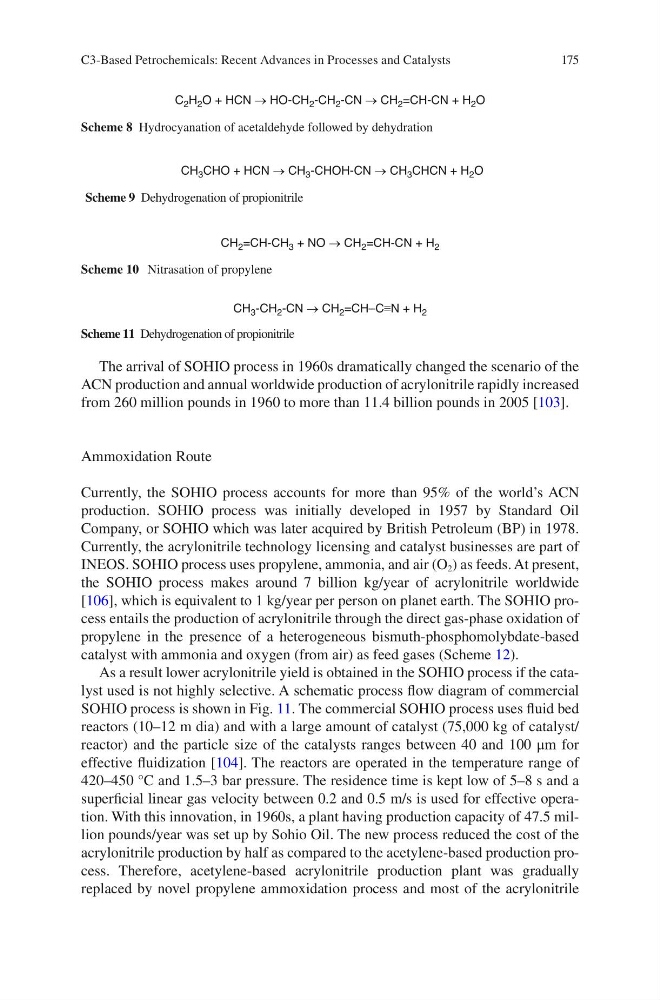
C 2 H 2 O + HCN o HO-CH 2 -CH 2 -CN o CH 2 =CH-CN + H 2 O
Scheme 8 Hydrocyanation of acetaldehyde followed by dehydration
CH 3 CHO + HCN o CH 3 -CHOH-CN o CH 3 CHCN + H 2 O
Scheme 9 Dehydrogenation of propionitrile
CH 2 =CH-CH 3 + NO o CH 2 =CH-CN + H 2
Scheme 10 Nitrasation of propylene
CH 3 -CH 2 -CN o CH 2 =CH–C≡N + H 2
Scheme 11 Dehydrogenation of propionitrile
C3-Based Petrochemicals: Recent Advances in Processes and Catalysts
The arrival of SOHIO process in 1960s dramatically changed the scenario of the
ACN production and annual worldwide production of acrylonitrile rapidly increased
from 260 million pounds in 1960 to more than 11.4 billion pounds in 2005 [103].
Ammoxidation Route
Currently, the SOHIO process accounts for more than 95% of the world’s ACN
production. SOHIO process was initially developed in 1957 by Standard Oil
Company, or SOHIO which was later acquired by British Petroleum (BP) in 1978.
Currently, the acrylonitrile technology licensing and catalyst businesses are part of
INEOS. SOHIO process uses propylene, ammonia, and air (O 2 ) as feeds. At present,
the SOHIO process makes around 7 billion kg/year of acrylonitrile worldwide
[106], which is equivalent to 1 kg/year per person on planet earth. The SOHIO process entails the production of acrylonitrile through the direct gas-phase oxidation of
propylene in the presence of a heterogeneous bismuth-phosphomolybdate-based
catalyst with ammonia and oxygen (from air) as feed gases (Scheme 12).
As a result lower acrylonitrile yield is obtained in the SOHIO process if the catalyst used is not highly selective. A schematic process flow diagram of commercial
SOHIO process is shown in Fig. 11. The commercial SOHIO process uses fluid bed
reactors (10–12 m dia) and with a large amount of catalyst (75,000 kg of catalyst/
reactor) and the particle size of the catalysts ranges between 40 and 100 μm for
effective fluidization [104]. The reactors are operated in the temperature range of
420–450 °C and 1.5–3 bar pressure. The residence time is kept low of 5–8 s and a
superficial linear gas velocity between 0.2 and 0.5 m/s is used for effective operation. With this innovation, in 1960s, a plant having production capacity of 47.5 million pounds/year was set up by Sohio Oil. The new process reduced the cost of the
acrylonitrile production by half as compared to the acetylene-based production process. Therefore, acetylene-based acrylonitrile production plant was gradually
replaced by novel propylene ammoxidation process and most of the acrylonitrile
C 2 H 2 O + HCN o HO-CH 2 -CH 2 -CN o CH 2 =CH-CN + H 2 O
Scheme 8 Hydrocyanation of acetaldehyde followed by dehydration
CH 3 CHO + HCN o CH 3 -CHOH-CN o CH 3 CHCN + H 2 O
Scheme 9 Dehydrogenation of propionitrile
CH 2 =CH-CH 3 + NO o CH 2 =CH-CN + H 2
Scheme 10 Nitrasation of propylene
CH 3 -CH 2 -CN o CH 2 =CH–C≡N + H 2
Scheme 11 Dehydrogenation of propionitrile
C3-Based Petrochemicals: Recent Advances in Processes and Catalysts