

167
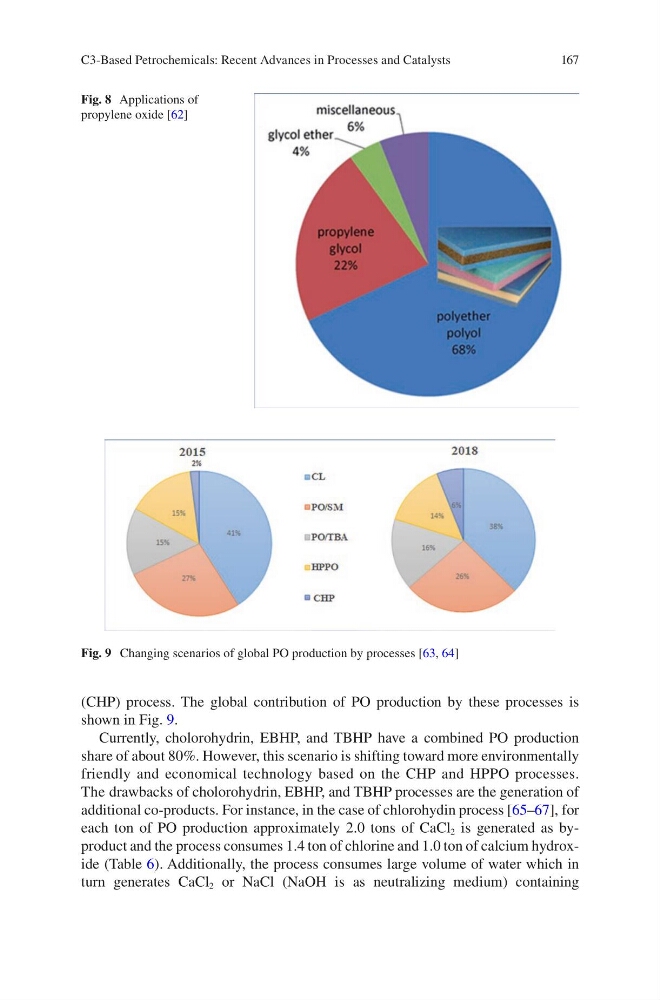
(CHP) process. The global contribution of PO production by these processes is
shown in Fig. 9.
Currently, cholorohydrin, EBHP, and TBHP have a combined PO production
share of about 80%. However, this scenario is shifting toward more environmentally
friendly and economical technology based on the CHP and HPPO processes.
The drawbacks of cholorohydrin, EBHP, and TBHP processes are the generation of
additional co-products. For instance, in the case of chlorohydin process [65–67], for
each ton of PO production approximately 2.0 tons of CaCl 2 is generated as byproduct and the process consumes 1.4 ton of chlorine and 1.0 ton of calcium hydroxide (Table 6). Additionally, the process consumes large volume of water which in
turn generates CaCl 2 or NaCl (NaOH is as neutralizing medium) containing
Fig. 8 Applications of
propylene oxide [62]
Fig. 9 Changing scenarios of global PO production by processes [63, 64]
C3-Based Petrochemicals: Recent Advances in Processes and Catalysts
(CHP) process. The global contribution of PO production by these processes is
shown in Fig. 9.
Currently, cholorohydrin, EBHP, and TBHP have a combined PO production
share of about 80%. However, this scenario is shifting toward more environmentally
friendly and economical technology based on the CHP and HPPO processes.
The drawbacks of cholorohydrin, EBHP, and TBHP processes are the generation of
additional co-products. For instance, in the case of chlorohydin process [65–67], for
each ton of PO production approximately 2.0 tons of CaCl 2 is generated as byproduct and the process consumes 1.4 ton of chlorine and 1.0 ton of calcium hydroxide (Table 6). Additionally, the process consumes large volume of water which in
turn generates CaCl 2 or NaCl (NaOH is as neutralizing medium) containing
Fig. 8 Applications of
propylene oxide [62]
Fig. 9 Changing scenarios of global PO production by processes [63, 64]
C3-Based Petrochemicals: Recent Advances in Processes and Catalysts