

156
(b.p.—42.1 °C) along with traces of other heavier products [24]. However, propylene derived from such refinery processes needs to be purified/upgraded for the
downstream production of propylene-based chemicals and polymers.
2.2 Alternative Sources/Processes: On-Purpose
Propylene Production
On-purpose propylene production route is increasingly being relevant to fill the gap
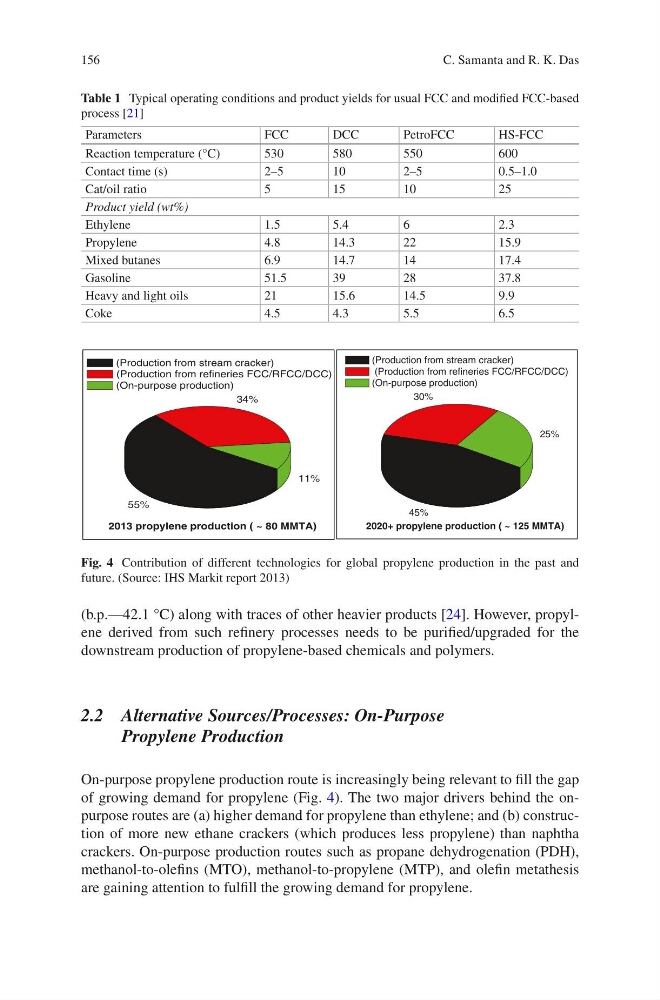
of growing demand for propylene (Fig. 4). The two major drivers behind the onpurpose routes are (a) higher demand for propylene than ethylene; and (b) construction of more new ethane crackers (which produces less propylene) than naphtha
crackers. On-purpose production routes such as propane dehydrogenation (PDH),
methanol-to-olefins (MTO), methanol-to-propylene (MTP), and olefin metathesis
are gaining attention to fulfill the growing demand for propylene.
Table 1 Typical operating conditions and product yields for usual FCC and modified FCC-based
process [21]
Parameters
FCC
DCC
PetroFCC
HS-FCC
Reaction temperature (°C)
530
580
550
600
Contact time (s)
2–5
10
2–5
0.5–1.0
Cat/oil ratio
5
15
10
25
Product yield (wt%)
Ethylene
1.5
5.4
6
2.3
Propylene
4.8
14.3
22
15.9
Mixed butanes
6.9
14.7
14
17.4
Gasoline
51.5
39
28
37.8
Heavy and light oils
21
15.6
14.5
9.9
Coke
4.5
4.3
5.5
6.5
34%
2013 propylene production ( ~ 80 MMTA)
11%
55%
(Production from stream cracker)
(Production from refineries FCC/RFCC/DCC)
(On-purpose production)
30%
2020+ propylene production ( ~ 125 MMTA)
25%
45%
(Production from stream cracker)
(Production from refineries FCC/RFCC/DCC)
(On-purpose production)
Fig. 4 Contribution of different technologies for global propylene production in the past and
future. (Source: IHS Markit report 2013)
C. Samanta and R. K. Das
(b.p.—42.1 °C) along with traces of other heavier products [24]. However, propylene derived from such refinery processes needs to be purified/upgraded for the
downstream production of propylene-based chemicals and polymers.
2.2 Alternative Sources/Processes: On-Purpose
Propylene Production
On-purpose propylene production route is increasingly being relevant to fill the gap
of growing demand for propylene (Fig. 4). The two major drivers behind the onpurpose routes are (a) higher demand for propylene than ethylene; and (b) construction of more new ethane crackers (which produces less propylene) than naphtha
crackers. On-purpose production routes such as propane dehydrogenation (PDH),
methanol-to-olefins (MTO), methanol-to-propylene (MTP), and olefin metathesis
are gaining attention to fulfill the growing demand for propylene.
Table 1 Typical operating conditions and product yields for usual FCC and modified FCC-based
process [21]
Parameters
FCC
DCC
PetroFCC
HS-FCC
Reaction temperature (°C)
530
580
550
600
Contact time (s)
2–5
10
2–5
0.5–1.0
Cat/oil ratio
5
15
10
25
Product yield (wt%)
Ethylene
1.5
5.4
6
2.3
Propylene
4.8
14.3
22
15.9
Mixed butanes
6.9
14.7
14
17.4
Gasoline
51.5
39
28
37.8
Heavy and light oils
21
15.6
14.5
9.9
Coke
4.5
4.3
5.5
6.5
34%
2013 propylene production ( ~ 80 MMTA)
11%
55%
(Production from stream cracker)
(Production from refineries FCC/RFCC/DCC)
(On-purpose production)
30%
2020+ propylene production ( ~ 125 MMTA)
25%
45%
(Production from stream cracker)
(Production from refineries FCC/RFCC/DCC)
(On-purpose production)
Fig. 4 Contribution of different technologies for global propylene production in the past and
future. (Source: IHS Markit report 2013)
C. Samanta and R. K. Das