

155
technology with more licensed units than all other licensors combined [13]. The
Alliance is also a leader in the Resid-to-Propylene (R2P™) technology [14]. These
technologies are based on modifying FCC technologies. Similarly, several FCCbased technologies have been developed and licensed by modifying catalyst’s formulation—specifically the pore architecture of zeolite, changing hardware
configuration, and finally by optimizing reaction parameters—by changing operational severity. For instance, ZSM-5 zeolite can be used along with conventional
ultra-stable Y (USY) zeolite-based FCC catalyst in FCC units without changing
much of the unit configuration for propylene yield maximization [15–17].
INDMAX–FCC process developed by Indian Oil/Lummus is one of such FCC technologies which does not require much change in hardware in FCC units. Deep catalytic cracking (DCC) technology developed by SINOPEC uses entirely ZSM-5-based
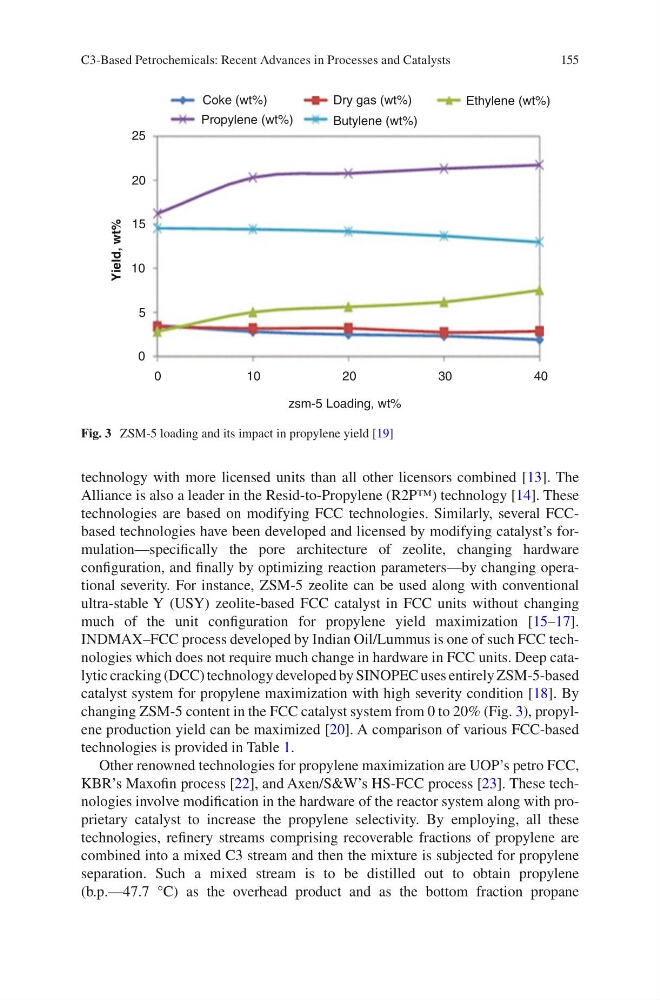
catalyst system for propylene maximization with high severity condition [18]. By
changing ZSM-5 content in the FCC catalyst system from 0 to 20% (Fig. 3), propylene production yield can be maximized [20]. A comparison of various FCC-based
technologies is provided in Table 1.
Other renowned technologies for propylene maximization are UOP’s petro FCC,
KBR’s Maxofin process [22], and Axen/S&W’s HS-FCC process [23]. These technologies involve modification in the hardware of the reactor system along with proprietary catalyst to increase the propylene selectivity. By employing, all these
technologies, refinery streams comprising recoverable fractions of propylene are
combined into a mixed C3 stream and then the mixture is subjected for propylene
separation. Such a mixed stream is to be distilled out to obtain propylene
(b.p.—47.7 °C) as the overhead product and as the bottom fraction propane
zsm-5 Loading, wt%
0
1 0
2 0
3 0
4 0
0
5
10
15
20
25
Coke (wt%)
Propylene (wt%)
Dry gas (wt%)
Ethylene (wt%)
Butylene (wt%)
Yield, wt%
Fig. 3 ZSM-5 loading and its impact in propylene yield [19]
C3-Based Petrochemicals: Recent Advances in Processes and Catalysts
technology with more licensed units than all other licensors combined [13]. The
Alliance is also a leader in the Resid-to-Propylene (R2P™) technology [14]. These
technologies are based on modifying FCC technologies. Similarly, several FCCbased technologies have been developed and licensed by modifying catalyst’s formulation—specifically the pore architecture of zeolite, changing hardware
configuration, and finally by optimizing reaction parameters—by changing operational severity. For instance, ZSM-5 zeolite can be used along with conventional
ultra-stable Y (USY) zeolite-based FCC catalyst in FCC units without changing
much of the unit configuration for propylene yield maximization [15–17].
INDMAX–FCC process developed by Indian Oil/Lummus is one of such FCC technologies which does not require much change in hardware in FCC units. Deep catalytic cracking (DCC) technology developed by SINOPEC uses entirely ZSM-5-based
catalyst system for propylene maximization with high severity condition [18]. By
changing ZSM-5 content in the FCC catalyst system from 0 to 20% (Fig. 3), propylene production yield can be maximized [20]. A comparison of various FCC-based
technologies is provided in Table 1.
Other renowned technologies for propylene maximization are UOP’s petro FCC,
KBR’s Maxofin process [22], and Axen/S&W’s HS-FCC process [23]. These technologies involve modification in the hardware of the reactor system along with proprietary catalyst to increase the propylene selectivity. By employing, all these
technologies, refinery streams comprising recoverable fractions of propylene are
combined into a mixed C3 stream and then the mixture is subjected for propylene
separation. Such a mixed stream is to be distilled out to obtain propylene
(b.p.—47.7 °C) as the overhead product and as the bottom fraction propane
zsm-5 Loading, wt%
0
1 0
2 0
3 0
4 0
0
5
10
15
20
25
Coke (wt%)
Propylene (wt%)
Dry gas (wt%)
Ethylene (wt%)
Butylene (wt%)
Yield, wt%
Fig. 3 ZSM-5 loading and its impact in propylene yield [19]
C3-Based Petrochemicals: Recent Advances in Processes and Catalysts