

133
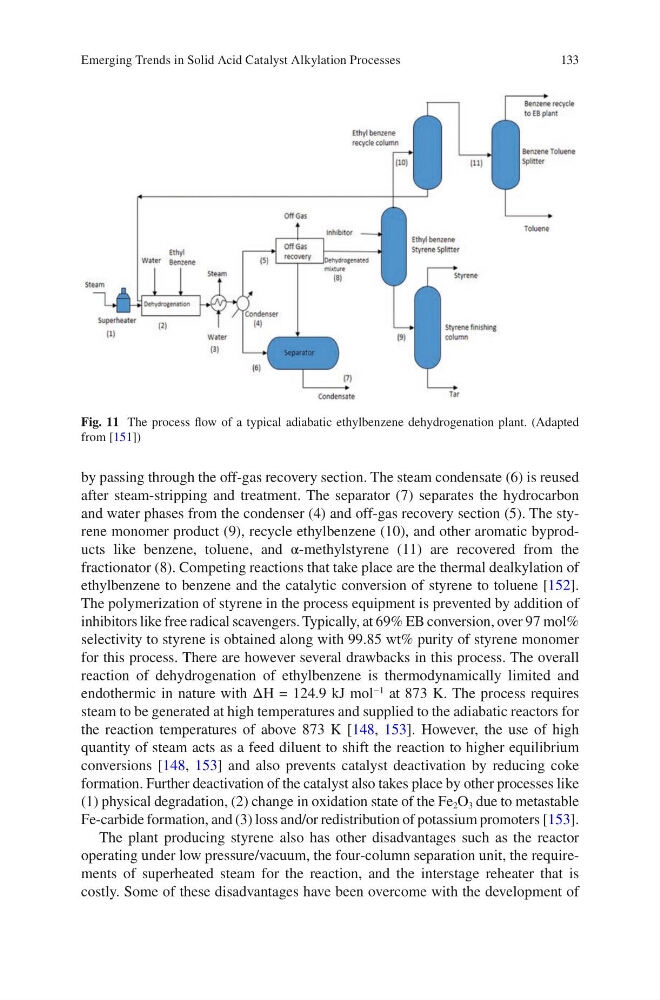
by passing through the off-gas recovery section. The steam condensate (6) is reused
after steam-stripping and treatment. The separator (7) separates the hydrocarbon
and water phases from the condenser (4) and off-gas recovery section (5). The styrene monomer product (9), recycle ethylbenzene (10), and other aromatic byproducts like benzene, toluene, and α-methylstyrene (11) are recovered from the
fractionator (8). Competing reactions that take place are the thermal dealkylation of
ethylbenzene to benzene and the catalytic conversion of styrene to toluene [152].
The polymerization of styrene in the process equipment is prevented by addition of
inhibitors like free radical scavengers. Typically, at 69% EB conversion, over 97 mol%
selectivity to styrene is obtained along with 99.85 wt% purity of styrene monomer
for this process. There are however several drawbacks in this process. The overall
reaction of dehydrogenation of ethylbenzene is thermodynamically limited and
endothermic in nature with ΔH = 124.9 kJ mol
−1
at 873 K. The process requires
steam to be generated at high temperatures and supplied to the adiabatic reactors for
the reaction temperatures of above 873 K [148, 153]. However, the use of high
quantity of steam acts as a feed diluent to shift the reaction to higher equilibrium
conversions [148, 153] and also prevents catalyst deactivation by reducing coke
formation. Further deactivation of the catalyst also takes place by other processes like
(1) physical degradation, (2) change in oxidation state of the Fe 2 O 3 due to metastable
Fe-carbide formation, and (3) loss and/or redistribution of potassium promoters [153].
The plant producing styrene also has other disadvantages such as the reactor
operating under low pressure/vacuum, the four-column separation unit, the requirements of superheated steam for the reaction, and the interstage reheater that is
costly. Some of these disadvantages have been overcome with the development of
Fig. 11 The process flow of a typical adiabatic ethylbenzene dehydrogenation plant. (Adapted
from [151])
Emerging Trends in Solid Acid Catalyst Alkylation Processes
by passing through the off-gas recovery section. The steam condensate (6) is reused
after steam-stripping and treatment. The separator (7) separates the hydrocarbon
and water phases from the condenser (4) and off-gas recovery section (5). The styrene monomer product (9), recycle ethylbenzene (10), and other aromatic byproducts like benzene, toluene, and α-methylstyrene (11) are recovered from the
fractionator (8). Competing reactions that take place are the thermal dealkylation of
ethylbenzene to benzene and the catalytic conversion of styrene to toluene [152].
The polymerization of styrene in the process equipment is prevented by addition of
inhibitors like free radical scavengers. Typically, at 69% EB conversion, over 97 mol%
selectivity to styrene is obtained along with 99.85 wt% purity of styrene monomer
for this process. There are however several drawbacks in this process. The overall
reaction of dehydrogenation of ethylbenzene is thermodynamically limited and
endothermic in nature with ΔH = 124.9 kJ mol
−1
at 873 K. The process requires
steam to be generated at high temperatures and supplied to the adiabatic reactors for
the reaction temperatures of above 873 K [148, 153]. However, the use of high
quantity of steam acts as a feed diluent to shift the reaction to higher equilibrium
conversions [148, 153] and also prevents catalyst deactivation by reducing coke
formation. Further deactivation of the catalyst also takes place by other processes like
(1) physical degradation, (2) change in oxidation state of the Fe 2 O 3 due to metastable
Fe-carbide formation, and (3) loss and/or redistribution of potassium promoters [153].
The plant producing styrene also has other disadvantages such as the reactor
operating under low pressure/vacuum, the four-column separation unit, the requirements of superheated steam for the reaction, and the interstage reheater that is
costly. Some of these disadvantages have been overcome with the development of
Fig. 11 The process flow of a typical adiabatic ethylbenzene dehydrogenation plant. (Adapted
from [151])
Emerging Trends in Solid Acid Catalyst Alkylation Processes