

129
comprising zeolites like MOR, beta, 13X, Y, and MCM-22 with metals like Pd, Ru,
Ni, Pt, and Rh supported on them have been studied for hydroalkylation of benzene.
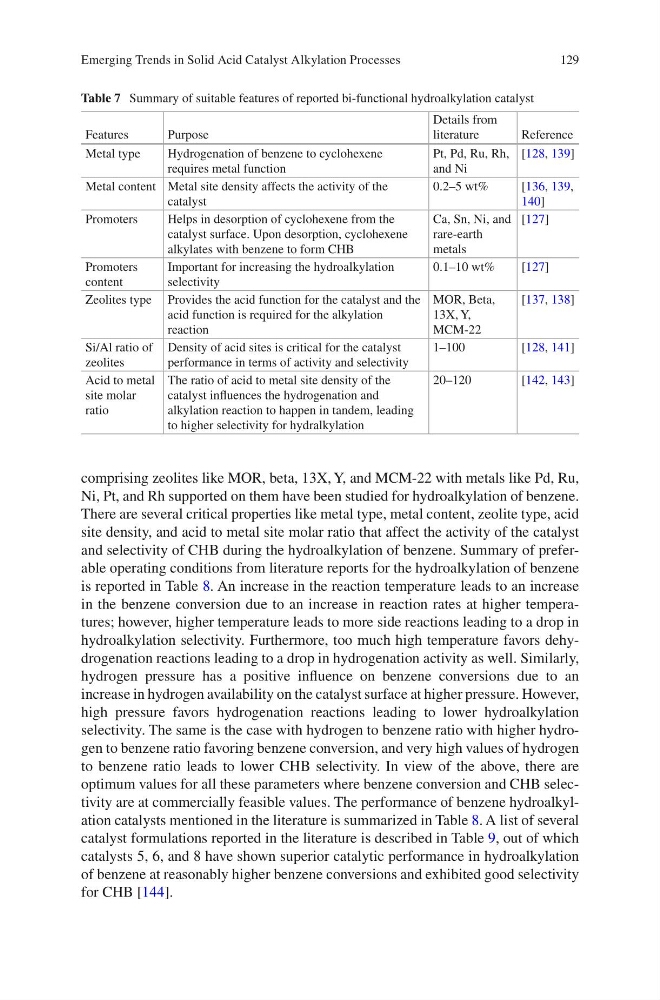
There are several critical properties like metal type, metal content, zeolite type, acid
site density, and acid to metal site molar ratio that affect the activity of the catalyst
and selectivity of CHB during the hydroalkylation of benzene. Summary of preferable operating conditions from literature reports for the hydroalkylation of benzene
is reported in Table 8. An increase in the reaction temperature leads to an increase
in the benzene conversion due to an increase in reaction rates at higher temperatures; however, higher temperature leads to more side reactions leading to a drop in
hydroalkylation selectivity. Furthermore, too much high temperature favors dehydrogenation reactions leading to a drop in hydrogenation activity as well. Similarly,
hydrogen pressure has a positive influence on benzene conversions due to an
increase in hydrogen availability on the catalyst surface at higher pressure. However,
high pressure favors hydrogenation reactions leading to lower hydroalkylation
selectivity. The same is the case with hydrogen to benzene ratio with higher hydrogen to benzene ratio favoring benzene conversion, and very high values of hydrogen
to benzene ratio leads to lower CHB selectivity. In view of the above, there are
optimum values for all these parameters where benzene conversion and CHB selectivity are at commercially feasible values. The performance of benzene hydroalkylation catalysts mentioned in the literature is summarized in Table 8. A list of several
catalyst formulations reported in the literature is described in Table 9, out of which
catalysts 5, 6, and 8 have shown superior catalytic performance in hydroalkylation
of benzene at reasonably higher benzene conversions and exhibited good selectivity
for CHB [144].
Table 7 Summary of suitable features of reported bi-functional hydroalkylation catalyst
Features
Purpose
Details from
literature
Reference
Metal type
Hydrogenation of benzene to cyclohexene
requires metal function
Pt, Pd, Ru, Rh,
and Ni
[128, 139]
Metal content Metal site density affects the activity of the
catalyst
0.2–5 wt%
[136, 139,
140]
Promoters
Helps in desorption of cyclohexene from the
catalyst surface. Upon desorption, cyclohexene
alkylates with benzene to form CHB
Ca, Sn, Ni, and
rare-earth
metals
[127]
Promoters
content
Important for increasing the hydroalkylation
selectivity
0.1–10 wt%
[127]
Zeolites type Provides the acid function for the catalyst and the
acid function is required for the alkylation
reaction
MOR, Beta,
13X, Y,
MCM-22
[137, 138]
Si/Al ratio of
zeolites
Density of acid sites is critical for the catalyst
performance in terms of activity and selectivity
1–100
[128, 141]
Acid to metal
site molar
ratio
The ratio of acid to metal site density of the
catalyst influences the hydrogenation and
alkylation reaction to happen in tandem, leading
to higher selectivity for hydralkylation
20–120
[142, 143]
Emerging Trends in Solid Acid Catalyst Alkylation Processes
comprising zeolites like MOR, beta, 13X, Y, and MCM-22 with metals like Pd, Ru,
Ni, Pt, and Rh supported on them have been studied for hydroalkylation of benzene.
There are several critical properties like metal type, metal content, zeolite type, acid
site density, and acid to metal site molar ratio that affect the activity of the catalyst
and selectivity of CHB during the hydroalkylation of benzene. Summary of preferable operating conditions from literature reports for the hydroalkylation of benzene
is reported in Table 8. An increase in the reaction temperature leads to an increase
in the benzene conversion due to an increase in reaction rates at higher temperatures; however, higher temperature leads to more side reactions leading to a drop in
hydroalkylation selectivity. Furthermore, too much high temperature favors dehydrogenation reactions leading to a drop in hydrogenation activity as well. Similarly,
hydrogen pressure has a positive influence on benzene conversions due to an
increase in hydrogen availability on the catalyst surface at higher pressure. However,
high pressure favors hydrogenation reactions leading to lower hydroalkylation
selectivity. The same is the case with hydrogen to benzene ratio with higher hydrogen to benzene ratio favoring benzene conversion, and very high values of hydrogen
to benzene ratio leads to lower CHB selectivity. In view of the above, there are
optimum values for all these parameters where benzene conversion and CHB selectivity are at commercially feasible values. The performance of benzene hydroalkylation catalysts mentioned in the literature is summarized in Table 8. A list of several
catalyst formulations reported in the literature is described in Table 9, out of which
catalysts 5, 6, and 8 have shown superior catalytic performance in hydroalkylation
of benzene at reasonably higher benzene conversions and exhibited good selectivity
for CHB [144].
Table 7 Summary of suitable features of reported bi-functional hydroalkylation catalyst
Features
Purpose
Details from
literature
Reference
Metal type
Hydrogenation of benzene to cyclohexene
requires metal function
Pt, Pd, Ru, Rh,
and Ni
[128, 139]
Metal content Metal site density affects the activity of the
catalyst
0.2–5 wt%
[136, 139,
140]
Promoters
Helps in desorption of cyclohexene from the
catalyst surface. Upon desorption, cyclohexene
alkylates with benzene to form CHB
Ca, Sn, Ni, and
rare-earth
metals
[127]
Promoters
content
Important for increasing the hydroalkylation
selectivity
0.1–10 wt%
[127]
Zeolites type Provides the acid function for the catalyst and the
acid function is required for the alkylation
reaction
MOR, Beta,
13X, Y,
MCM-22
[137, 138]
Si/Al ratio of
zeolites
Density of acid sites is critical for the catalyst
performance in terms of activity and selectivity
1–100
[128, 141]
Acid to metal
site molar
ratio
The ratio of acid to metal site density of the
catalyst influences the hydrogenation and
alkylation reaction to happen in tandem, leading
to higher selectivity for hydralkylation
20–120
[142, 143]
Emerging Trends in Solid Acid Catalyst Alkylation Processes