

116
high surface area support results in an increase in the surface area of the Nafion
moiety [45, 61–64]. When Nafion resin was supported on mesostructured SBA-15
modified by –OH capping, a high surface area of 400 m
2
g
−1
was obtained with narrow pore size distribution. The capping of surface –OH leads to a decrease in the
density of surface silanol groups, thus providing a hydrophobic environment for the
isobutane/1-butene reaction [65]. Its thermal stability ranges between 453 and
473 K [66].
Zeolites, especially large pore, are also found to be effective for alkylation of
butenes with isobutane, due to their large pore size and excellent hydrothermal stability [67–69]. Although zeolite catalyzes hydride transfer, which is a rate determining step, in C 4 alkylation they undergo fast deactivation [70–73]. In this context,
Faujasites (Zeolite-X and Y), beta, mordenite, and MCM-22 [20, 26, 27, 74–98]
have been studied. Lanthanum- or cerium-modified zeolite catalysts prepared via
ion exchange route offer preference for the formation of high RON hydrocarbons
2,3,3- and 2,3,4-TMPs (RON 106.1 and 102.7) as compared to 2,2,4-TMP
(RON-100) [26, 99]. The effect of zeolite pore diameter can be observed from the
difference in TMP distribution obtained while using zeolites vis-à-vis mineral acids
(H 2 SO 4 /HF) [7]. Likewise, alkyl chloride-doped C4 alkylation over metal-exchanged
Y-zeolite is reported to have significantly slower deactivation with the TMPs being
produced at higher concentration in the product as compared to the H-form of the
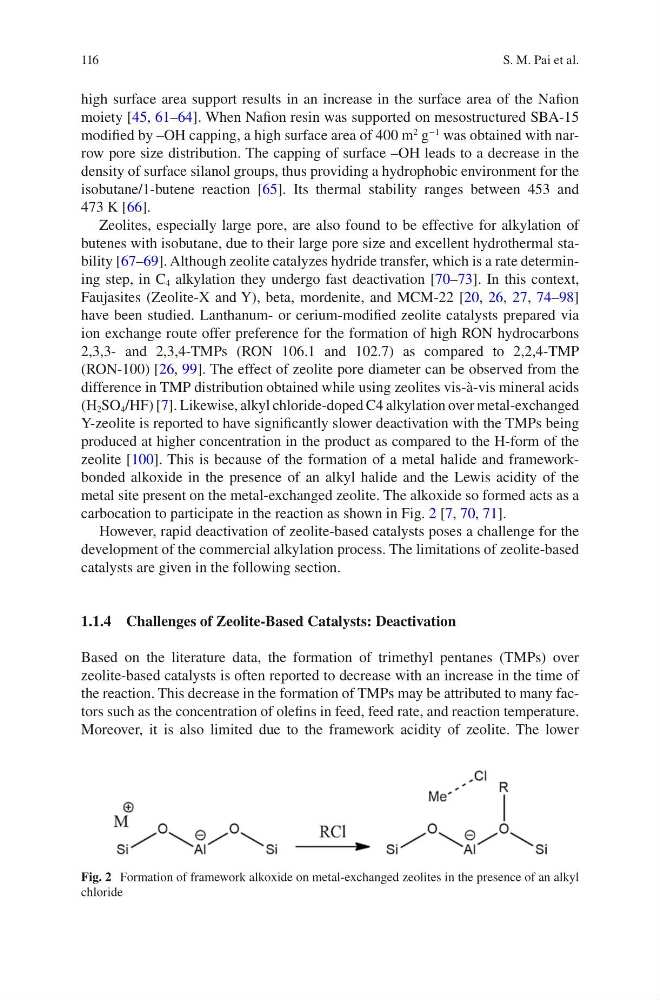
zeolite [100]. This is because of the formation of a metal halide and frameworkbonded alkoxide in the presence of an alkyl halide and the Lewis acidity of the
metal site present on the metal-exchanged zeolite. The alkoxide so formed acts as a
carbocation to participate in the reaction as shown in Fig. 2 [7, 70, 71].
However, rapid deactivation of zeolite-based catalysts poses a challenge for the
development of the commercial alkylation process. The limitations of zeolite-based
catalysts are given in the following section.
1.1.4 Challenges of Zeolite-Based Catalysts: Deactivation
Based on the literature data, the formation of trimethyl pentanes (TMPs) over
zeolite- based catalysts is often reported to decrease with an increase in the time of
the reaction. This decrease in the formation of TMPs may be attributed to many factors such as the concentration of olefins in feed, feed rate, and reaction temperature.
Moreover, it is also limited due to the framework acidity of zeolite. The lower
Fig. 2 Formation of framework alkoxide on metal-exchanged zeolites in the presence of an alkyl
chloride
S. M. Pai et al.
high surface area support results in an increase in the surface area of the Nafion
moiety [45, 61–64]. When Nafion resin was supported on mesostructured SBA-15
modified by –OH capping, a high surface area of 400 m
2
g
−1
was obtained with narrow pore size distribution. The capping of surface –OH leads to a decrease in the
density of surface silanol groups, thus providing a hydrophobic environment for the
isobutane/1-butene reaction [65]. Its thermal stability ranges between 453 and
473 K [66].
Zeolites, especially large pore, are also found to be effective for alkylation of
butenes with isobutane, due to their large pore size and excellent hydrothermal stability [67–69]. Although zeolite catalyzes hydride transfer, which is a rate determining step, in C 4 alkylation they undergo fast deactivation [70–73]. In this context,
Faujasites (Zeolite-X and Y), beta, mordenite, and MCM-22 [20, 26, 27, 74–98]
have been studied. Lanthanum- or cerium-modified zeolite catalysts prepared via
ion exchange route offer preference for the formation of high RON hydrocarbons
2,3,3- and 2,3,4-TMPs (RON 106.1 and 102.7) as compared to 2,2,4-TMP
(RON-100) [26, 99]. The effect of zeolite pore diameter can be observed from the
difference in TMP distribution obtained while using zeolites vis-à-vis mineral acids
(H 2 SO 4 /HF) [7]. Likewise, alkyl chloride-doped C4 alkylation over metal-exchanged
Y-zeolite is reported to have significantly slower deactivation with the TMPs being
produced at higher concentration in the product as compared to the H-form of the
zeolite [100]. This is because of the formation of a metal halide and frameworkbonded alkoxide in the presence of an alkyl halide and the Lewis acidity of the
metal site present on the metal-exchanged zeolite. The alkoxide so formed acts as a
carbocation to participate in the reaction as shown in Fig. 2 [7, 70, 71].
However, rapid deactivation of zeolite-based catalysts poses a challenge for the
development of the commercial alkylation process. The limitations of zeolite-based
catalysts are given in the following section.
1.1.4 Challenges of Zeolite-Based Catalysts: Deactivation
Based on the literature data, the formation of trimethyl pentanes (TMPs) over
zeolite- based catalysts is often reported to decrease with an increase in the time of
the reaction. This decrease in the formation of TMPs may be attributed to many factors such as the concentration of olefins in feed, feed rate, and reaction temperature.
Moreover, it is also limited due to the framework acidity of zeolite. The lower
Fig. 2 Formation of framework alkoxide on metal-exchanged zeolites in the presence of an alkyl
chloride
S. M. Pai et al.