

115
1.1.3 Development of Environmentally Friendly Solid Catalysts
for Alkylation Processes
The use of heterogeneous catalysts can overcome environmental and corrosion
problems with reduced capital and revenue costs. The solid acid catalyst system can
be based on Bronsted or Lewis acids. Aluminum chloride (AlCl 3 )-based catalyst in
the presence of hydrochloric acid was the first Lewis acid catalyst used in this reaction. The salts of hydrofluoric acid such as antimony pentafluoride (SbF 5 ) and boron
trifluoride (BF 3 ) have also been exploited for C 4 alkylation reactions [16]. Other
solid acid catalysts like zeolites, sulfated zirconia, mixed oxides and heteropolyacids, and acid resins have also been explored by researchers for alkylation reactions
[17–46].
Sulfated zirconia and sulfated alumina are good catalysts for this reaction.
Sulfated zirconia is highly active due to higher strength of acid sites equivalent to
Hammett acidity (Ho) of ≤−16.04, while sulfated alumina, due to its low acidity
(Ho ≤ −14.5), possesses low activity [47–52]. However, sulfated alumina is widely
available, heat resistant, cost effective, and thermally stable due to which it is considered superior to sulfated zirconia. The activity of sulfated oxides depends on the
amount of the sulfate content, and only the monolayer coverage of the substrate is
required, after which there is a decrease in the catalytic activity and faster deactivation due to accumulation of the sulfate ions. The accumulation of the sulfate ions
leads to reduction in pore size distribution and pore diameter of the catalyst support
due to the transformation of mesopores to micropores. The catalytic activity initiates when the content of the sulfate ion reaches more than half of the monolayer
coverage [53]. The properties of the catalysts depend on the type of sulfate precursor used. The use of sulfuric acid as a precursor initially leads to the dissolution of
the support and subsequent deposition of sulfate species at the time of drying. When
ammonium sulfate is used as the precursor, the interaction with the support occurs
during the calcination stage. The active sites are mainly monosulfate or polysulfate
species bonded to the oxide surface in the case of sulfate-promoted oxides
[48, 54–56].
The synthetic polymer Nafion (sulfonated tetrafluoroethylene-based fluoropolymer copolymer) can also be used for C 4 alkylation [57–60]. Even though Nafion
possesses strong acidity due to the presence of electron-withdrawing perfluorocarbon groups, its low surface area is the cause of poor catalytic activity. The use of
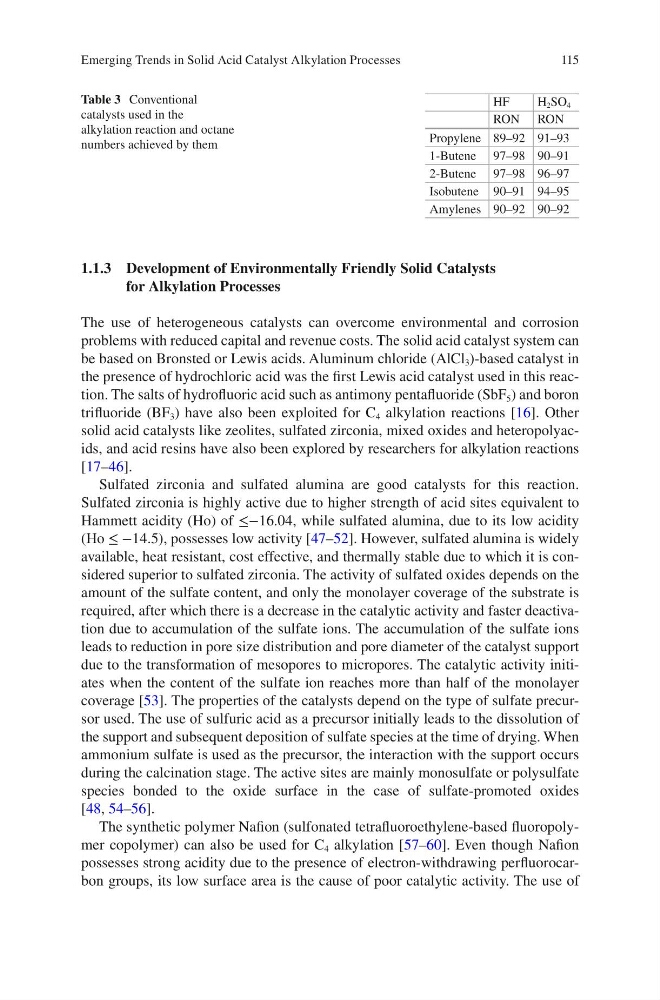
Table 3 Conventional
catalysts used in the
alkylation reaction and octane
numbers achieved by them
HF
H 2 SO 4
RON RON
Propylene 89–92 91–93
1-Butene 97–98 90–91
2-Butene 97–98 96–97
Isobutene 90–91 94–95
Amylenes 90–92 90–92
Emerging Trends in Solid Acid Catalyst Alkylation Processes
1.1.3 Development of Environmentally Friendly Solid Catalysts
for Alkylation Processes
The use of heterogeneous catalysts can overcome environmental and corrosion
problems with reduced capital and revenue costs. The solid acid catalyst system can
be based on Bronsted or Lewis acids. Aluminum chloride (AlCl 3 )-based catalyst in
the presence of hydrochloric acid was the first Lewis acid catalyst used in this reaction. The salts of hydrofluoric acid such as antimony pentafluoride (SbF 5 ) and boron
trifluoride (BF 3 ) have also been exploited for C 4 alkylation reactions [16]. Other
solid acid catalysts like zeolites, sulfated zirconia, mixed oxides and heteropolyacids, and acid resins have also been explored by researchers for alkylation reactions
[17–46].
Sulfated zirconia and sulfated alumina are good catalysts for this reaction.
Sulfated zirconia is highly active due to higher strength of acid sites equivalent to
Hammett acidity (Ho) of ≤−16.04, while sulfated alumina, due to its low acidity
(Ho ≤ −14.5), possesses low activity [47–52]. However, sulfated alumina is widely
available, heat resistant, cost effective, and thermally stable due to which it is considered superior to sulfated zirconia. The activity of sulfated oxides depends on the
amount of the sulfate content, and only the monolayer coverage of the substrate is
required, after which there is a decrease in the catalytic activity and faster deactivation due to accumulation of the sulfate ions. The accumulation of the sulfate ions
leads to reduction in pore size distribution and pore diameter of the catalyst support
due to the transformation of mesopores to micropores. The catalytic activity initiates when the content of the sulfate ion reaches more than half of the monolayer
coverage [53]. The properties of the catalysts depend on the type of sulfate precursor used. The use of sulfuric acid as a precursor initially leads to the dissolution of
the support and subsequent deposition of sulfate species at the time of drying. When
ammonium sulfate is used as the precursor, the interaction with the support occurs
during the calcination stage. The active sites are mainly monosulfate or polysulfate
species bonded to the oxide surface in the case of sulfate-promoted oxides
[48, 54–56].
The synthetic polymer Nafion (sulfonated tetrafluoroethylene-based fluoropolymer copolymer) can also be used for C 4 alkylation [57–60]. Even though Nafion
possesses strong acidity due to the presence of electron-withdrawing perfluorocarbon groups, its low surface area is the cause of poor catalytic activity. The use of
Table 3 Conventional
catalysts used in the
alkylation reaction and octane
numbers achieved by them
HF
H 2 SO 4
RON RON
Propylene 89–92 91–93
1-Butene 97–98 90–91
2-Butene 97–98 96–97
Isobutene 90–91 94–95
Amylenes 90–92 90–92
Emerging Trends in Solid Acid Catalyst Alkylation Processes