

111
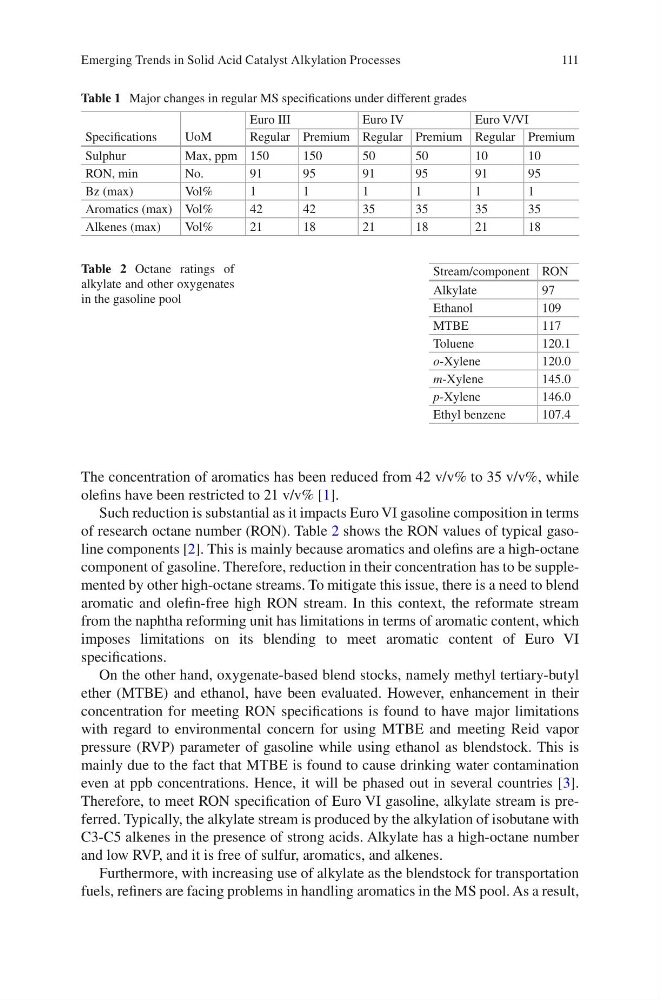
The concentration of aromatics has been reduced from 42 v/v% to 35 v/v%, while
olefins have been restricted to 21 v/v% [1].
Such reduction is substantial as it impacts Euro VI gasoline composition in terms
of research octane number (RON). Table 2 shows the RON values of typical gasoline components [2]. This is mainly because aromatics and olefins are a high-octane
component of gasoline. Therefore, reduction in their concentration has to be supplemented by other high-octane streams. To mitigate this issue, there is a need to blend
aromatic and olefin-free high RON stream. In this context, the reformate stream
from the naphtha reforming unit has limitations in terms of aromatic content, which
imposes limitations on its blending to meet aromatic content of Euro VI
specifications.
On the other hand, oxygenate-based blend stocks, namely methyl tertiary-butyl
ether (MTBE) and ethanol, have been evaluated. However, enhancement in their
concentration for meeting RON specifications is found to have major limitations
with regard to environmental concern for using MTBE and meeting Reid vapor
pressure (RVP) parameter of gasoline while using ethanol as blendstock. This is
mainly due to the fact that MTBE is found to cause drinking water contamination
even at ppb concentrations. Hence, it will be phased out in several countries [3].
Therefore, to meet RON specification of Euro VI gasoline, alkylate stream is preferred. Typically, the alkylate stream is produced by the alkylation of isobutane with
C3-C5 alkenes in the presence of strong acids. Alkylate has a high-octane number
and low RVP, and it is free of sulfur, aromatics, and alkenes.
Furthermore, with increasing use of alkylate as the blendstock for transportation
fuels, refiners are facing problems in handling aromatics in the MS pool. As a result,
Table 1 Major changes in regular MS specifications under different grades
Specifications
UoM
Euro III
Euro IV
Euro V/VI
Regular Premium Regular Premium Regular Premium
Sulphur
Max, ppm 150
150
50
50
10
10
RON, min
No.
91
95
91
95
91
95
Bz (max)
Vol%
1
1
1
1
1
1
Aromatics (max) Vol%
42
42
35
35
35
35
Alkenes (max)
Vol%
21
18
21
18
21
18
Table 2 Octane ratings of
alkylate and other oxygenates
in the gasoline pool
Stream/component RON
Alkylate
97
Ethanol
109
MTBE
117
Toluene
120.1
o-Xylene
120.0
m-Xylene
145.0
p-Xylene
146.0
Ethyl benzene
107.4
Emerging Trends in Solid Acid Catalyst Alkylation Processes
The concentration of aromatics has been reduced from 42 v/v% to 35 v/v%, while
olefins have been restricted to 21 v/v% [1].
Such reduction is substantial as it impacts Euro VI gasoline composition in terms
of research octane number (RON). Table 2 shows the RON values of typical gasoline components [2]. This is mainly because aromatics and olefins are a high-octane
component of gasoline. Therefore, reduction in their concentration has to be supplemented by other high-octane streams. To mitigate this issue, there is a need to blend
aromatic and olefin-free high RON stream. In this context, the reformate stream
from the naphtha reforming unit has limitations in terms of aromatic content, which
imposes limitations on its blending to meet aromatic content of Euro VI
specifications.
On the other hand, oxygenate-based blend stocks, namely methyl tertiary-butyl
ether (MTBE) and ethanol, have been evaluated. However, enhancement in their
concentration for meeting RON specifications is found to have major limitations
with regard to environmental concern for using MTBE and meeting Reid vapor
pressure (RVP) parameter of gasoline while using ethanol as blendstock. This is
mainly due to the fact that MTBE is found to cause drinking water contamination
even at ppb concentrations. Hence, it will be phased out in several countries [3].
Therefore, to meet RON specification of Euro VI gasoline, alkylate stream is preferred. Typically, the alkylate stream is produced by the alkylation of isobutane with
C3-C5 alkenes in the presence of strong acids. Alkylate has a high-octane number
and low RVP, and it is free of sulfur, aromatics, and alkenes.
Furthermore, with increasing use of alkylate as the blendstock for transportation
fuels, refiners are facing problems in handling aromatics in the MS pool. As a result,
Table 1 Major changes in regular MS specifications under different grades
Specifications
UoM
Euro III
Euro IV
Euro V/VI
Regular Premium Regular Premium Regular Premium
Sulphur
Max, ppm 150
150
50
50
10
10
RON, min
No.
91
95
91
95
91
95
Bz (max)
Vol%
1
1
1
1
1
1
Aromatics (max) Vol%
42
42
35
35
35
35
Alkenes (max)
Vol%
21
18
21
18
21
18
Table 2 Octane ratings of
alkylate and other oxygenates
in the gasoline pool
Stream/component RON
Alkylate
97
Ethanol
109
MTBE
117
Toluene
120.1
o-Xylene
120.0
m-Xylene
145.0
p-Xylene
146.0
Ethyl benzene
107.4
Emerging Trends in Solid Acid Catalyst Alkylation Processes