

103
olefins. Commercial data presented by Axens indicate an increase in propylene
yield by 1.5–2.0 wt% for every 0.5 wt% increase in feed hydrogen content [8].
7.2 ZSM-5 Addition
ZSM-5 is a shape-selective zeolite, which is specially developed for producing high
octane motor gasoline. However, since the late 1990s, its application has focussed
on maximizing yields of light olefins. It has low rare-earth content and a high silica
to alumina ratio. Hence, it has low acid site density, which discourages hydrogen
transfer and isomerization reactions. At the same time, it has high acidity and low
pore size (0.5 nm) compared to Y-zeolite (0.74 nm), which enables the cracking of
heavy olefins (C5–C7) and restricts entry of branched and cyclic hydrocarbons.
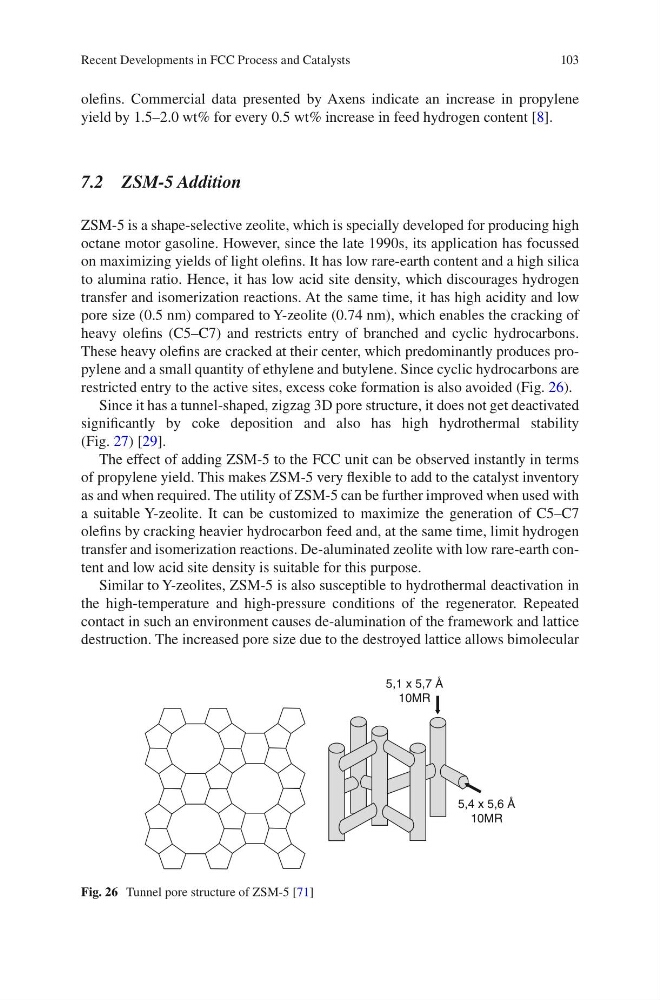
These heavy olefins are cracked at their center, which predominantly produces propylene and a small quantity of ethylene and butylene. Since cyclic hydrocarbons are
restricted entry to the active sites, excess coke formation is also avoided (Fig. 26).
Since it has a tunnel-shaped, zigzag 3D pore structure, it does not get deactivated
significantly by coke deposition and also has high hydrothermal stability
(Fig. 27) [29].
The effect of adding ZSM-5 to the FCC unit can be observed instantly in terms
of propylene yield. This makes ZSM-5 very flexible to add to the catalyst inventory
as and when required. The utility of ZSM-5 can be further improved when used with
a suitable Y-zeolite. It can be customized to maximize the generation of C5–C7
olefins by cracking heavier hydrocarbon feed and, at the same time, limit hydrogen
transfer and isomerization reactions. De-aluminated zeolite with low rare-earth content and low acid site density is suitable for this purpose.
Similar to Y-zeolites, ZSM-5 is also susceptible to hydrothermal deactivation in
the high-temperature and high-pressure conditions of the regenerator. Repeated
contact in such an environment causes de-alumination of the framework and lattice
destruction. The increased pore size due to the destroyed lattice allows bimolecular
5,1 x 5,7 Å
10MR
5,4 x 5,6 Å
10MR
Fig. 26 Tunnel pore structure of ZSM-5 [71]
Recent Developments in FCC Process and Catalysts
olefins. Commercial data presented by Axens indicate an increase in propylene
yield by 1.5–2.0 wt% for every 0.5 wt% increase in feed hydrogen content [8].
7.2 ZSM-5 Addition
ZSM-5 is a shape-selective zeolite, which is specially developed for producing high
octane motor gasoline. However, since the late 1990s, its application has focussed
on maximizing yields of light olefins. It has low rare-earth content and a high silica
to alumina ratio. Hence, it has low acid site density, which discourages hydrogen
transfer and isomerization reactions. At the same time, it has high acidity and low
pore size (0.5 nm) compared to Y-zeolite (0.74 nm), which enables the cracking of
heavy olefins (C5–C7) and restricts entry of branched and cyclic hydrocarbons.
These heavy olefins are cracked at their center, which predominantly produces propylene and a small quantity of ethylene and butylene. Since cyclic hydrocarbons are
restricted entry to the active sites, excess coke formation is also avoided (Fig. 26).
Since it has a tunnel-shaped, zigzag 3D pore structure, it does not get deactivated
significantly by coke deposition and also has high hydrothermal stability
(Fig. 27) [29].
The effect of adding ZSM-5 to the FCC unit can be observed instantly in terms
of propylene yield. This makes ZSM-5 very flexible to add to the catalyst inventory
as and when required. The utility of ZSM-5 can be further improved when used with
a suitable Y-zeolite. It can be customized to maximize the generation of C5–C7
olefins by cracking heavier hydrocarbon feed and, at the same time, limit hydrogen
transfer and isomerization reactions. De-aluminated zeolite with low rare-earth content and low acid site density is suitable for this purpose.
Similar to Y-zeolites, ZSM-5 is also susceptible to hydrothermal deactivation in
the high-temperature and high-pressure conditions of the regenerator. Repeated
contact in such an environment causes de-alumination of the framework and lattice
destruction. The increased pore size due to the destroyed lattice allows bimolecular
5,1 x 5,7 Å
10MR
5,4 x 5,6 Å
10MR
Fig. 26 Tunnel pore structure of ZSM-5 [71]
Recent Developments in FCC Process and Catalysts