

This equation is valid for the three velocity components and shows that in the
inertial subrange there is convergence of the spectral curves of different velocity
components. These curves correspond to different situations of thermal stability and
give a straight line with a slope of −2/3.
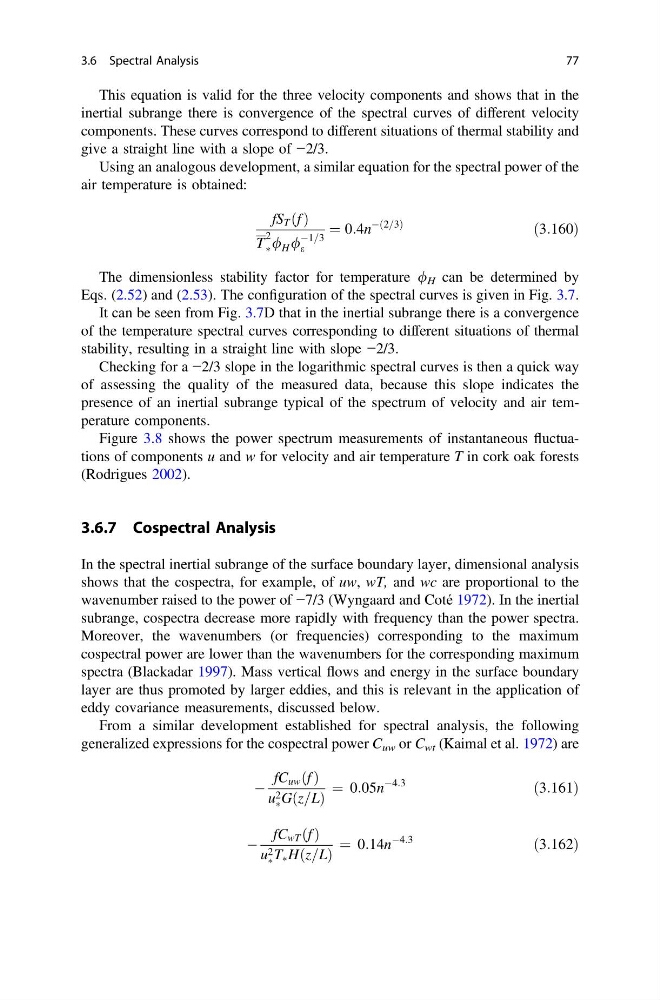
Using an analogous development, a similar equation for the spectral power of the
air temperature is obtained:
fS T ðf Þ
T
2
à / H /
À1=3
e
¼ 0:4n
Àð2=3Þ
ð3:160Þ
The dimensionless stability factor for temperature / H can be determined by
Eqs. (2.52) and (2.53). The configuration of the spectral curves is given in Fig. 3.7.
It can be seen from Fig. 3.7D that in the inertial subrange there is a convergence
of the temperature spectral curves corresponding to different situations of thermal
stability, resulting in a straight line with slope −2/3.
Checking for a −2/3 slope in the logarithmic spectral curves is then a quick way
of assessing the quality of the measured data, because this slope indicates the
presence of an inertial subrange typical of the spectrum of velocity and air temperature components.
Figure 3.8 shows the power spectrum measurements of instantaneous fluctuations of components u and w for velocity and air temperature T in cork oak forests
(Rodrigues 2002).
3.6.7 Cospectral Analysis
In the spectral inertial subrange of the surface boundary layer, dimensional analysis
shows that the cospectra, for example, of uw, wT, and wc are proportional to the
wavenumber raised to the power of −7/3 (Wyngaard and Coté 1972). In the inertial
subrange, cospectra decrease more rapidly with frequency than the power spectra.
Moreover, the wavenumbers (or frequencies) corresponding to the maximum
cospectral power are lower than the wavenumbers for the corresponding maximum
spectra (Blackadar 1997). Mass vertical flows and energy in the surface boundary
layer are thus promoted by larger eddies, and this is relevant in the application of
eddy covariance measurements, discussed below.
From a similar development established for spectral analysis, the following
generalized expressions for the cospectral power C uw or C wt (Kaimal et al. 1972) are
À
fC uw ðf Þ
u 2
à Gðz=LÞ
¼ 0:05n
À4:3
ð3:161Þ
À
fC wT ðf Þ
u 2
à T à Hðz=LÞ
¼ 0:14n
À4:3
ð3:162Þ
3.6 Spectral Analysis
77
inertial subrange there is convergence of the spectral curves of different velocity
components. These curves correspond to different situations of thermal stability and
give a straight line with a slope of −2/3.
Using an analogous development, a similar equation for the spectral power of the
air temperature is obtained:
fS T ðf Þ
T
2
à / H /
À1=3
e
¼ 0:4n
Àð2=3Þ
ð3:160Þ
The dimensionless stability factor for temperature / H can be determined by
Eqs. (2.52) and (2.53). The configuration of the spectral curves is given in Fig. 3.7.
It can be seen from Fig. 3.7D that in the inertial subrange there is a convergence
of the temperature spectral curves corresponding to different situations of thermal
stability, resulting in a straight line with slope −2/3.
Checking for a −2/3 slope in the logarithmic spectral curves is then a quick way
of assessing the quality of the measured data, because this slope indicates the
presence of an inertial subrange typical of the spectrum of velocity and air temperature components.
Figure 3.8 shows the power spectrum measurements of instantaneous fluctuations of components u and w for velocity and air temperature T in cork oak forests
(Rodrigues 2002).
3.6.7 Cospectral Analysis
In the spectral inertial subrange of the surface boundary layer, dimensional analysis
shows that the cospectra, for example, of uw, wT, and wc are proportional to the
wavenumber raised to the power of −7/3 (Wyngaard and Coté 1972). In the inertial
subrange, cospectra decrease more rapidly with frequency than the power spectra.
Moreover, the wavenumbers (or frequencies) corresponding to the maximum
cospectral power are lower than the wavenumbers for the corresponding maximum
spectra (Blackadar 1997). Mass vertical flows and energy in the surface boundary
layer are thus promoted by larger eddies, and this is relevant in the application of
eddy covariance measurements, discussed below.
From a similar development established for spectral analysis, the following
generalized expressions for the cospectral power C uw or C wt (Kaimal et al. 1972) are
À
fC uw ðf Þ
u 2
à Gðz=LÞ
¼ 0:05n
À4:3
ð3:161Þ
À
fC wT ðf Þ
u 2
à T à Hðz=LÞ
¼ 0:14n
À4:3
ð3:162Þ
3.6 Spectral Analysis
77