

tangential stresses and thermal buoyancy and consequently, storage. These eddies
are mainly responsible for the turbulent transport phenomena.
The inertial subrange corresponds to a set of eddies with average frequencies and
isotropic characteristics, in which there is convergence of the spectral curves,
corresponding to different situations of thermal stability, to a straight line with slope
˗5/3 (e.g., Foken 2017). This convergence can be plotted on a graph with the
variation of the natural logarithm of spectral energy density in the ordinate and the
variable ln(j) in the abscissa (Blackadar 1997). In this subrange, such convergence
derives from the fact that kinetic energy transfer occurs in a turbulent cascade
between the larger and smaller eddies. The inertial designation derives from the fact
that in this intermediate frequency range, neither produce nor dissipate of kinetic
energy occurs. The dissipation spectral subrange corresponds to the turbulence due
to small eddies responsible for the molecular dissipation of kinetic energy into heat.
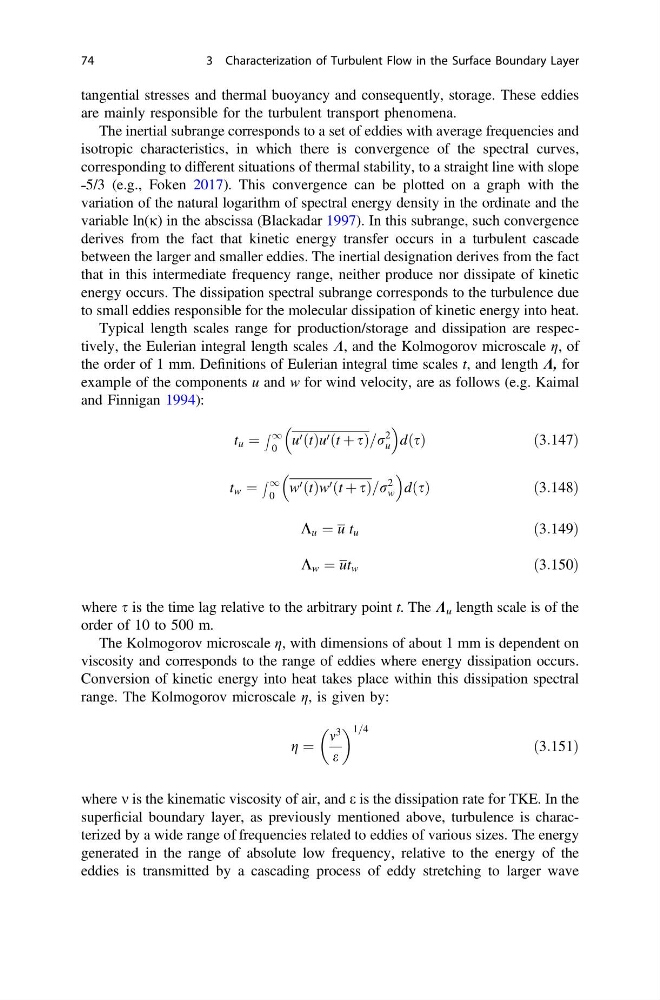
Typical length scales range for production/storage and dissipation are respectively, the Eulerian integral length scales K, and the Kolmogorov microscale η, of
the order of 1 mm. Definitions of Eulerian integral time scales t, and length K, for
example of the components u and w for wind velocity, are as follows (e.g. Kaimal
and Finnigan 1994):
t u ¼
Z 1
0
u 0 ðtÞu 0 ðt þ sÞ=r
2
u
dðsÞ
ð 3:147Þ
t w ¼
Z 1
0
w 0 ðtÞw 0 ðt þ sÞ=r
2
w
dðsÞ
ð 3:148Þ
K u ¼ u t u
ð3:149Þ
K w ¼ ut w
ð3:150Þ
where s is the time lag relative to the arbitrary point t. The K u length scale is of the
order of 10 to 500 m.
The Kolmogorov microscale η, with dimensions of about 1 mm is dependent on
viscosity and corresponds to the range of eddies where energy dissipation occurs.
Conversion of kinetic energy into heat takes place within this dissipation spectral
range. The Kolmogorov microscale η, is given by:
g ¼
m
3
e
1=4
ð3:151Þ
where m is the kinematic viscosity of air, and e is the dissipation rate for TKE. In the
superficial boundary layer, as previously mentioned above, turbulence is characterized by a wide range of frequencies related to eddies of various sizes. The energy
generated in the range of absolute low frequency, relative to the energy of the
eddies is transmitted by a cascading process of eddy stretching to larger wave
74
3 Characterization of Turbulent Flow in the Surface Boundary Layer
are mainly responsible for the turbulent transport phenomena.
The inertial subrange corresponds to a set of eddies with average frequencies and
isotropic characteristics, in which there is convergence of the spectral curves,
corresponding to different situations of thermal stability, to a straight line with slope
˗5/3 (e.g., Foken 2017). This convergence can be plotted on a graph with the
variation of the natural logarithm of spectral energy density in the ordinate and the
variable ln(j) in the abscissa (Blackadar 1997). In this subrange, such convergence
derives from the fact that kinetic energy transfer occurs in a turbulent cascade
between the larger and smaller eddies. The inertial designation derives from the fact
that in this intermediate frequency range, neither produce nor dissipate of kinetic
energy occurs. The dissipation spectral subrange corresponds to the turbulence due
to small eddies responsible for the molecular dissipation of kinetic energy into heat.
Typical length scales range for production/storage and dissipation are respectively, the Eulerian integral length scales K, and the Kolmogorov microscale η, of
the order of 1 mm. Definitions of Eulerian integral time scales t, and length K, for
example of the components u and w for wind velocity, are as follows (e.g. Kaimal
and Finnigan 1994):
t u ¼
Z 1
0
u 0 ðtÞu 0 ðt þ sÞ=r
2
u
dðsÞ
ð 3:147Þ
t w ¼
Z 1
0
w 0 ðtÞw 0 ðt þ sÞ=r
2
w
dðsÞ
ð 3:148Þ
K u ¼ u t u
ð3:149Þ
K w ¼ ut w
ð3:150Þ
where s is the time lag relative to the arbitrary point t. The K u length scale is of the
order of 10 to 500 m.
The Kolmogorov microscale η, with dimensions of about 1 mm is dependent on
viscosity and corresponds to the range of eddies where energy dissipation occurs.
Conversion of kinetic energy into heat takes place within this dissipation spectral
range. The Kolmogorov microscale η, is given by:
g ¼
m
3
e
1=4
ð3:151Þ
where m is the kinematic viscosity of air, and e is the dissipation rate for TKE. In the
superficial boundary layer, as previously mentioned above, turbulence is characterized by a wide range of frequencies related to eddies of various sizes. The energy
generated in the range of absolute low frequency, relative to the energy of the
eddies is transmitted by a cascading process of eddy stretching to larger wave
74
3 Characterization of Turbulent Flow in the Surface Boundary Layer