

H
qc p
¼ u 0
3 T 0 ¼ C H u T 0 À T
ð
Þ
ð3:104Þ
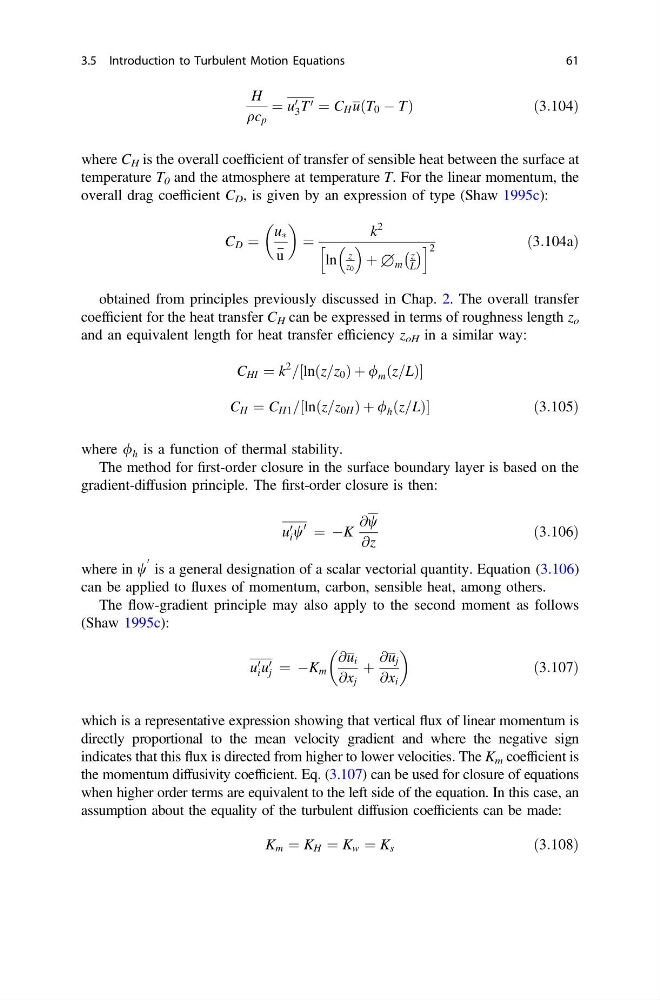
where C H is the overall coefficient of transfer of sensible heat between the surface at
temperature T 0 and the atmosphere at temperature T. For the linear momentum, the
overall drag coefficient C D , is given by an expression of type (Shaw 1995c):
C D ¼
u Ã
À
u
¼
k
2
ln
z
z 0
þ £ m
z
L
À Á
h
i 2
ð3:104aÞ
obtained from principles previously discussed in Chap. 2. The overall transfer
coefficient for the heat transfer C H can be expressed in terms of roughness length z o
and an equivalent length for heat transfer efficiency z oH in a similar way:
C HI ¼ k
2
= ln z=z 0
ð
Þþ/ m ðz=LÞ
½
C H ¼ C H1 = ln z=z 0H
ð
Þþ/ h ðz=LÞ
½
ð 3:105Þ
where / h is a function of thermal stability.
The method for first-order closure in the surface boundary layer is based on the
gradient-diffusion principle. The first-order closure is then:
u 0
i w
0
¼ ÀK
@w
@z
ð3:106Þ
where in w
0
is a general designation of a scalar vectorial quantity. Equation (3.106)
can be applied to fluxes of momentum, carbon, sensible heat, among others.
The flow-gradient principle may also apply to the second moment as follows
(Shaw 1995c):
u 0
i u 0
j ¼ ÀK m
@u i
@x j
þ
@u j
@x i
ð3:107Þ
which is a representative expression showing that vertical flux of linear momentum is
directly proportional to the mean velocity gradient and where the negative sign
indicates that this flux is directed from higher to lower velocities. The K m coefficient is
the momentum diffusivity coefficient. Eq. (3.107) can be used for closure of equations
when higher order terms are equivalent to the left side of the equation. In this case, an
assumption about the equality of the turbulent diffusion coefficients can be made:
K m ¼ K H ¼ K w ¼ K s
ð3:108Þ
3.5 Introduction to Turbulent Motion Equations
61
qc p
¼ u 0
3 T 0 ¼ C H u T 0 À T
ð
Þ
ð3:104Þ
where C H is the overall coefficient of transfer of sensible heat between the surface at
temperature T 0 and the atmosphere at temperature T. For the linear momentum, the
overall drag coefficient C D , is given by an expression of type (Shaw 1995c):
C D ¼
u Ã
À
u
¼
k
2
ln
z
z 0
þ £ m
z
L
À Á
h
i 2
ð3:104aÞ
obtained from principles previously discussed in Chap. 2. The overall transfer
coefficient for the heat transfer C H can be expressed in terms of roughness length z o
and an equivalent length for heat transfer efficiency z oH in a similar way:
C HI ¼ k
2
= ln z=z 0
ð
Þþ/ m ðz=LÞ
½
C H ¼ C H1 = ln z=z 0H
ð
Þþ/ h ðz=LÞ
½
ð 3:105Þ
where / h is a function of thermal stability.
The method for first-order closure in the surface boundary layer is based on the
gradient-diffusion principle. The first-order closure is then:
u 0
i w
0
¼ ÀK
@w
@z
ð3:106Þ
where in w
0
is a general designation of a scalar vectorial quantity. Equation (3.106)
can be applied to fluxes of momentum, carbon, sensible heat, among others.
The flow-gradient principle may also apply to the second moment as follows
(Shaw 1995c):
u 0
i u 0
j ¼ ÀK m
@u i
@x j
þ
@u j
@x i
ð3:107Þ
which is a representative expression showing that vertical flux of linear momentum is
directly proportional to the mean velocity gradient and where the negative sign
indicates that this flux is directed from higher to lower velocities. The K m coefficient is
the momentum diffusivity coefficient. Eq. (3.107) can be used for closure of equations
when higher order terms are equivalent to the left side of the equation. In this case, an
assumption about the equality of the turbulent diffusion coefficients can be made:
K m ¼ K H ¼ K w ¼ K s
ð3:108Þ
3.5 Introduction to Turbulent Motion Equations
61