

due to buoyancy. Under conditions of atmospheric instability, the / p term obtained
from field measurements is equal to the difference between the production of kinetic
energy by tangential stresses and dissipation (Kaimal and Finnigan 1994).
Under conditions of thermal stability, measurements carried out in the field
(Kaimal and Finnigan 1994) have shown that / t = 0 and / M % / e . Thus, / p will be
of the same order of magnitude as production by buoyancy n, and negative under
these conditions.
Production of TKE involves mechanical production of turbulence by tangential
interaction among turbulent eddies and the mean flow (VI term of Eq. 3.89). Thus,
there will be a transfer of kinetic energy from the mean flow to the instantaneous
fluctuations (Stull 1994).
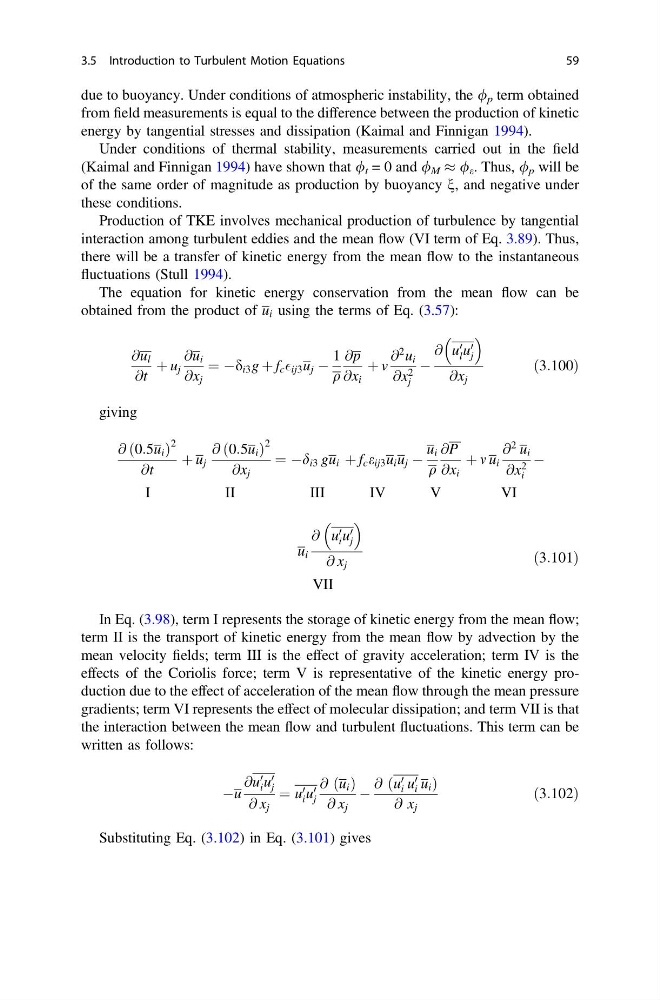
The equation for kinetic energy conservation from the mean flow can be
obtained from the product of u i using the terms of Eq. (3.57):
@u l
@t
þ u j
@u i
@x j
¼ Àd i3 g þ f c ij3 u j À
1
q
@p
@x i
þ v
@
2 u i
@x 2
j
À
@ u 0
l u 0
j
@x j
ð3:100Þ
giving
@ 0:5u i
ð
Þ
2
@t
þ u j
@ 0:5u i
ð
Þ
2
@x j
¼ Àd i3 gu i þ f c e ij3 u i u j À
u i
q
@P
@x i
þ m u i
@
2 u i
@x 2
i
À
I
II
III
IV
V
VI
u i
@ u 0
i u 0
j
@ x j
VII
ð3:101Þ
In Eq. (3.98), term I represents the storage of kinetic energy from the mean flow;
term II is the transport of kinetic energy from the mean flow by advection by the
mean velocity fields; term III is the effect of gravity acceleration; term IV is the
effects of the Coriolis force; term V is representative of the kinetic energy production due to the effect of acceleration of the mean flow through the mean pressure
gradients; term VI represents the effect of molecular dissipation; and term VII is that
the interaction between the mean flow and turbulent fluctuations. This term can be
written as follows:
Àu
@u 0
i u 0
j
@ x j
¼ u 0
i u 0
j
@ ðu i Þ
@ x j
À
@ ðu 0
i u 0
i u i Þ
@ x j
ð3:102Þ
Substituting Eq. (3.102) in Eq. (3.101) gives
3.5 Introduction to Turbulent Motion Equations
59
from field measurements is equal to the difference between the production of kinetic
energy by tangential stresses and dissipation (Kaimal and Finnigan 1994).
Under conditions of thermal stability, measurements carried out in the field
(Kaimal and Finnigan 1994) have shown that / t = 0 and / M % / e . Thus, / p will be
of the same order of magnitude as production by buoyancy n, and negative under
these conditions.
Production of TKE involves mechanical production of turbulence by tangential
interaction among turbulent eddies and the mean flow (VI term of Eq. 3.89). Thus,
there will be a transfer of kinetic energy from the mean flow to the instantaneous
fluctuations (Stull 1994).
The equation for kinetic energy conservation from the mean flow can be
obtained from the product of u i using the terms of Eq. (3.57):
@u l
@t
þ u j
@u i
@x j
¼ Àd i3 g þ f c ij3 u j À
1
q
@p
@x i
þ v
@
2 u i
@x 2
j
À
@ u 0
l u 0
j
@x j
ð3:100Þ
giving
@ 0:5u i
ð
Þ
2
@t
þ u j
@ 0:5u i
ð
Þ
2
@x j
¼ Àd i3 gu i þ f c e ij3 u i u j À
u i
q
@P
@x i
þ m u i
@
2 u i
@x 2
i
À
I
II
III
IV
V
VI
u i
@ u 0
i u 0
j
@ x j
VII
ð3:101Þ
In Eq. (3.98), term I represents the storage of kinetic energy from the mean flow;
term II is the transport of kinetic energy from the mean flow by advection by the
mean velocity fields; term III is the effect of gravity acceleration; term IV is the
effects of the Coriolis force; term V is representative of the kinetic energy production due to the effect of acceleration of the mean flow through the mean pressure
gradients; term VI represents the effect of molecular dissipation; and term VII is that
the interaction between the mean flow and turbulent fluctuations. This term can be
written as follows:
Àu
@u 0
i u 0
j
@ x j
¼ u 0
i u 0
j
@ ðu i Þ
@ x j
À
@ ðu 0
i u 0
i u i Þ
@ x j
ð3:102Þ
Substituting Eq. (3.102) in Eq. (3.101) gives
3.5 Introduction to Turbulent Motion Equations
59