

The values of terms ∂u i '/∂x i are higher for smaller eddies, so that the isotropy increases
in smaller dimensional scales corresponding to higher spectral frequency range.
The second term on the right-hand side of Eq. (3.64) is the Coriolis number that
can be described in the following way:
2f c e ij3 u 0
i u 0
j ¼ 2 f c e 213 u 0
2 u 0
1 þ 2 f c e 123 u 0
1 u 0
2 ¼
¼ À2 f c u 0
2 u 0
1 þ 2 f c u 0
1 u 0
2 ¼ 0
ð3:70Þ
The equality Eq. (3.70) means that the Coriolis force does not generate variance
or turbulent kinetic energy (TKE). The Coriolis term only promotes internal
redistribution of kinetic energy at a rate which is about of three orders of magnitude
lower than the other terms of Eq. (3.64). Thus, this term can be neglected.
After these simplifications, Eq. (3.64) becomes:
@ u 0
i
ð Þ
2
@t
þ u j
@ u 0
i
ð Þ
2
@x j
¼
I
I I
¼ 2d i3
u 0
i h v 0
h v
g À
@ u 0
j u 02
i
@x j
À
2
q
@ u 0
i p 0
ð Þ
@x i
À 2u 0
i u 0
j
@u i
@x j
À 2e
III
IV
V
VI
VII
ð3:71Þ
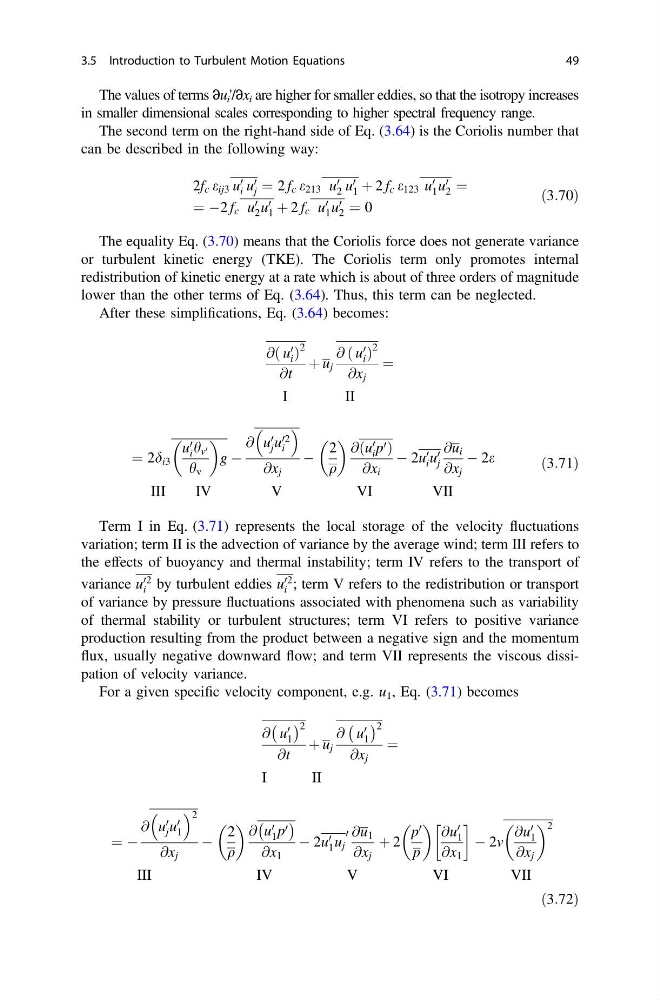
Term I in Eq. (3.71) represents the local storage of the velocity fluctuations
variation; term II is the advection of variance by the average wind; term III refers to
the effects of buoyancy and thermal instability; term IV refers to the transport of
variance u 02
i by turbulent eddies u 02
i ; term V refers to the redistribution or transport
of variance by pressure fluctuations associated with phenomena such as variability
of thermal stability or turbulent structures; term VI refers to positive variance
production resulting from the product between a negative sign and the momentum
flux, usually negative downward flow; and term VII represents the viscous dissipation of velocity variance.
For a given specific velocity component, e.g. u 1 , Eq. (3.71) becomes
@ u 0
1
À Á 2
@t
þ u j
@ u 0
1
À Á 2
@x j
¼
I
I I
¼ À
@ u 0
j u 0
1
2
@x j
À
2
q
@ u 0
1 p 0
À
Á
@x 1
À 2u 0
1 u j
0 @u 1
@x j
þ 2
p
0
p
@u
0
1
@x 1
!
À 2v
@u 0
1
@x j
2
III
IV
V
VI
VII
ð3:72Þ
3.5 Introduction to Turbulent Motion Equations
49
in smaller dimensional scales corresponding to higher spectral frequency range.
The second term on the right-hand side of Eq. (3.64) is the Coriolis number that
can be described in the following way:
2f c e ij3 u 0
i u 0
j ¼ 2 f c e 213 u 0
2 u 0
1 þ 2 f c e 123 u 0
1 u 0
2 ¼
¼ À2 f c u 0
2 u 0
1 þ 2 f c u 0
1 u 0
2 ¼ 0
ð3:70Þ
The equality Eq. (3.70) means that the Coriolis force does not generate variance
or turbulent kinetic energy (TKE). The Coriolis term only promotes internal
redistribution of kinetic energy at a rate which is about of three orders of magnitude
lower than the other terms of Eq. (3.64). Thus, this term can be neglected.
After these simplifications, Eq. (3.64) becomes:
@ u 0
i
ð Þ
2
@t
þ u j
@ u 0
i
ð Þ
2
@x j
¼
I
I I
¼ 2d i3
u 0
i h v 0
h v
g À
@ u 0
j u 02
i
@x j
À
2
q
@ u 0
i p 0
ð Þ
@x i
À 2u 0
i u 0
j
@u i
@x j
À 2e
III
IV
V
VI
VII
ð3:71Þ
Term I in Eq. (3.71) represents the local storage of the velocity fluctuations
variation; term II is the advection of variance by the average wind; term III refers to
the effects of buoyancy and thermal instability; term IV refers to the transport of
variance u 02
i by turbulent eddies u 02
i ; term V refers to the redistribution or transport
of variance by pressure fluctuations associated with phenomena such as variability
of thermal stability or turbulent structures; term VI refers to positive variance
production resulting from the product between a negative sign and the momentum
flux, usually negative downward flow; and term VII represents the viscous dissipation of velocity variance.
For a given specific velocity component, e.g. u 1 , Eq. (3.71) becomes
@ u 0
1
À Á 2
@t
þ u j
@ u 0
1
À Á 2
@x j
¼
I
I I
¼ À
@ u 0
j u 0
1
2
@x j
À
2
q
@ u 0
1 p 0
À
Á
@x 1
À 2u 0
1 u j
0 @u 1
@x j
þ 2
p
0
p
@u
0
1
@x 1
!
À 2v
@u 0
1
@x j
2
III
IV
V
VI
VII
ð3:72Þ
3.5 Introduction to Turbulent Motion Equations
49