

@
2 ðu 02
i Þ
@ x 2
j
¼
@
@x j
@ u 0
i
ð Þ
2
@ x j
"
#
¼
@
@x j
2 u
0
i
@ u 0
i
@ x j
!
¼ 2
@ u 0
i
@ x j
@ u 0
i
@ x j
!
þ
þ 2 u
0
i
@ 2 u 0
i
@ x 2
j
!
¼ 2
@ u 0
i
@ x j
2
!
þ 2 u
0
i
@ 2 u 0
i
@ x 2
j
!
ð3:66Þ
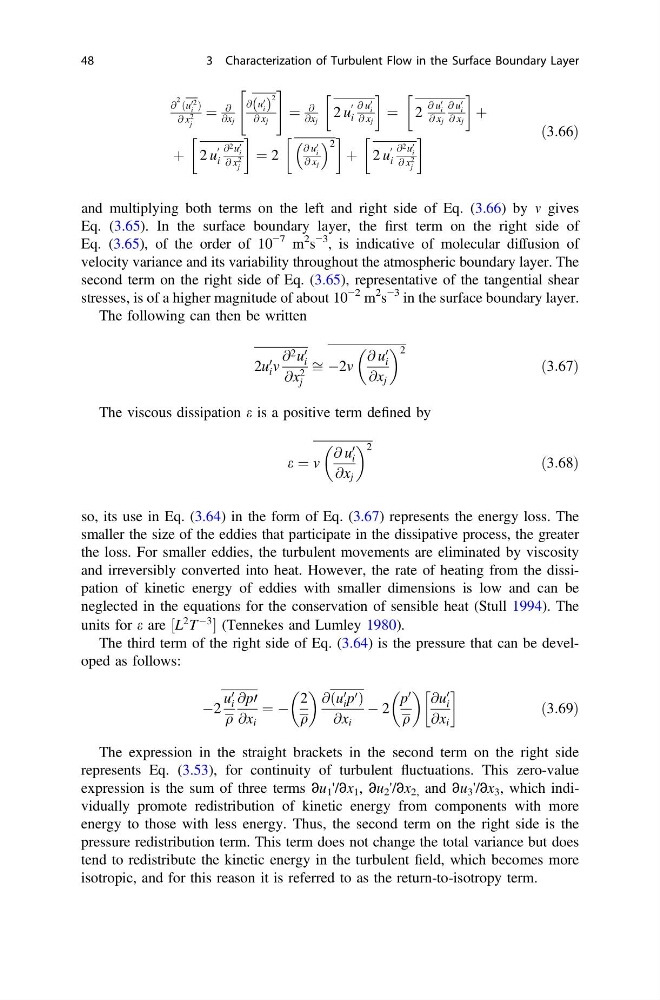
and multiplying both terms on the left and right side of Eq. (3.66) by m gives
Eq. (3.65). In the surface boundary layer, the first term on the right side of
Eq. (3.65), of the order of 10
−7 m
2 s
−3 , is indicative of molecular diffusion of
velocity variance and its variability throughout the atmospheric boundary layer. The
second term on the right side of Eq. (3.65), representative of the tangential shear
stresses, is of a higher magnitude of about 10
−2 m
2 s
−3 in the surface boundary layer.
The following can then be written
2u 0
i v
@ 2 u 0
i
@x 2
j
ffi À2v
@ u 0
i
@x j
2
ð3:67Þ
The viscous dissipation e is a positive term defined by
e ¼ v
@ u 0
i
@x j
2
ð3:68Þ
so, its use in Eq. (3.64) in the form of Eq. (3.67) represents the energy loss. The
smaller the size of the eddies that participate in the dissipative process, the greater
the loss. For smaller eddies, the turbulent movements are eliminated by viscosity
and irreversibly converted into heat. However, the rate of heating from the dissipation of kinetic energy of eddies with smaller dimensions is low and can be
neglected in the equations for the conservation of sensible heat (Stull 1994). The
units for e are L
2 T
À3
½
(Tennekes and Lumley 1980).
The third term of the right side of Eq. (3.64) is the pressure that can be developed as follows:
À2
u 0
i
q
@p0
@x i
¼ À
2
q
@ u 0
i p 0
ð Þ
@x i
À 2
p
0
q
@u
0
i
@x i
!
ð3:69Þ
The expression in the straight brackets in the second term on the right side
represents Eq. (3.53), for continuity of turbulent fluctuations. This zero-value
expression is the sum of three terms ∂u 1 '/∂x 1 , ∂u 2 '/∂x 2, and ∂u 3 '/∂x 3 , which individually promote redistribution of kinetic energy from components with more
energy to those with less energy. Thus, the second term on the right side is the
pressure redistribution term. This term does not change the total variance but does
tend to redistribute the kinetic energy in the turbulent field, which becomes more
isotropic, and for this reason it is referred to as the return-to-isotropy term.
48
3 Characterization of Turbulent Flow in the Surface Boundary Layer
2 ðu 02
i Þ
@ x 2
j
¼
@
@x j
@ u 0
i
ð Þ
2
@ x j
"
#
¼
@
@x j
2 u
0
i
@ u 0
i
@ x j
!
¼ 2
@ u 0
i
@ x j
@ u 0
i
@ x j
!
þ
þ 2 u
0
i
@ 2 u 0
i
@ x 2
j
!
¼ 2
@ u 0
i
@ x j
2
!
þ 2 u
0
i
@ 2 u 0
i
@ x 2
j
!
ð3:66Þ
and multiplying both terms on the left and right side of Eq. (3.66) by m gives
Eq. (3.65). In the surface boundary layer, the first term on the right side of
Eq. (3.65), of the order of 10
−7 m
2 s
−3 , is indicative of molecular diffusion of
velocity variance and its variability throughout the atmospheric boundary layer. The
second term on the right side of Eq. (3.65), representative of the tangential shear
stresses, is of a higher magnitude of about 10
−2 m
2 s
−3 in the surface boundary layer.
The following can then be written
2u 0
i v
@ 2 u 0
i
@x 2
j
ffi À2v
@ u 0
i
@x j
2
ð3:67Þ
The viscous dissipation e is a positive term defined by
e ¼ v
@ u 0
i
@x j
2
ð3:68Þ
so, its use in Eq. (3.64) in the form of Eq. (3.67) represents the energy loss. The
smaller the size of the eddies that participate in the dissipative process, the greater
the loss. For smaller eddies, the turbulent movements are eliminated by viscosity
and irreversibly converted into heat. However, the rate of heating from the dissipation of kinetic energy of eddies with smaller dimensions is low and can be
neglected in the equations for the conservation of sensible heat (Stull 1994). The
units for e are L
2 T
À3
½
(Tennekes and Lumley 1980).
The third term of the right side of Eq. (3.64) is the pressure that can be developed as follows:
À2
u 0
i
q
@p0
@x i
¼ À
2
q
@ u 0
i p 0
ð Þ
@x i
À 2
p
0
q
@u
0
i
@x i
!
ð3:69Þ
The expression in the straight brackets in the second term on the right side
represents Eq. (3.53), for continuity of turbulent fluctuations. This zero-value
expression is the sum of three terms ∂u 1 '/∂x 1 , ∂u 2 '/∂x 2, and ∂u 3 '/∂x 3 , which individually promote redistribution of kinetic energy from components with more
energy to those with less energy. Thus, the second term on the right side is the
pressure redistribution term. This term does not change the total variance but does
tend to redistribute the kinetic energy in the turbulent field, which becomes more
isotropic, and for this reason it is referred to as the return-to-isotropy term.
48
3 Characterization of Turbulent Flow in the Surface Boundary Layer