

2.2 Turbulent Diffusivity Coefficients
The eddy diffusivity coefficient K, of a given quantity at any point in a fluid
medium, can be defined as the ratio between the flux property through the medium
and the mean concentration gradient, in the same direction through a given point
(Thom 1975; Monteith and Unsworth 1991). Therefore, for any property with
physical dimensions, Q
K ¼ Q=L
2 T
À
Á = Q=L
3
À
Á =L
È
É ¼ L
2 T
À1
ð2:18Þ
The physical dimensions of K are area per unit time. This means that for any
diffusive process, the magnitude value for K is related to the area affected per
second, by the diffusion of a given scalar or vectorial property in a small fluid
sample. During laminar airflow, when diffusion is only molecular in nature, j, the
equivalent molecular diffusion coefficient in laminar flow, the turbulent diffusivity
coefficient, is only about 10–20 mm
2 s
−1 . In the case of turbulent flux over plant
communities, the diffusivity coefficient K can be of the order of 1 m
2 s
−1 (Oke 1992;
Thom 1975). Molecular diffusivity is a physical property of the fluid, independent
of its location. Turbulent diffusivity is a property of the flow directly proportional to
eddy size and to the distance from the ground, minus height d, as defined above.
In the case of the horizontal momentum, its turbulent diffusivity coefficient K M ,
or turbulent viscosity is defined as the ratio of the momentum flux s and its concentration gradient ð@ðqu=@ðzÞÞ. As the flow is incompressible, the following is
obtained:
s ¼ K M ð@u=@zÞ
ð 2:19Þ
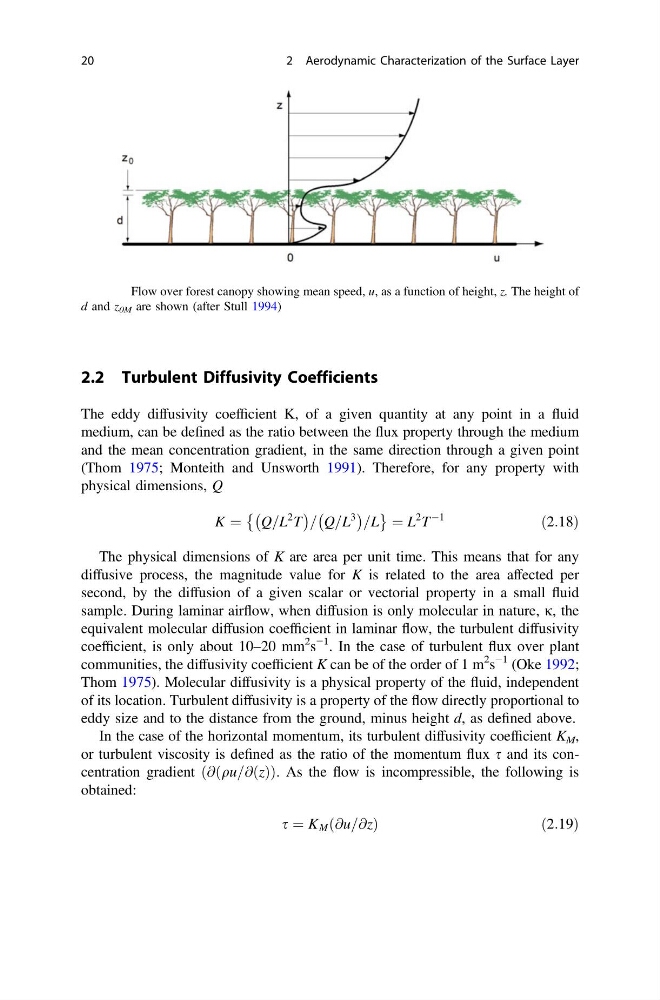
Fig. 2.3 Flow over forest canopy showing mean speed, u, as a function of height, z. The height of
d and z 0M are shown (after Stull 1994)
20
2 Aerodynamic Characterization of the Surface Layer
The eddy diffusivity coefficient K, of a given quantity at any point in a fluid
medium, can be defined as the ratio between the flux property through the medium
and the mean concentration gradient, in the same direction through a given point
(Thom 1975; Monteith and Unsworth 1991). Therefore, for any property with
physical dimensions, Q
K ¼ Q=L
2 T
À
Á = Q=L
3
À
Á =L
È
É ¼ L
2 T
À1
ð2:18Þ
The physical dimensions of K are area per unit time. This means that for any
diffusive process, the magnitude value for K is related to the area affected per
second, by the diffusion of a given scalar or vectorial property in a small fluid
sample. During laminar airflow, when diffusion is only molecular in nature, j, the
equivalent molecular diffusion coefficient in laminar flow, the turbulent diffusivity
coefficient, is only about 10–20 mm
2 s
−1 . In the case of turbulent flux over plant
communities, the diffusivity coefficient K can be of the order of 1 m
2 s
−1 (Oke 1992;
Thom 1975). Molecular diffusivity is a physical property of the fluid, independent
of its location. Turbulent diffusivity is a property of the flow directly proportional to
eddy size and to the distance from the ground, minus height d, as defined above.
In the case of the horizontal momentum, its turbulent diffusivity coefficient K M ,
or turbulent viscosity is defined as the ratio of the momentum flux s and its concentration gradient ð@ðqu=@ðzÞÞ. As the flow is incompressible, the following is
obtained:
s ¼ K M ð@u=@zÞ
ð 2:19Þ
Fig. 2.3 Flow over forest canopy showing mean speed, u, as a function of height, z. The height of
d and z 0M are shown (after Stull 1994)
20
2 Aerodynamic Characterization of the Surface Layer