

stipulates that the pressure applied to a confined fluid is transmitted integrally to the
entire volume of fluid and perpendicularly to the walls of the container as well.
For example, the pressure due to water at a depth of 200 m below the surface of a
lake, considering P o as the atmospheric pressure at the lake surface, is by
Eq. (A2.24):
P = P o + (1000 kgm
−3 ) (9.8ms
−2 ) (200m) = P o + 19.6 * 10
5 Nm
−2 = P o + 19.4
atm = 20.4 atm.
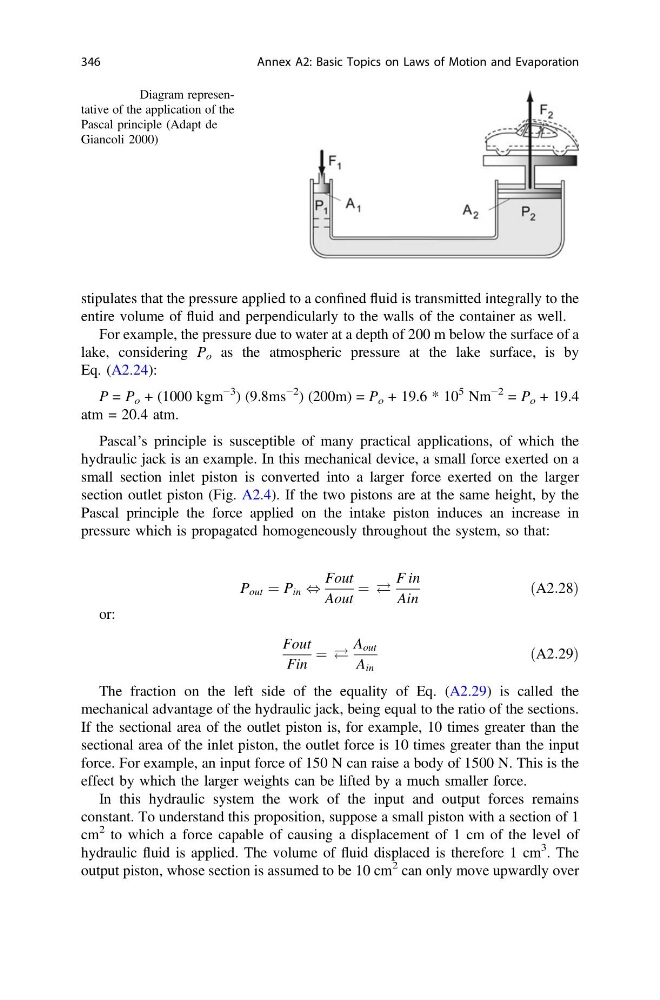
Pascal’s principle is susceptible of many practical applications, of which the
hydraulic jack is an example. In this mechanical device, a small force exerted on a
small section inlet piston is converted into a larger force exerted on the larger
section outlet piston (Fig. A2.4). If the two pistons are at the same height, by the
Pascal principle the force applied on the intake piston induces an increase in
pressure which is propagated homogeneously throughout the system, so that:
P out ¼ P in ,
Fout
Aout
¼
F in
Ain
ðA2:28Þ
or:
Fout
Fin
¼
A out
A in
ðA2:29Þ
The fraction on the left side of the equality of Eq. (A2.29) is called the
mechanical advantage of the hydraulic jack, being equal to the ratio of the sections.
If the sectional area of the outlet piston is, for example, 10 times greater than the
sectional area of the inlet piston, the outlet force is 10 times greater than the input
force. For example, an input force of 150 N can raise a body of 1500 N. This is the
effect by which the larger weights can be lifted by a much smaller force.
In this hydraulic system the work of the input and output forces remains
constant. To understand this proposition, suppose a small piston with a section of 1
cm
2 to which a force capable of causing a displacement of 1 cm of the level of
hydraulic fluid is applied. The volume of fluid displaced is therefore 1 cm
3 . The
output piston, whose section is assumed to be 10 cm
2 can only move upwardly over
Fig. A2.4 Diagram representative of the application of the
Pascal principle (Adapt de
Giancoli 2000)
346
Annex A2: Basic Topics on Laws of Motion and Evaporation
entire volume of fluid and perpendicularly to the walls of the container as well.
For example, the pressure due to water at a depth of 200 m below the surface of a
lake, considering P o as the atmospheric pressure at the lake surface, is by
Eq. (A2.24):
P = P o + (1000 kgm
−3 ) (9.8ms
−2 ) (200m) = P o + 19.6 * 10
5 Nm
−2 = P o + 19.4
atm = 20.4 atm.
Pascal’s principle is susceptible of many practical applications, of which the
hydraulic jack is an example. In this mechanical device, a small force exerted on a
small section inlet piston is converted into a larger force exerted on the larger
section outlet piston (Fig. A2.4). If the two pistons are at the same height, by the
Pascal principle the force applied on the intake piston induces an increase in
pressure which is propagated homogeneously throughout the system, so that:
P out ¼ P in ,
Fout
Aout
¼
F in
Ain
ðA2:28Þ
or:
Fout
Fin
¼
A out
A in
ðA2:29Þ
The fraction on the left side of the equality of Eq. (A2.29) is called the
mechanical advantage of the hydraulic jack, being equal to the ratio of the sections.
If the sectional area of the outlet piston is, for example, 10 times greater than the
sectional area of the inlet piston, the outlet force is 10 times greater than the input
force. For example, an input force of 150 N can raise a body of 1500 N. This is the
effect by which the larger weights can be lifted by a much smaller force.
In this hydraulic system the work of the input and output forces remains
constant. To understand this proposition, suppose a small piston with a section of 1
cm
2 to which a force capable of causing a displacement of 1 cm of the level of
hydraulic fluid is applied. The volume of fluid displaced is therefore 1 cm
3 . The
output piston, whose section is assumed to be 10 cm
2 can only move upwardly over
Fig. A2.4 Diagram representative of the application of the
Pascal principle (Adapt de
Giancoli 2000)
346
Annex A2: Basic Topics on Laws of Motion and Evaporation