

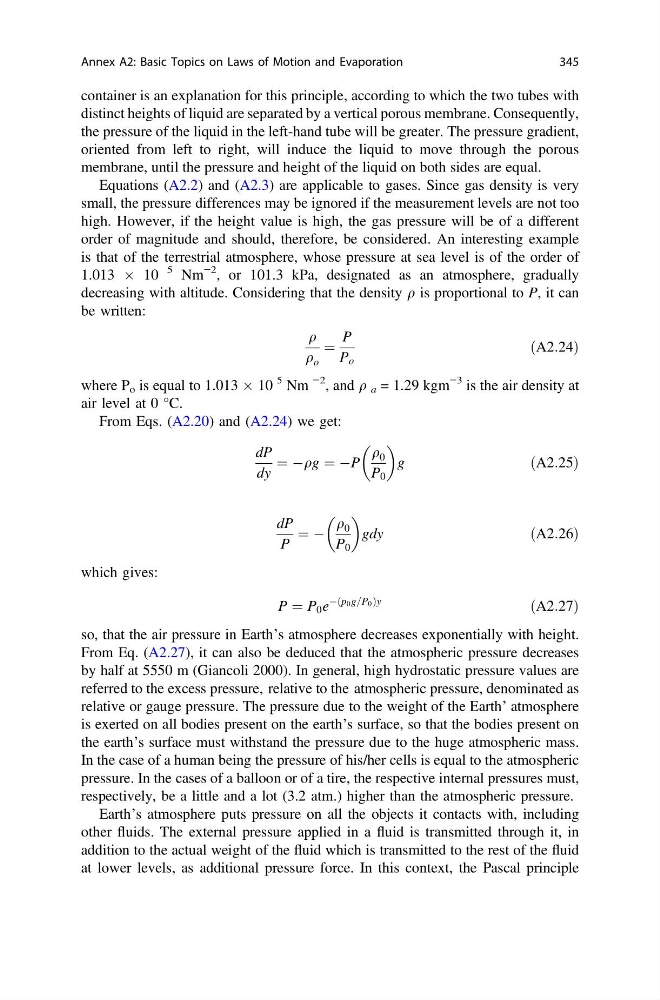
container is an explanation for this principle, according to which the two tubes with
distinct heights of liquid are separated by a vertical porous membrane. Consequently,
the pressure of the liquid in the left-hand tube will be greater. The pressure gradient,
oriented from left to right, will induce the liquid to move through the porous
membrane, until the pressure and height of the liquid on both sides are equal.
Equations (A2.2) and (A2.3) are applicable to gases. Since gas density is very
small, the pressure differences may be ignored if the measurement levels are not too
high. However, if the height value is high, the gas pressure will be of a different
order of magnitude and should, therefore, be considered. An interesting example
is that of the terrestrial atmosphere, whose pressure at sea level is of the order of
1.013 Â 10
5 Nm
−2 , or 101.3 kPa, designated as an atmosphere, gradually
decreasing with altitude. Considering that the density q is proportional to P, it can
be written:
q
q o
¼
P
P o
ðA2:24Þ
where P o is equal to 1.013 Â 10
5 Nm
−2 , and q a = 1.29 kgm
−3 is the air density at
air level at 0 °C.
From Eqs. (A2.20) and (A2.24) we get:
dP
dy
¼ Àqg ¼ ÀP
q 0
P 0
g
ðA2:25Þ
dP
P
¼ À
q 0
P 0
gdy
ðA2:26Þ
which gives:
P ¼ P 0 e
À p 0 g=P 0
ð
Þ y
ðA2:27Þ
so, that the air pressure in Earth’s atmosphere decreases exponentially with height.
From Eq. (A2.27), it can also be deduced that the atmospheric pressure decreases
by half at 5550 m (Giancoli 2000). In general, high hydrostatic pressure values are
referred to the excess pressure, relative to the atmospheric pressure, denominated as
relative or gauge pressure. The pressure due to the weight of the Earth’ atmosphere
is exerted on all bodies present on the earth’s surface, so that the bodies present on
the earth’s surface must withstand the pressure due to the huge atmospheric mass.
In the case of a human being the pressure of his/her cells is equal to the atmospheric
pressure. In the cases of a balloon or of a tire, the respective internal pressures must,
respectively, be a little and a lot (3.2 atm.) higher than the atmospheric pressure.
Earth’s atmosphere puts pressure on all the objects it contacts with, including
other fluids. The external pressure applied in a fluid is transmitted through it, in
addition to the actual weight of the fluid which is transmitted to the rest of the fluid
at lower levels, as additional pressure force. In this context, the Pascal principle
Annex A2: Basic Topics on Laws of Motion and Evaporation
345
distinct heights of liquid are separated by a vertical porous membrane. Consequently,
the pressure of the liquid in the left-hand tube will be greater. The pressure gradient,
oriented from left to right, will induce the liquid to move through the porous
membrane, until the pressure and height of the liquid on both sides are equal.
Equations (A2.2) and (A2.3) are applicable to gases. Since gas density is very
small, the pressure differences may be ignored if the measurement levels are not too
high. However, if the height value is high, the gas pressure will be of a different
order of magnitude and should, therefore, be considered. An interesting example
is that of the terrestrial atmosphere, whose pressure at sea level is of the order of
1.013 Â 10
5 Nm
−2 , or 101.3 kPa, designated as an atmosphere, gradually
decreasing with altitude. Considering that the density q is proportional to P, it can
be written:
q
q o
¼
P
P o
ðA2:24Þ
where P o is equal to 1.013 Â 10
5 Nm
−2 , and q a = 1.29 kgm
−3 is the air density at
air level at 0 °C.
From Eqs. (A2.20) and (A2.24) we get:
dP
dy
¼ Àqg ¼ ÀP
q 0
P 0
g
ðA2:25Þ
dP
P
¼ À
q 0
P 0
gdy
ðA2:26Þ
which gives:
P ¼ P 0 e
À p 0 g=P 0
ð
Þ y
ðA2:27Þ
so, that the air pressure in Earth’s atmosphere decreases exponentially with height.
From Eq. (A2.27), it can also be deduced that the atmospheric pressure decreases
by half at 5550 m (Giancoli 2000). In general, high hydrostatic pressure values are
referred to the excess pressure, relative to the atmospheric pressure, denominated as
relative or gauge pressure. The pressure due to the weight of the Earth’ atmosphere
is exerted on all bodies present on the earth’s surface, so that the bodies present on
the earth’s surface must withstand the pressure due to the huge atmospheric mass.
In the case of a human being the pressure of his/her cells is equal to the atmospheric
pressure. In the cases of a balloon or of a tire, the respective internal pressures must,
respectively, be a little and a lot (3.2 atm.) higher than the atmospheric pressure.
Earth’s atmosphere puts pressure on all the objects it contacts with, including
other fluids. The external pressure applied in a fluid is transmitted through it, in
addition to the actual weight of the fluid which is transmitted to the rest of the fluid
at lower levels, as additional pressure force. In this context, the Pascal principle
Annex A2: Basic Topics on Laws of Motion and Evaporation
345