

For terrestrial and mid-latitude areas, about 30 min after sunrise, a mixed thermal
convective boundary layer is formed adjacent to the ground, because of radiative
surface heating which in turn promotes heating of the adjacent air. The boundary
layer grows throughout the morning, while mixing and retaining air from the less
turbulent upper atmosphere, reaching a height of 1 to 2 km by mid-afternoon.
The nocturnal residual and stable boundary layers are quickly destroyed after
sunrise with the formation of the mixed layer, especially on days with strong solar
radiation. The nocturnal inversion, which prevails before sunrise, evolves into the
capping layer to height z i (Fig. 1.6) and rises with the convective layer as it expands
vertically. In winter and cloudy days, the mixed layer development will be damped
due to weak thermal energy transport from the surface to the atmosphere and low
solar radiation (Foken 2017).
The capping inversion can remain at the same level during the day or may fall in
the form of reverse subsidence. The height at which this reversal occurs corresponds to the top of the diurnal atmospheric boundary layer. Figures 1.1 and 1.5
provide schematic representations of the daily evolution of the atmospheric
boundary layer.
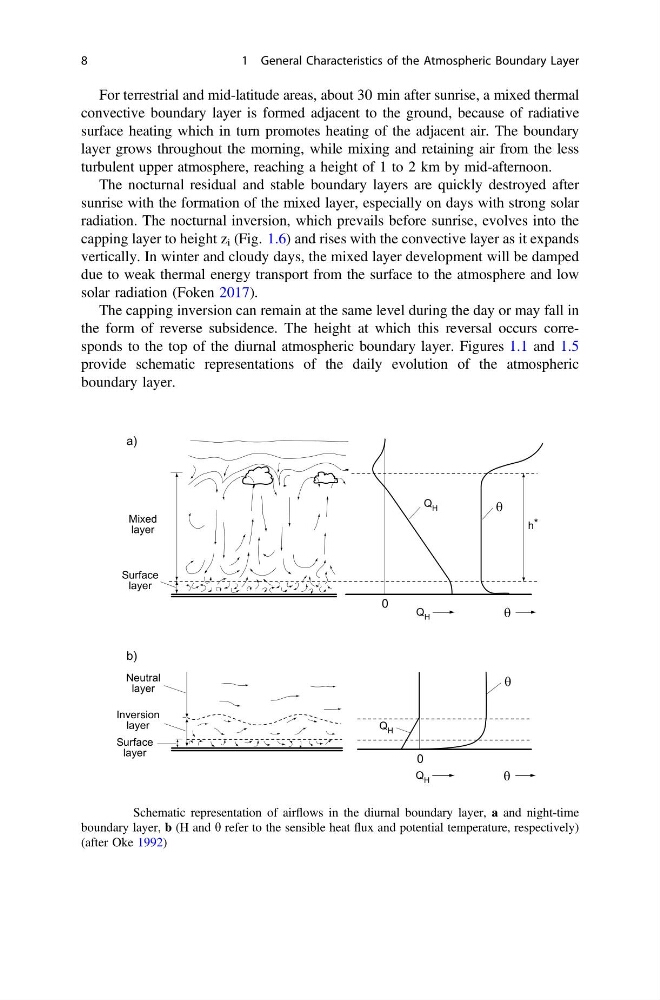
Fig. 1.7 Schematic representation of airflows in the diurnal boundary layer, a and night-time
boundary layer, b (H and h refer to the sensible heat flux and potential temperature, respectively)
(after Oke 1992)
8
1 General Characteristics of the Atmospheric Boundary Layer
convective boundary layer is formed adjacent to the ground, because of radiative
surface heating which in turn promotes heating of the adjacent air. The boundary
layer grows throughout the morning, while mixing and retaining air from the less
turbulent upper atmosphere, reaching a height of 1 to 2 km by mid-afternoon.
The nocturnal residual and stable boundary layers are quickly destroyed after
sunrise with the formation of the mixed layer, especially on days with strong solar
radiation. The nocturnal inversion, which prevails before sunrise, evolves into the
capping layer to height z i (Fig. 1.6) and rises with the convective layer as it expands
vertically. In winter and cloudy days, the mixed layer development will be damped
due to weak thermal energy transport from the surface to the atmosphere and low
solar radiation (Foken 2017).
The capping inversion can remain at the same level during the day or may fall in
the form of reverse subsidence. The height at which this reversal occurs corresponds to the top of the diurnal atmospheric boundary layer. Figures 1.1 and 1.5
provide schematic representations of the daily evolution of the atmospheric
boundary layer.
Fig. 1.7 Schematic representation of airflows in the diurnal boundary layer, a and night-time
boundary layer, b (H and h refer to the sensible heat flux and potential temperature, respectively)
(after Oke 1992)
8
1 General Characteristics of the Atmospheric Boundary Layer