

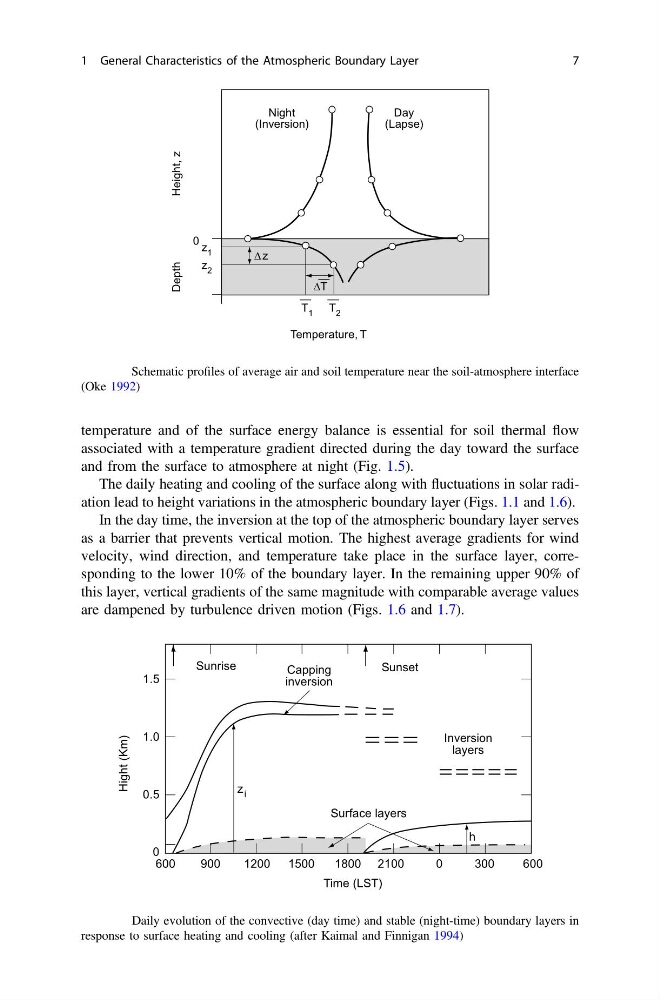
temperature and of the surface energy balance is essential for soil thermal flow
associated with a temperature gradient directed during the day toward the surface
and from the surface to atmosphere at night (Fig. 1.5).
The daily heating and cooling of the surface along with fluctuations in solar radiation lead to height variations in the atmospheric boundary layer (Figs. 1.1 and 1.6).
In the day time, the inversion at the top of the atmospheric boundary layer serves
as a barrier that prevents vertical motion. The highest average gradients for wind
velocity, wind direction, and temperature take place in the surface layer, corresponding to the lower 10% of the boundary layer. In the remaining upper 90% of
this layer, vertical gradients of the same magnitude with comparable average values
are dampened by turbulence driven motion (Figs. 1.6 and 1.7).
Temperature, T
0 z 1
T 1
ΔT
Δz
T 2
z 2
Depth
Height, z
Night
(Inversion)
Day
(Lapse)
Fig. 1.5 Schematic profiles of average air and soil temperature near the soil-atmosphere interface
(Oke 1992)
0.5
z i
h
1.5
1.0
0
600
900
1200
1500
1800 2100
0
300
600
Time (LST)
Sunset
Sunrise
Hight (Km)
Capping
inversion
Inversion
layers
Surface layers
Fig. 1.6 Daily evolution of the convective (day time) and stable (night-time) boundary layers in
response to surface heating and cooling (after Kaimal and Finnigan 1994)
1 General Characteristics of the Atmospheric Boundary Layer
7
associated with a temperature gradient directed during the day toward the surface
and from the surface to atmosphere at night (Fig. 1.5).
The daily heating and cooling of the surface along with fluctuations in solar radiation lead to height variations in the atmospheric boundary layer (Figs. 1.1 and 1.6).
In the day time, the inversion at the top of the atmospheric boundary layer serves
as a barrier that prevents vertical motion. The highest average gradients for wind
velocity, wind direction, and temperature take place in the surface layer, corresponding to the lower 10% of the boundary layer. In the remaining upper 90% of
this layer, vertical gradients of the same magnitude with comparable average values
are dampened by turbulence driven motion (Figs. 1.6 and 1.7).
Temperature, T
0 z 1
T 1
ΔT
Δz
T 2
z 2
Depth
Height, z
Night
(Inversion)
Day
(Lapse)
Fig. 1.5 Schematic profiles of average air and soil temperature near the soil-atmosphere interface
(Oke 1992)
0.5
z i
h
1.5
1.0
0
600
900
1200
1500
1800 2100
0
300
600
Time (LST)
Sunset
Sunrise
Hight (Km)
Capping
inversion
Inversion
layers
Surface layers
Fig. 1.6 Daily evolution of the convective (day time) and stable (night-time) boundary layers in
response to surface heating and cooling (after Kaimal and Finnigan 1994)
1 General Characteristics of the Atmospheric Boundary Layer
7