

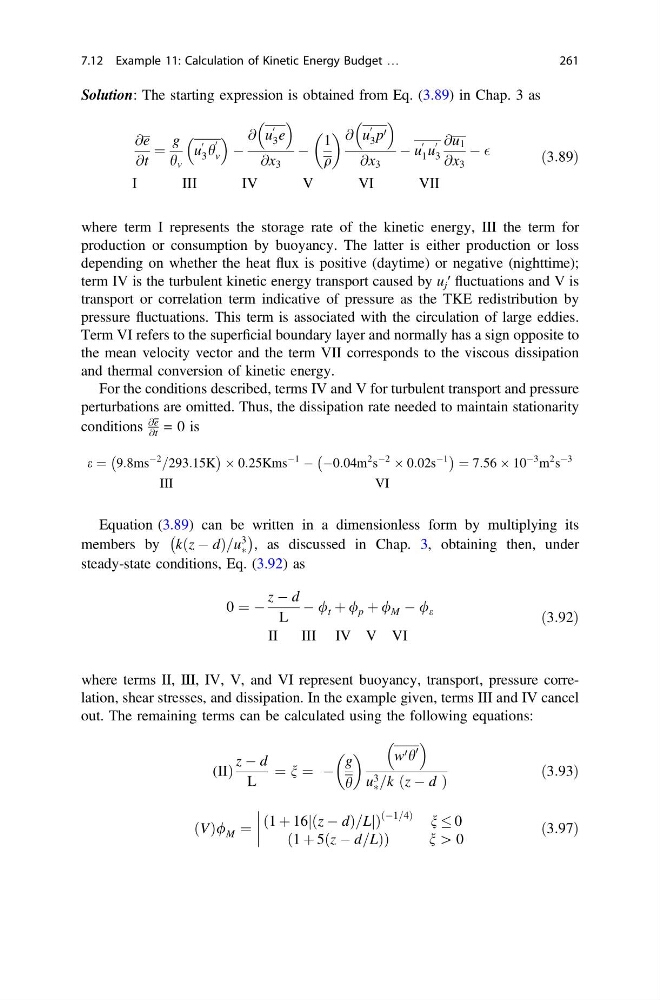
Solution: The starting expression is obtained from Eq. (3.89) in Chap. 3 as
@e
@t
¼
g
h v
u
0
3 h
0
v
À
@ u
0
3 e
@x 3
À
1
q
@ u
0
3 p 0
@x 3
À u
0
1 u
0
3
@u 1
@x 3
À
I
III
IV
V
VI
VII
ð3:89Þ
where term I represents the storage rate of the kinetic energy, III the term for
production or consumption by buoyancy. The latter is either production or loss
depending on whether the heat flux is positive (daytime) or negative (nighttime);
term IV is the turbulent kinetic energy transport caused by u j ′ fluctuations and V is
transport or correlation term indicative of pressure as the TKE redistribution by
pressure fluctuations. This term is associated with the circulation of large eddies.
Term VI refers to the superficial boundary layer and normally has a sign opposite to
the mean velocity vector and the term VII corresponds to the viscous dissipation
and thermal conversion of kinetic energy.
For the conditions described, terms IV and V for turbulent transport and pressure
perturbations are omitted. Thus, the dissipation rate needed to maintain stationarity
conditions
@e
@t = 0 is
e ¼ 9:8ms
À2 =293:15K
À
Á Â 0:25Kms
À1 À À0:04m
2 s
À2 Â 0:02s
À1
À
Á ¼ 7:56 Â 10
À3 m
2 s
À3
III
VI
Equation (3.89) can be written in a dimensionless form by multiplying its
members by k z À d
ð
Þ=u
3
Ã
À
Á
, as discussed in Chap. 3, obtaining then, under
steady-state conditions, Eq. (3.92) as
0 ¼ À
z À d
L
À / t þ / p þ / M À / e
II
III IV V VI
ð3:92Þ
where terms II, III, IV, V, and VI represent buoyancy, transport, pressure correlation, shear stresses, and dissipation. In the example given, terms III and IV cancel
out. The remaining terms can be calculated using the following equations:
(IIÞ
z À d
L
¼ n ¼ À
g
h
w 0 h
0
u 3
à =k ðz À d Þ
ð3:93Þ
ðVÞ/ M ¼ 1 þ 16 z À d
ð
Þ=L
j
j
ð
Þ
À1=4
ð
Þ
n 0
1 þ 5 z À d=L
ð
Þ
ð
Þ
n [ 0
ð3:97Þ
7.12 Example 11: Calculation of Kinetic Energy Budget …
261
@e
@t
¼
g
h v
u
0
3 h
0
v
À
@ u
0
3 e
@x 3
À
1
q
@ u
0
3 p 0
@x 3
À u
0
1 u
0
3
@u 1
@x 3
À
I
III
IV
V
VI
VII
ð3:89Þ
where term I represents the storage rate of the kinetic energy, III the term for
production or consumption by buoyancy. The latter is either production or loss
depending on whether the heat flux is positive (daytime) or negative (nighttime);
term IV is the turbulent kinetic energy transport caused by u j ′ fluctuations and V is
transport or correlation term indicative of pressure as the TKE redistribution by
pressure fluctuations. This term is associated with the circulation of large eddies.
Term VI refers to the superficial boundary layer and normally has a sign opposite to
the mean velocity vector and the term VII corresponds to the viscous dissipation
and thermal conversion of kinetic energy.
For the conditions described, terms IV and V for turbulent transport and pressure
perturbations are omitted. Thus, the dissipation rate needed to maintain stationarity
conditions
@e
@t = 0 is
e ¼ 9:8ms
À2 =293:15K
À
Á Â 0:25Kms
À1 À À0:04m
2 s
À2 Â 0:02s
À1
À
Á ¼ 7:56 Â 10
À3 m
2 s
À3
III
VI
Equation (3.89) can be written in a dimensionless form by multiplying its
members by k z À d
ð
Þ=u
3
Ã
À
Á
, as discussed in Chap. 3, obtaining then, under
steady-state conditions, Eq. (3.92) as
0 ¼ À
z À d
L
À / t þ / p þ / M À / e
II
III IV V VI
ð3:92Þ
where terms II, III, IV, V, and VI represent buoyancy, transport, pressure correlation, shear stresses, and dissipation. In the example given, terms III and IV cancel
out. The remaining terms can be calculated using the following equations:
(IIÞ
z À d
L
¼ n ¼ À
g
h
w 0 h
0
u 3
à =k ðz À d Þ
ð3:93Þ
ðVÞ/ M ¼ 1 þ 16 z À d
ð
Þ=L
j
j
ð
Þ
À1=4
ð
Þ
n 0
1 þ 5 z À d=L
ð
Þ
ð
Þ
n [ 0
ð3:97Þ
7.12 Example 11: Calculation of Kinetic Energy Budget …
261