

with height) is equal to the environmental temperature gradient. As a result, there is
no difference in density between these air parcels, the surrounding and ascending
air, and circulation until a stationary state is reached which takes place due to
internal adiabatic cooling.
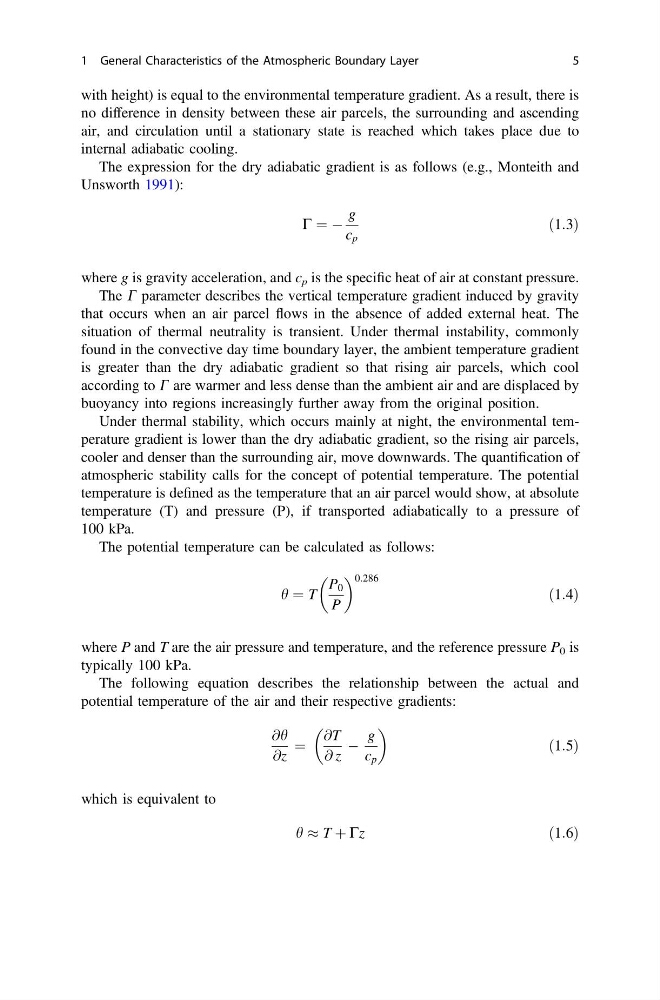
The expression for the dry adiabatic gradient is as follows (e.g., Monteith and
Unsworth 1991):
C ¼ À
g
c p
ð1:3Þ
where g is gravity acceleration, and c p is the specific heat of air at constant pressure.
The C parameter describes the vertical temperature gradient induced by gravity
that occurs when an air parcel flows in the absence of added external heat. The
situation of thermal neutrality is transient. Under thermal instability, commonly
found in the convective day time boundary layer, the ambient temperature gradient
is greater than the dry adiabatic gradient so that rising air parcels, which cool
according to C are warmer and less dense than the ambient air and are displaced by
buoyancy into regions increasingly further away from the original position.
Under thermal stability, which occurs mainly at night, the environmental temperature gradient is lower than the dry adiabatic gradient, so the rising air parcels,
cooler and denser than the surrounding air, move downwards. The quantification of
atmospheric stability calls for the concept of potential temperature. The potential
temperature is defined as the temperature that an air parcel would show, at absolute
temperature (T) and pressure (P), if transported adiabatically to a pressure of
100 kPa.
The potential temperature can be calculated as follows:
h ¼ T
P 0
P
0:286
ð1:4Þ
where P and T are the air pressure and temperature, and the reference pressure P 0 is
typically 100 kPa.
The following equation describes the relationship between the actual and
potential temperature of the air and their respective gradients:
@h
@z
¼
@T
@ z
À
g
c p
ð1:5Þ
which is equivalent to
h % T þ Cz
ð1:6Þ
1 General Characteristics of the Atmospheric Boundary Layer
5
no difference in density between these air parcels, the surrounding and ascending
air, and circulation until a stationary state is reached which takes place due to
internal adiabatic cooling.
The expression for the dry adiabatic gradient is as follows (e.g., Monteith and
Unsworth 1991):
C ¼ À
g
c p
ð1:3Þ
where g is gravity acceleration, and c p is the specific heat of air at constant pressure.
The C parameter describes the vertical temperature gradient induced by gravity
that occurs when an air parcel flows in the absence of added external heat. The
situation of thermal neutrality is transient. Under thermal instability, commonly
found in the convective day time boundary layer, the ambient temperature gradient
is greater than the dry adiabatic gradient so that rising air parcels, which cool
according to C are warmer and less dense than the ambient air and are displaced by
buoyancy into regions increasingly further away from the original position.
Under thermal stability, which occurs mainly at night, the environmental temperature gradient is lower than the dry adiabatic gradient, so the rising air parcels,
cooler and denser than the surrounding air, move downwards. The quantification of
atmospheric stability calls for the concept of potential temperature. The potential
temperature is defined as the temperature that an air parcel would show, at absolute
temperature (T) and pressure (P), if transported adiabatically to a pressure of
100 kPa.
The potential temperature can be calculated as follows:
h ¼ T
P 0
P
0:286
ð1:4Þ
where P and T are the air pressure and temperature, and the reference pressure P 0 is
typically 100 kPa.
The following equation describes the relationship between the actual and
potential temperature of the air and their respective gradients:
@h
@z
¼
@T
@ z
À
g
c p
ð1:5Þ
which is equivalent to
h % T þ Cz
ð1:6Þ
1 General Characteristics of the Atmospheric Boundary Layer
5