

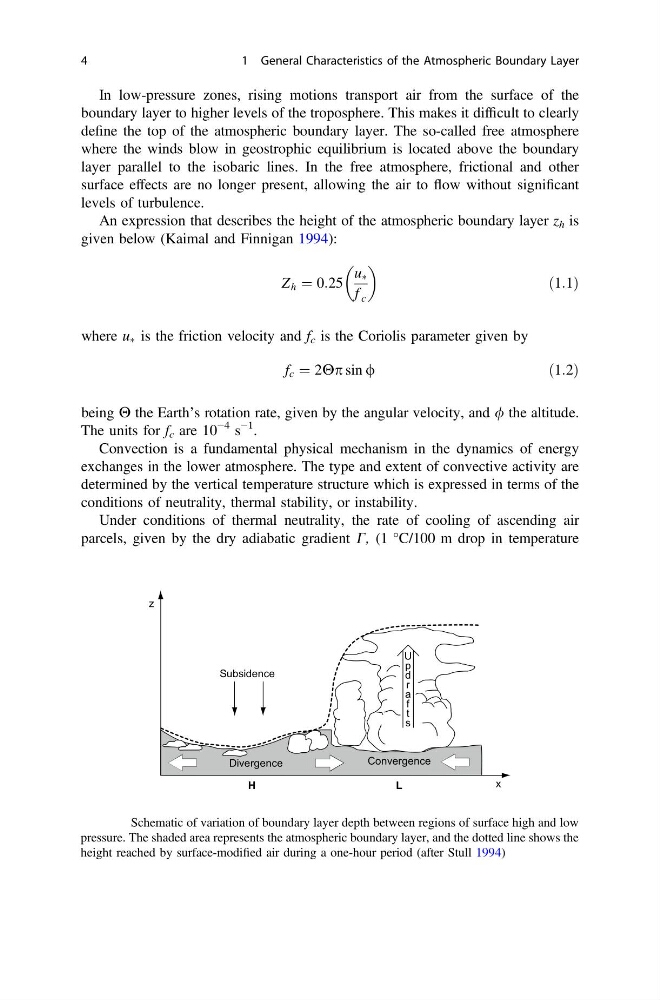
In low-pressure zones, rising motions transport air from the surface of the
boundary layer to higher levels of the troposphere. This makes it difficult to clearly
define the top of the atmospheric boundary layer. The so-called free atmosphere
where the winds blow in geostrophic equilibrium is located above the boundary
layer parallel to the isobaric lines. In the free atmosphere, frictional and other
surface effects are no longer present, allowing the air to flow without significant
levels of turbulence.
An expression that describes the height of the atmospheric boundary layer z h is
given below (Kaimal and Finnigan 1994):
Z h ¼ 0:25
u Ã
f c
ð1:1Þ
where u à is the friction velocity and f c is the Coriolis parameter given by
f c ¼ 2Hp sin /
ð1:2Þ
being H the Earth’s rotation rate, given by the angular velocity, and / the altitude.
The units for f c are 10
−4 s
−1 .
Convection is a fundamental physical mechanism in the dynamics of energy
exchanges in the lower atmosphere. The type and extent of convective activity are
determined by the vertical temperature structure which is expressed in terms of the
conditions of neutrality, thermal stability, or instability.
Under conditions of thermal neutrality, the rate of cooling of ascending air
parcels, given by the dry adiabatic gradient C, (1 °C/100 m drop in temperature
Convergence
Divergence
Subsidence
z
x
U
p
d
r
a
f
t
s
L
H
Fig. 1.3 Schematic of variation of boundary layer depth between regions of surface high and low
pressure. The shaded area represents the atmospheric boundary layer, and the dotted line shows the
height reached by surface-modified air during a one-hour period (after Stull 1994)
4
1 General Characteristics of the Atmospheric Boundary Layer
boundary layer to higher levels of the troposphere. This makes it difficult to clearly
define the top of the atmospheric boundary layer. The so-called free atmosphere
where the winds blow in geostrophic equilibrium is located above the boundary
layer parallel to the isobaric lines. In the free atmosphere, frictional and other
surface effects are no longer present, allowing the air to flow without significant
levels of turbulence.
An expression that describes the height of the atmospheric boundary layer z h is
given below (Kaimal and Finnigan 1994):
Z h ¼ 0:25
u Ã
f c
ð1:1Þ
where u à is the friction velocity and f c is the Coriolis parameter given by
f c ¼ 2Hp sin /
ð1:2Þ
being H the Earth’s rotation rate, given by the angular velocity, and / the altitude.
The units for f c are 10
−4 s
−1 .
Convection is a fundamental physical mechanism in the dynamics of energy
exchanges in the lower atmosphere. The type and extent of convective activity are
determined by the vertical temperature structure which is expressed in terms of the
conditions of neutrality, thermal stability, or instability.
Under conditions of thermal neutrality, the rate of cooling of ascending air
parcels, given by the dry adiabatic gradient C, (1 °C/100 m drop in temperature
Convergence
Divergence
Subsidence
z
x
U
p
d
r
a
f
t
s
L
H
Fig. 1.3 Schematic of variation of boundary layer depth between regions of surface high and low
pressure. The shaded area represents the atmospheric boundary layer, and the dotted line shows the
height reached by surface-modified air during a one-hour period (after Stull 1994)
4
1 General Characteristics of the Atmospheric Boundary Layer