

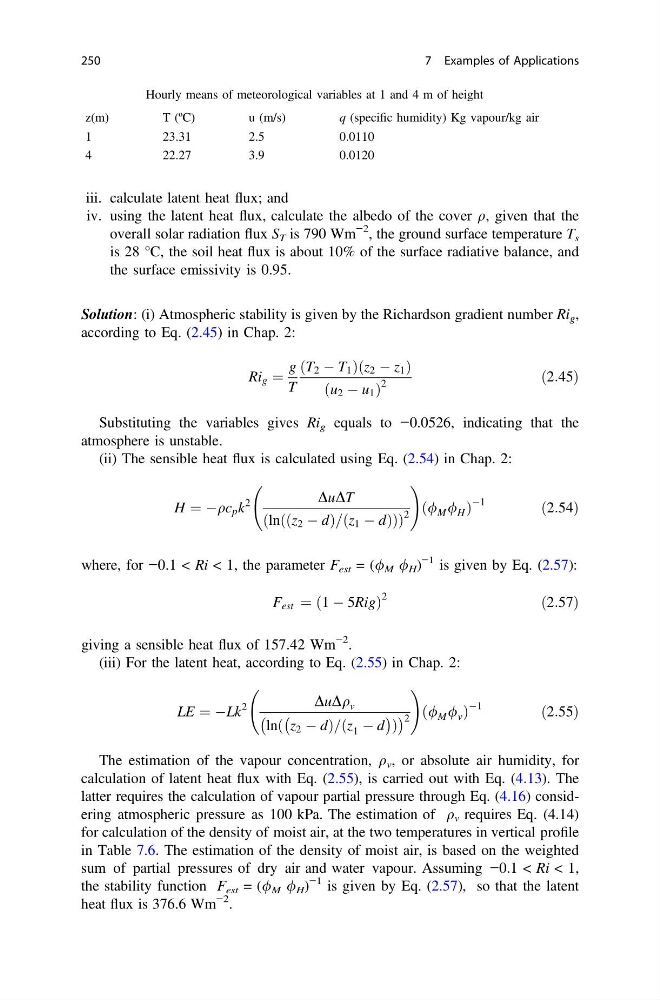
Table. 7.6 Hourly means of meteorological variables at 1 and 4 m of height
z(m)
T (ºC)
u (m/s)
q (specific humidity) Kg vapour/kg air
1
23.31
2.5
0.0110
4
22.27
3.9
0.0120
iii. calculate latent heat flux; and
iv. using the latent heat flux, calculate the albedo of the cover q, given that the
overall solar radiation flux S T is 790 Wm
−2 , the ground surface temperature T s
is 28 °C, the soil heat flux is about 10% of the surface radiative balance, and
the surface emissivity is 0.95.
Solution: (i) Atmospheric stability is given by the Richardson gradient number Ri g ,
according to Eq. (2.45) in Chap. 2:
Ri g ¼
g
T
ðT 2 À T 1 Þðz 2 À z 1 Þ
ðu 2 À u 1 Þ
2
ð2:45Þ
Substituting the variables gives Ri g equals to −0.0526, indicating that the
atmosphere is unstable.
(ii) The sensible heat flux is calculated using Eq. (2.54) in Chap. 2:
H ¼ Àqc p k
2
DuDT
lnð z 2 À dÞ=ðz 1 À d
ð
Þ Þ
ð
Þ
2
!
/ M / H
ð
Þ
À1
ð2:54Þ
where, for −0.1 < Ri < 1, the parameter F est = (/ M / H )
−1 is given by Eq. (2.57):
F est ¼ ð1 À 5RigÞ
2
ð2:57Þ
giving a sensible heat flux of 157.42 Wm
−2 .
(iii) For the latent heat, according to Eq. (2.55) in Chap. 2:
LE ¼ ÀLk
2
DuDq v
lnð z 2 À dÞ=ðz 1 À d
À
Á Þ
À
Á 2
!
/ M / v
ð
Þ
À1
ð2:55Þ
The estimation of the vapour concentration, q v , or absolute air humidity, for
calculation of latent heat flux with Eq. (2.55), is carried out with Eq. (4.13). The
latter requires the calculation of vapour partial pressure through Eq. (4.16) considering atmospheric pressure as 100 kPa. The estimation of q v requires Eq. (4.14)
for calculation of the density of moist air, at the two temperatures in vertical profile
in Table 7.6. The estimation of the density of moist air, is based on the weighted
sum of partial pressures of dry air and water vapour. Assuming −0.1 < Ri < 1,
the stability function F est = (/ M / H )
−1 is given by Eq. (2.57), so that the latent
heat flux is 376.6 Wm
−2 .
250
7 Examples of Applications
z(m)
T (ºC)
u (m/s)
q (specific humidity) Kg vapour/kg air
1
23.31
2.5
0.0110
4
22.27
3.9
0.0120
iii. calculate latent heat flux; and
iv. using the latent heat flux, calculate the albedo of the cover q, given that the
overall solar radiation flux S T is 790 Wm
−2 , the ground surface temperature T s
is 28 °C, the soil heat flux is about 10% of the surface radiative balance, and
the surface emissivity is 0.95.
Solution: (i) Atmospheric stability is given by the Richardson gradient number Ri g ,
according to Eq. (2.45) in Chap. 2:
Ri g ¼
g
T
ðT 2 À T 1 Þðz 2 À z 1 Þ
ðu 2 À u 1 Þ
2
ð2:45Þ
Substituting the variables gives Ri g equals to −0.0526, indicating that the
atmosphere is unstable.
(ii) The sensible heat flux is calculated using Eq. (2.54) in Chap. 2:
H ¼ Àqc p k
2
DuDT
lnð z 2 À dÞ=ðz 1 À d
ð
Þ Þ
ð
Þ
2
!
/ M / H
ð
Þ
À1
ð2:54Þ
where, for −0.1 < Ri < 1, the parameter F est = (/ M / H )
−1 is given by Eq. (2.57):
F est ¼ ð1 À 5RigÞ
2
ð2:57Þ
giving a sensible heat flux of 157.42 Wm
−2 .
(iii) For the latent heat, according to Eq. (2.55) in Chap. 2:
LE ¼ ÀLk
2
DuDq v
lnð z 2 À dÞ=ðz 1 À d
À
Á Þ
À
Á 2
!
/ M / v
ð
Þ
À1
ð2:55Þ
The estimation of the vapour concentration, q v , or absolute air humidity, for
calculation of latent heat flux with Eq. (2.55), is carried out with Eq. (4.13). The
latter requires the calculation of vapour partial pressure through Eq. (4.16) considering atmospheric pressure as 100 kPa. The estimation of q v requires Eq. (4.14)
for calculation of the density of moist air, at the two temperatures in vertical profile
in Table 7.6. The estimation of the density of moist air, is based on the weighted
sum of partial pressures of dry air and water vapour. Assuming −0.1 < Ri < 1,
the stability function F est = (/ M / H )
−1 is given by Eq. (2.57), so that the latent
heat flux is 376.6 Wm
−2 .
250
7 Examples of Applications