

Given an albedo of 0.15 for the forest, the radiative balance can be calculated (R n
in Eq. 7.1, the algebraic sum of the various radiation components) and shown to
compare with the values measured using the net radiometer throughout the day. The
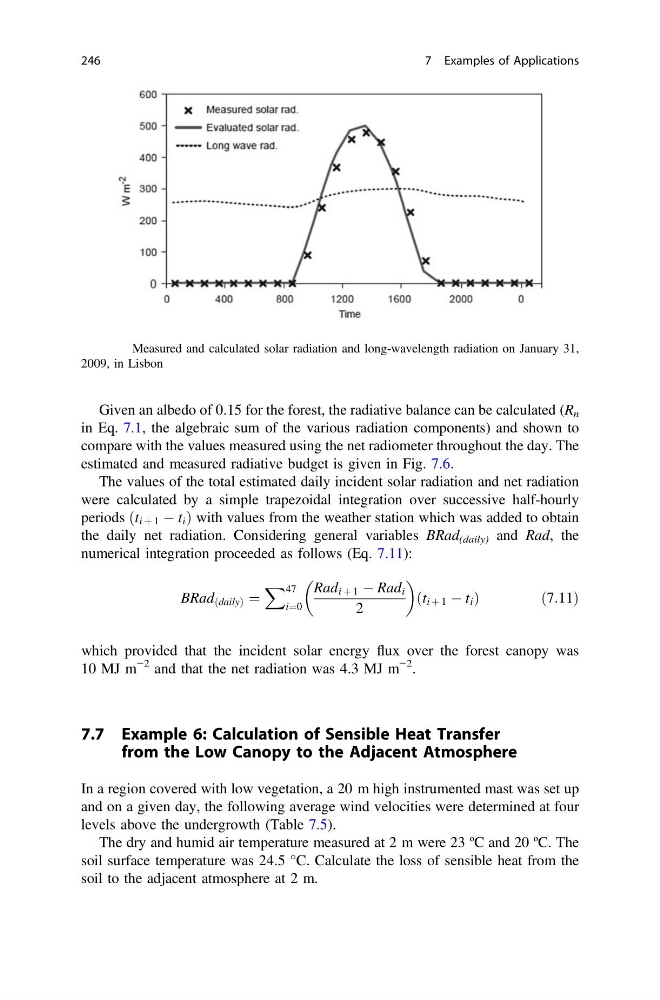
estimated and measured radiative budget is given in Fig. 7.6.
The values of the total estimated daily incident solar radiation and net radiation
were calculated by a simple trapezoidal integration over successive half-hourly
periods t i þ 1 À t i
ð
Þwith values from the weather station which was added to obtain
the daily net radiation. Considering general variables BRad (daily) and Rad, the
numerical integration proceeded as follows (Eq. 7.11):
BRad daily
ð
Þ ¼
X 47
i¼0
Rad i þ 1 À Rad i
2
t i þ 1 À t i
ð
Þ
ð 7:11Þ
which provided that the incident solar energy flux over the forest canopy was
10 MJ m
−2 and that the net radiation was 4.3 MJ m
−2 .
7.7 Example 6: Calculation of Sensible Heat Transfer
from the Low Canopy to the Adjacent Atmosphere
In a region covered with low vegetation, a 20 m high instrumented mast was set up
and on a given day, the following average wind velocities were determined at four
levels above the undergrowth (Table 7.5).
The dry and humid air temperature measured at 2 m were 23 ºC and 20 ºC. The
soil surface temperature was 24.5 °C. Calculate the loss of sensible heat from the
soil to the adjacent atmosphere at 2 m.
Fig. 7.4 Measured and calculated solar radiation and long-wavelength radiation on January 31,
2009, in Lisbon
246
7 Examples of Applications
in Eq. 7.1, the algebraic sum of the various radiation components) and shown to
compare with the values measured using the net radiometer throughout the day. The
estimated and measured radiative budget is given in Fig. 7.6.
The values of the total estimated daily incident solar radiation and net radiation
were calculated by a simple trapezoidal integration over successive half-hourly
periods t i þ 1 À t i
ð
Þwith values from the weather station which was added to obtain
the daily net radiation. Considering general variables BRad (daily) and Rad, the
numerical integration proceeded as follows (Eq. 7.11):
BRad daily
ð
Þ ¼
X 47
i¼0
Rad i þ 1 À Rad i
2
t i þ 1 À t i
ð
Þ
ð 7:11Þ
which provided that the incident solar energy flux over the forest canopy was
10 MJ m
−2 and that the net radiation was 4.3 MJ m
−2 .
7.7 Example 6: Calculation of Sensible Heat Transfer
from the Low Canopy to the Adjacent Atmosphere
In a region covered with low vegetation, a 20 m high instrumented mast was set up
and on a given day, the following average wind velocities were determined at four
levels above the undergrowth (Table 7.5).
The dry and humid air temperature measured at 2 m were 23 ºC and 20 ºC. The
soil surface temperature was 24.5 °C. Calculate the loss of sensible heat from the
soil to the adjacent atmosphere at 2 m.
Fig. 7.4 Measured and calculated solar radiation and long-wavelength radiation on January 31,
2009, in Lisbon
246
7 Examples of Applications