

Most objects on the Earth’s surface are exposed to solar radiation and in addition, receive thermal radiation emitted by the atmosphere and other bodies. These
objects also emit thermal radiation. The balance of these radiative exchanges
between the object and the external environment is the radiative budget, or net
radiation, Rn. This net radiation is a major cause of the Earth’s warming and
cooling.
An ideal surface has no thickness and so cannot store energy. The net radiative
exchange is distributed through other forms of energy including conduction/energy
storage (G), energy used for evaporation or gained by condensation (kE, latent
heat), energy gained to heat the air from adjacent layers or gained by air cooling (H,
convection, or sensible heat), and energy associated with biological processes such
as photosynthesis and respiration (M). For plants, M is usually small compared to
the other forms of energy and can be neglected.
The energy budget is
R n þ M ¼ H þ kE þ G
ð7:1Þ
Each term is the mean value of the respective heat flux per unit area during a
given time interval, typically from 30 to 60 min. The terms of this general energy
budget equation, follow the principle that the sum of all energy exchanges in the
steady-state system is zero. The signal convention assumed is that received fluxes
are assigned with positive values, whereas fluxes exiting the system have negative
values. So, on the left side of Eq. (7.1), R n and M are positive when there are gains,
and negative when losses are represented. On the right side of the equation, H, kE,
and G are positive when they represent heat loss and negative when they represent
gains. The concept of transient heat balance characterized by non-equilibrium
transient heat transfer processes with time lags between outputs and inputs of
energy was assessed in Sect. 6.4.
7.2 Example 1: Calculation of Energy in a Light Photon
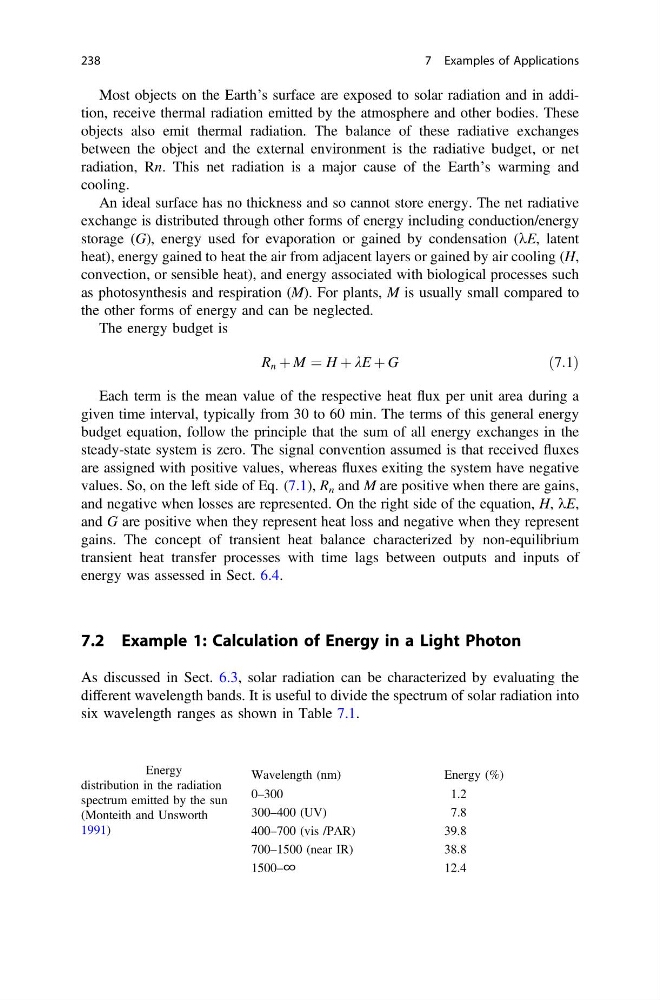
As discussed in Sect. 6.3, solar radiation can be characterized by evaluating the
different wavelength bands. It is useful to divide the spectrum of solar radiation into
six wavelength ranges as shown in Table 7.1.
Table. 7.1 Energy
distribution in the radiation
spectrum emitted by the sun
(Monteith and Unsworth
1991)
Wavelength (nm)
Energy (%)
0–300
1.2
300–400 (UV)
7.8
400–700 (vis /PAR)
39.8
700–1500 (near IR)
38.8
1500–∞
12.4
238
7 Examples of Applications
objects also emit thermal radiation. The balance of these radiative exchanges
between the object and the external environment is the radiative budget, or net
radiation, Rn. This net radiation is a major cause of the Earth’s warming and
cooling.
An ideal surface has no thickness and so cannot store energy. The net radiative
exchange is distributed through other forms of energy including conduction/energy
storage (G), energy used for evaporation or gained by condensation (kE, latent
heat), energy gained to heat the air from adjacent layers or gained by air cooling (H,
convection, or sensible heat), and energy associated with biological processes such
as photosynthesis and respiration (M). For plants, M is usually small compared to
the other forms of energy and can be neglected.
The energy budget is
R n þ M ¼ H þ kE þ G
ð7:1Þ
Each term is the mean value of the respective heat flux per unit area during a
given time interval, typically from 30 to 60 min. The terms of this general energy
budget equation, follow the principle that the sum of all energy exchanges in the
steady-state system is zero. The signal convention assumed is that received fluxes
are assigned with positive values, whereas fluxes exiting the system have negative
values. So, on the left side of Eq. (7.1), R n and M are positive when there are gains,
and negative when losses are represented. On the right side of the equation, H, kE,
and G are positive when they represent heat loss and negative when they represent
gains. The concept of transient heat balance characterized by non-equilibrium
transient heat transfer processes with time lags between outputs and inputs of
energy was assessed in Sect. 6.4.
7.2 Example 1: Calculation of Energy in a Light Photon
As discussed in Sect. 6.3, solar radiation can be characterized by evaluating the
different wavelength bands. It is useful to divide the spectrum of solar radiation into
six wavelength ranges as shown in Table 7.1.
Table. 7.1 Energy
distribution in the radiation
spectrum emitted by the sun
(Monteith and Unsworth
1991)
Wavelength (nm)
Energy (%)
0–300
1.2
300–400 (UV)
7.8
400–700 (vis /PAR)
39.8
700–1500 (near IR)
38.8
1500–∞
12.4
238
7 Examples of Applications