

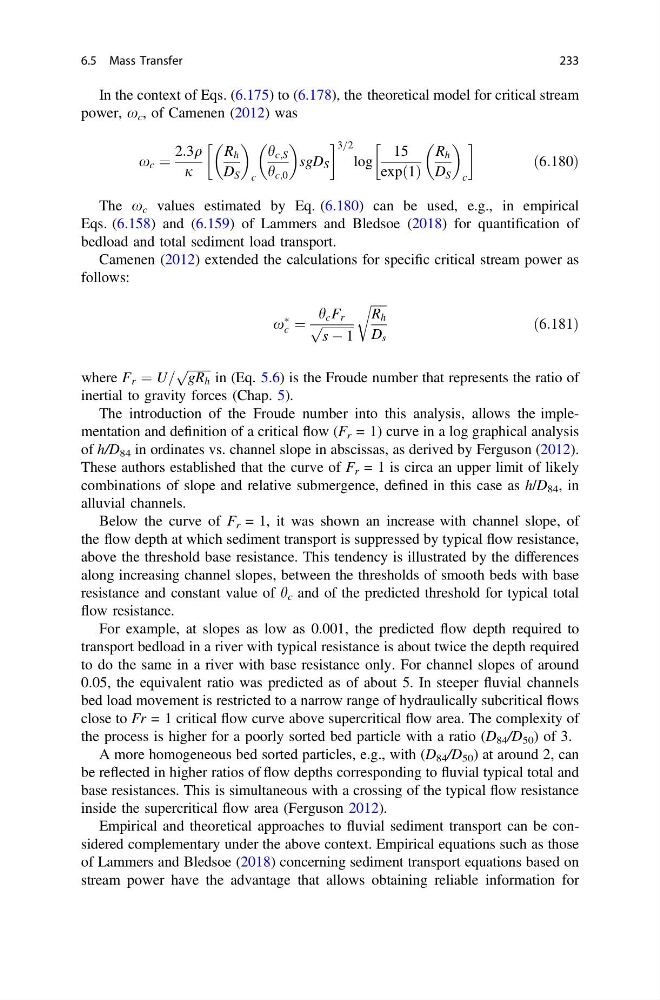
In the context of Eqs. (6.175) to (6.178), the theoretical model for critical stream
power, x c , of Camenen (2012) was
x c ¼
2:3q
j
R h
D S
c
h c;S
h c;0
sgD S
! 3=2
log
15
expð1Þ
R h
D S
c
!
ð6:180Þ
The x c values estimated by Eq. (6.180) can be used, e.g., in empirical
Eqs. (6.158) and (6.159) of Lammers and Bledsoe (2018) for quantification of
bedload and total sediment load transport.
Camenen (2012) extended the calculations for specific critical stream power as
follows:
x
Ã
c ¼
h c F r
ffiffiffiffiffiffiffiffiffiffi ffi
s À 1
p
ffiffiffiffiffi
R h
D s
r
ð6:181Þ
where F r ¼ U=
ffiffiffiffiffiffiffi ffi
gR h
p
in (Eq. 5.6) is the Froude number that represents the ratio of
inertial to gravity forces (Chap. 5).
The introduction of the Froude number into this analysis, allows the implementation and definition of a critical flow (F r = 1) curve in a log graphical analysis
of h/D 84 in ordinates vs. channel slope in abscissas, as derived by Ferguson (2012).
These authors established that the curve of F r = 1 is circa an upper limit of likely
combinations of slope and relative submergence, defined in this case as h/D 84 , in
alluvial channels.
Below the curve of F r = 1, it was shown an increase with channel slope, of
the flow depth at which sediment transport is suppressed by typical flow resistance,
above the threshold base resistance. This tendency is illustrated by the differences
along increasing channel slopes, between the thresholds of smooth beds with base
resistance and constant value of h c and of the predicted threshold for typical total
flow resistance.
For example, at slopes as low as 0.001, the predicted flow depth required to
transport bedload in a river with typical resistance is about twice the depth required
to do the same in a river with base resistance only. For channel slopes of around
0.05, the equivalent ratio was predicted as of about 5. In steeper fluvial channels
bed load movement is restricted to a narrow range of hydraulically subcritical flows
close to Fr = 1 critical flow curve above supercritical flow area. The complexity of
the process is higher for a poorly sorted bed particle with a ratio (D 84 /D 50 ) of 3.
A more homogeneous bed sorted particles, e.g., with (D 84 /D 50 ) at around 2, can
be reflected in higher ratios of flow depths corresponding to fluvial typical total and
base resistances. This is simultaneous with a crossing of the typical flow resistance
inside the supercritical flow area (Ferguson 2012).
Empirical and theoretical approaches to fluvial sediment transport can be considered complementary under the above context. Empirical equations such as those
of Lammers and Bledsoe (2018) concerning sediment transport equations based on
stream power have the advantage that allows obtaining reliable information for
6.5 Mass Transfer
233
power, x c , of Camenen (2012) was
x c ¼
2:3q
j
R h
D S
c
h c;S
h c;0
sgD S
! 3=2
log
15
expð1Þ
R h
D S
c
!
ð6:180Þ
The x c values estimated by Eq. (6.180) can be used, e.g., in empirical
Eqs. (6.158) and (6.159) of Lammers and Bledsoe (2018) for quantification of
bedload and total sediment load transport.
Camenen (2012) extended the calculations for specific critical stream power as
follows:
x
Ã
c ¼
h c F r
ffiffiffiffiffiffiffiffiffiffi ffi
s À 1
p
ffiffiffiffiffi
R h
D s
r
ð6:181Þ
where F r ¼ U=
ffiffiffiffiffiffiffi ffi
gR h
p
in (Eq. 5.6) is the Froude number that represents the ratio of
inertial to gravity forces (Chap. 5).
The introduction of the Froude number into this analysis, allows the implementation and definition of a critical flow (F r = 1) curve in a log graphical analysis
of h/D 84 in ordinates vs. channel slope in abscissas, as derived by Ferguson (2012).
These authors established that the curve of F r = 1 is circa an upper limit of likely
combinations of slope and relative submergence, defined in this case as h/D 84 , in
alluvial channels.
Below the curve of F r = 1, it was shown an increase with channel slope, of
the flow depth at which sediment transport is suppressed by typical flow resistance,
above the threshold base resistance. This tendency is illustrated by the differences
along increasing channel slopes, between the thresholds of smooth beds with base
resistance and constant value of h c and of the predicted threshold for typical total
flow resistance.
For example, at slopes as low as 0.001, the predicted flow depth required to
transport bedload in a river with typical resistance is about twice the depth required
to do the same in a river with base resistance only. For channel slopes of around
0.05, the equivalent ratio was predicted as of about 5. In steeper fluvial channels
bed load movement is restricted to a narrow range of hydraulically subcritical flows
close to Fr = 1 critical flow curve above supercritical flow area. The complexity of
the process is higher for a poorly sorted bed particle with a ratio (D 84 /D 50 ) of 3.
A more homogeneous bed sorted particles, e.g., with (D 84 /D 50 ) at around 2, can
be reflected in higher ratios of flow depths corresponding to fluvial typical total and
base resistances. This is simultaneous with a crossing of the typical flow resistance
inside the supercritical flow area (Ferguson 2012).
Empirical and theoretical approaches to fluvial sediment transport can be considered complementary under the above context. Empirical equations such as those
of Lammers and Bledsoe (2018) concerning sediment transport equations based on
stream power have the advantage that allows obtaining reliable information for
6.5 Mass Transfer
233