

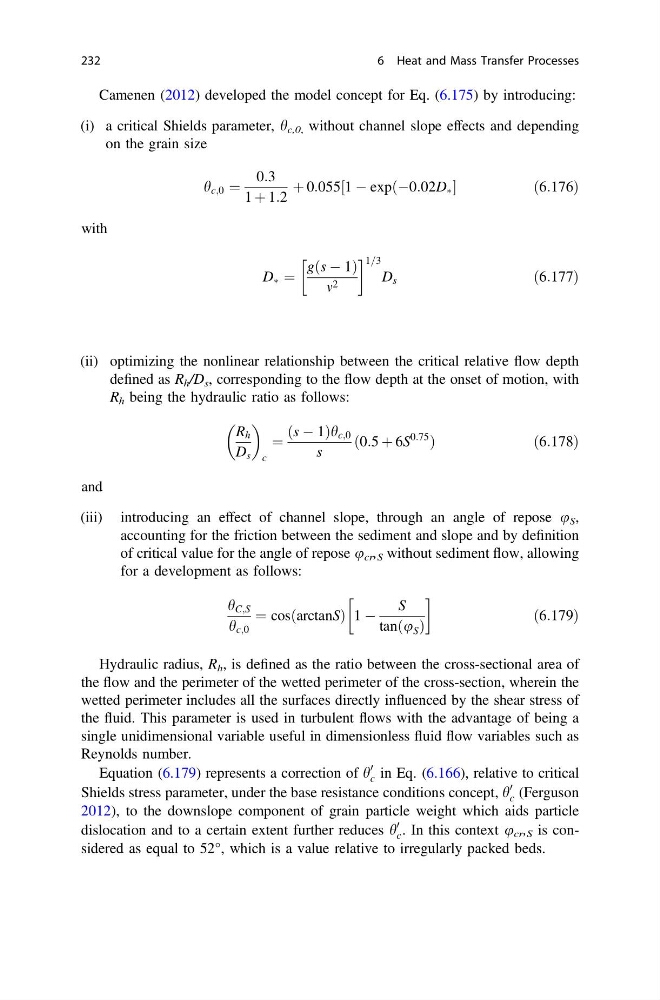
Camenen (2012) developed the model concept for Eq. (6.175) by introducing:
(i) a critical Shields parameter, h c,0, without channel slope effects and depending
on the grain size
h c;0 ¼
0:3
1 þ 1:2
þ 0:055 1 À expðÀ0:02D Ã
½
ð 6:176Þ
with
D Ã ¼
gðs À 1Þ
m 2
! 1=3
D s
ð6:177Þ
(ii) optimizing the nonlinear relationship between the critical relative flow depth
defined as R h /D s , corresponding to the flow depth at the onset of motion, with
R h being the hydraulic ratio as follows:
R h
D s
c
¼
s À 1
ð
Þh c;0
s
ð0:5 þ 6S
0:75
Þ
ð 6:178Þ
and
(iii) introducing an effect of channel slope, through an angle of repose u S ,
accounting for the friction between the sediment and slope and by definition
of critical value for the angle of repose u cr , S without sediment flow, allowing
for a development as follows:
h C;S
h c;0
¼ cosðarctanSÞ 1 À
S
tanðu S Þ
!
ð6:179Þ
Hydraulic radius, R h , is defined as the ratio between the cross-sectional area of
the flow and the perimeter of the wetted perimeter of the cross-section, wherein the
wetted perimeter includes all the surfaces directly influenced by the shear stress of
the fluid. This parameter is used in turbulent flows with the advantage of being a
single unidimensional variable useful in dimensionless fluid flow variables such as
Reynolds number.
Equation (6.179) represents a correction of h
0
c in Eq. (6.166), relative to critical
Shields stress parameter, under the base resistance conditions concept, h
0
c (Ferguson
2012), to the downslope component of grain particle weight which aids particle
dislocation and to a certain extent further reduces h
0
c . In this context u cr , S is considered as equal to 52°, which is a value relative to irregularly packed beds.
232
6 Heat and Mass Transfer Processes
(i) a critical Shields parameter, h c,0, without channel slope effects and depending
on the grain size
h c;0 ¼
0:3
1 þ 1:2
þ 0:055 1 À expðÀ0:02D Ã
½
ð 6:176Þ
with
D Ã ¼
gðs À 1Þ
m 2
! 1=3
D s
ð6:177Þ
(ii) optimizing the nonlinear relationship between the critical relative flow depth
defined as R h /D s , corresponding to the flow depth at the onset of motion, with
R h being the hydraulic ratio as follows:
R h
D s
c
¼
s À 1
ð
Þh c;0
s
ð0:5 þ 6S
0:75
Þ
ð 6:178Þ
and
(iii) introducing an effect of channel slope, through an angle of repose u S ,
accounting for the friction between the sediment and slope and by definition
of critical value for the angle of repose u cr , S without sediment flow, allowing
for a development as follows:
h C;S
h c;0
¼ cosðarctanSÞ 1 À
S
tanðu S Þ
!
ð6:179Þ
Hydraulic radius, R h , is defined as the ratio between the cross-sectional area of
the flow and the perimeter of the wetted perimeter of the cross-section, wherein the
wetted perimeter includes all the surfaces directly influenced by the shear stress of
the fluid. This parameter is used in turbulent flows with the advantage of being a
single unidimensional variable useful in dimensionless fluid flow variables such as
Reynolds number.
Equation (6.179) represents a correction of h
0
c in Eq. (6.166), relative to critical
Shields stress parameter, under the base resistance conditions concept, h
0
c (Ferguson
2012), to the downslope component of grain particle weight which aids particle
dislocation and to a certain extent further reduces h
0
c . In this context u cr , S is considered as equal to 52°, which is a value relative to irregularly packed beds.
232
6 Heat and Mass Transfer Processes