

5.6 Katabatic Winds Under Stability Conditions
Katabatic winds form when cold, dense air accelerates downstream by gravity over
a gentle slope, and are commonly found in the stable boundary layer, up to 10–
15 m high. These winds are caused by an inverse thermal structure formed during
periods of mild winds at meso and synoptic scales. The katabatic winds occur
particularly on calm nights on down slopes under regimes of thermal stability and
radiation cooling (Oke 1992).
Even gentle sloping (0.001 to 0.01) across large areas can cause katabatic winds
of about 1–2 m/s (Stull 1994). These winds occur over most surfaces, with the
general exception of large lakes and oceans.
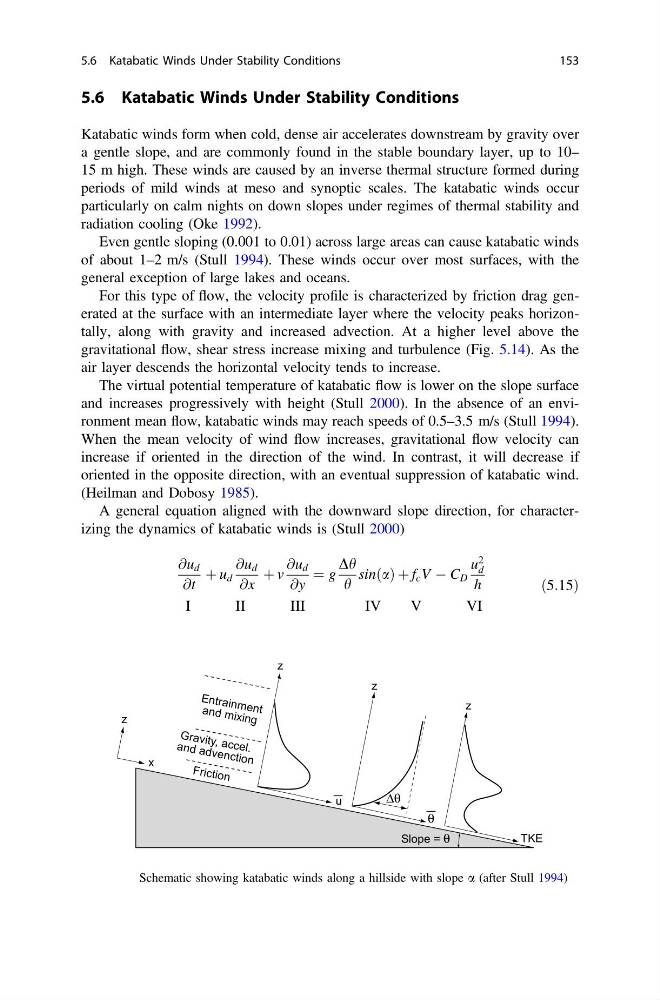
For this type of flow, the velocity profile is characterized by friction drag generated at the surface with an intermediate layer where the velocity peaks horizontally, along with gravity and increased advection. At a higher level above the
gravitational flow, shear stress increase mixing and turbulence (Fig. 5.14). As the
air layer descends the horizontal velocity tends to increase.
The virtual potential temperature of katabatic flow is lower on the slope surface
and increases progressively with height (Stull 2000). In the absence of an environment mean flow, katabatic winds may reach speeds of 0.5–3.5 m/s (Stull 1994).
When the mean velocity of wind flow increases, gravitational flow velocity can
increase if oriented in the direction of the wind. In contrast, it will decrease if
oriented in the opposite direction, with an eventual suppression of katabatic wind.
(Heilman and Dobosy 1985).
A general equation aligned with the downward slope direction, for characterizing the dynamics of katabatic winds is (Stull 2000)
@u d
@t
þ u d
@u d
@x
þ v
@u d
@y
¼ g
Dh
h
sin a
ð Þ þ f c V À C D
u
2
d
h
I
II
III
IV
V
VI
ð5:15Þ
z
z
z
z
TKE
Fr ic tio n
G ra vi ty, ac ce l.
an d ad ve nc tio n
En tra in m en t
an d m ix in g
Slope = θ
x
u
θ
Δθ
Fig. 5.14 Schematic showing katabatic winds along a hillside with slope a (after Stull 1994)
5.6 Katabatic Winds Under Stability Conditions
153
Katabatic winds form when cold, dense air accelerates downstream by gravity over
a gentle slope, and are commonly found in the stable boundary layer, up to 10–
15 m high. These winds are caused by an inverse thermal structure formed during
periods of mild winds at meso and synoptic scales. The katabatic winds occur
particularly on calm nights on down slopes under regimes of thermal stability and
radiation cooling (Oke 1992).
Even gentle sloping (0.001 to 0.01) across large areas can cause katabatic winds
of about 1–2 m/s (Stull 1994). These winds occur over most surfaces, with the
general exception of large lakes and oceans.
For this type of flow, the velocity profile is characterized by friction drag generated at the surface with an intermediate layer where the velocity peaks horizontally, along with gravity and increased advection. At a higher level above the
gravitational flow, shear stress increase mixing and turbulence (Fig. 5.14). As the
air layer descends the horizontal velocity tends to increase.
The virtual potential temperature of katabatic flow is lower on the slope surface
and increases progressively with height (Stull 2000). In the absence of an environment mean flow, katabatic winds may reach speeds of 0.5–3.5 m/s (Stull 1994).
When the mean velocity of wind flow increases, gravitational flow velocity can
increase if oriented in the direction of the wind. In contrast, it will decrease if
oriented in the opposite direction, with an eventual suppression of katabatic wind.
(Heilman and Dobosy 1985).
A general equation aligned with the downward slope direction, for characterizing the dynamics of katabatic winds is (Stull 2000)
@u d
@t
þ u d
@u d
@x
þ v
@u d
@y
¼ g
Dh
h
sin a
ð Þ þ f c V À C D
u
2
d
h
I
II
III
IV
V
VI
ð5:15Þ
z
z
z
z
TKE
Fr ic tio n
G ra vi ty, ac ce l.
an d ad ve nc tio n
En tra in m en t
an d m ix in g
Slope = θ
x
u
θ
Δθ
Fig. 5.14 Schematic showing katabatic winds along a hillside with slope a (after Stull 1994)
5.6 Katabatic Winds Under Stability Conditions
153