

Dz max ffi z o e
2k
2 L 1=2
ð
Þ
b
ð5:14Þ
where b is an empirical factor ranging between 0.5 and 1. The height above the top
of a slight hill, wherein the acceleration peaks is of the order of 2.5–5 m (Taylor
et al. 1987). The acceleration will be greater over natural concave obstacles, perpendicular to the main flow. A convex shape decreases the acceleration due to the
lateral deflection of the circulating air (Rohatgi and Nelson 1994).
In the case of hill arrays and gentle valleys, wind tunnel results indicate that for
the first pair, flow changes are like those for an isolated pair (Arya 1988) and the
acceleration factor reaches a maximum at the top of the first hill. This acceleration is
attenuated downstream due to interactions between successive pairs of valleys and
hills. Thus, the acceleration factor value on the top of successive downstream hills
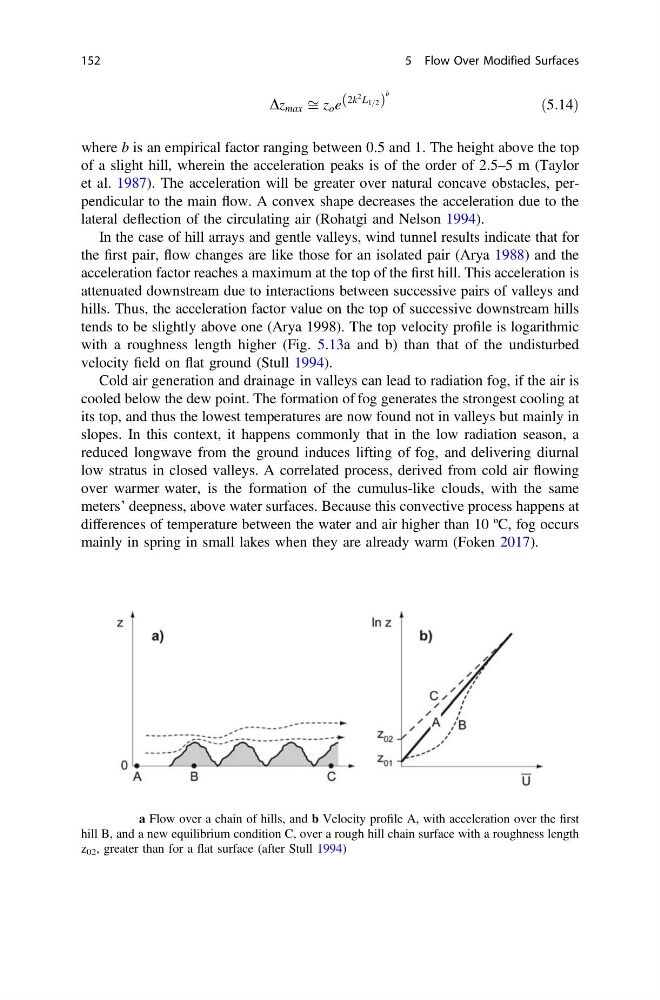
tends to be slightly above one (Arya 1998). The top velocity profile is logarithmic
with a roughness length higher (Fig. 5.13a and b) than that of the undisturbed
velocity field on flat ground (Stull 1994).
Cold air generation and drainage in valleys can lead to radiation fog, if the air is
cooled below the dew point. The formation of fog generates the strongest cooling at
its top, and thus the lowest temperatures are now found not in valleys but mainly in
slopes. In this context, it happens commonly that in the low radiation season, a
reduced longwave from the ground induces lifting of fog, and delivering diurnal
low stratus in closed valleys. A correlated process, derived from cold air flowing
over warmer water, is the formation of the cumulus-like clouds, with the same
meters’ deepness, above water surfaces. Because this convective process happens at
differences of temperature between the water and air higher than 10 ºC, fog occurs
mainly in spring in small lakes when they are already warm (Foken 2017).
Fig. 5.13 a Flow over a chain of hills, and b Velocity profile A, with acceleration over the first
hill B, and a new equilibrium condition C, over a rough hill chain surface with a roughness length
z 02 , greater than for a flat surface (after Stull 1994)
152
5 Flow Over Modified Surfaces
2k
2 L 1=2
ð
Þ
b
ð5:14Þ
where b is an empirical factor ranging between 0.5 and 1. The height above the top
of a slight hill, wherein the acceleration peaks is of the order of 2.5–5 m (Taylor
et al. 1987). The acceleration will be greater over natural concave obstacles, perpendicular to the main flow. A convex shape decreases the acceleration due to the
lateral deflection of the circulating air (Rohatgi and Nelson 1994).
In the case of hill arrays and gentle valleys, wind tunnel results indicate that for
the first pair, flow changes are like those for an isolated pair (Arya 1988) and the
acceleration factor reaches a maximum at the top of the first hill. This acceleration is
attenuated downstream due to interactions between successive pairs of valleys and
hills. Thus, the acceleration factor value on the top of successive downstream hills
tends to be slightly above one (Arya 1998). The top velocity profile is logarithmic
with a roughness length higher (Fig. 5.13a and b) than that of the undisturbed
velocity field on flat ground (Stull 1994).
Cold air generation and drainage in valleys can lead to radiation fog, if the air is
cooled below the dew point. The formation of fog generates the strongest cooling at
its top, and thus the lowest temperatures are now found not in valleys but mainly in
slopes. In this context, it happens commonly that in the low radiation season, a
reduced longwave from the ground induces lifting of fog, and delivering diurnal
low stratus in closed valleys. A correlated process, derived from cold air flowing
over warmer water, is the formation of the cumulus-like clouds, with the same
meters’ deepness, above water surfaces. Because this convective process happens at
differences of temperature between the water and air higher than 10 ºC, fog occurs
mainly in spring in small lakes when they are already warm (Foken 2017).
Fig. 5.13 a Flow over a chain of hills, and b Velocity profile A, with acceleration over the first
hill B, and a new equilibrium condition C, over a rough hill chain surface with a roughness length
z 02 , greater than for a flat surface (after Stull 1994)
152
5 Flow Over Modified Surfaces