

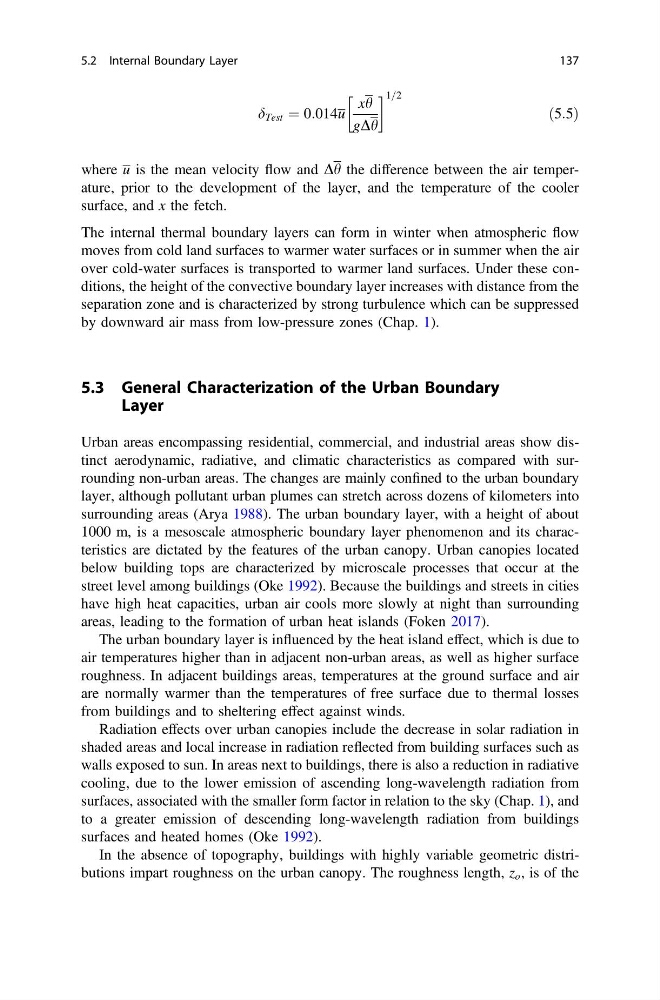
d Test ¼ 0:014u
xh
gDh
1=2
ð5:5Þ
where u is the mean velocity flow and Dh the difference between the air temperature, prior to the development of the layer, and the temperature of the cooler
surface, and x the fetch.
The internal thermal boundary layers can form in winter when atmospheric flow
moves from cold land surfaces to warmer water surfaces or in summer when the air
over cold-water surfaces is transported to warmer land surfaces. Under these conditions, the height of the convective boundary layer increases with distance from the
separation zone and is characterized by strong turbulence which can be suppressed
by downward air mass from low-pressure zones (Chap. 1).
5.3 General Characterization of the Urban Boundary
Layer
Urban areas encompassing residential, commercial, and industrial areas show distinct aerodynamic, radiative, and climatic characteristics as compared with surrounding non-urban areas. The changes are mainly confined to the urban boundary
layer, although pollutant urban plumes can stretch across dozens of kilometers into
surrounding areas (Arya 1988). The urban boundary layer, with a height of about
1000 m, is a mesoscale atmospheric boundary layer phenomenon and its characteristics are dictated by the features of the urban canopy. Urban canopies located
below building tops are characterized by microscale processes that occur at the
street level among buildings (Oke 1992). Because the buildings and streets in cities
have high heat capacities, urban air cools more slowly at night than surrounding
areas, leading to the formation of urban heat islands (Foken 2017).
The urban boundary layer is influenced by the heat island effect, which is due to
air temperatures higher than in adjacent non-urban areas, as well as higher surface
roughness. In adjacent buildings areas, temperatures at the ground surface and air
are normally warmer than the temperatures of free surface due to thermal losses
from buildings and to sheltering effect against winds.
Radiation effects over urban canopies include the decrease in solar radiation in
shaded areas and local increase in radiation reflected from building surfaces such as
walls exposed to sun. In areas next to buildings, there is also a reduction in radiative
cooling, due to the lower emission of ascending long-wavelength radiation from
surfaces, associated with the smaller form factor in relation to the sky (Chap. 1), and
to a greater emission of descending long-wavelength radiation from buildings
surfaces and heated homes (Oke 1992).
In the absence of topography, buildings with highly variable geometric distributions impart roughness on the urban canopy. The roughness length, z o , is of the
5.2 Internal Boundary Layer
137
xh
gDh
1=2
ð5:5Þ
where u is the mean velocity flow and Dh the difference between the air temperature, prior to the development of the layer, and the temperature of the cooler
surface, and x the fetch.
The internal thermal boundary layers can form in winter when atmospheric flow
moves from cold land surfaces to warmer water surfaces or in summer when the air
over cold-water surfaces is transported to warmer land surfaces. Under these conditions, the height of the convective boundary layer increases with distance from the
separation zone and is characterized by strong turbulence which can be suppressed
by downward air mass from low-pressure zones (Chap. 1).
5.3 General Characterization of the Urban Boundary
Layer
Urban areas encompassing residential, commercial, and industrial areas show distinct aerodynamic, radiative, and climatic characteristics as compared with surrounding non-urban areas. The changes are mainly confined to the urban boundary
layer, although pollutant urban plumes can stretch across dozens of kilometers into
surrounding areas (Arya 1988). The urban boundary layer, with a height of about
1000 m, is a mesoscale atmospheric boundary layer phenomenon and its characteristics are dictated by the features of the urban canopy. Urban canopies located
below building tops are characterized by microscale processes that occur at the
street level among buildings (Oke 1992). Because the buildings and streets in cities
have high heat capacities, urban air cools more slowly at night than surrounding
areas, leading to the formation of urban heat islands (Foken 2017).
The urban boundary layer is influenced by the heat island effect, which is due to
air temperatures higher than in adjacent non-urban areas, as well as higher surface
roughness. In adjacent buildings areas, temperatures at the ground surface and air
are normally warmer than the temperatures of free surface due to thermal losses
from buildings and to sheltering effect against winds.
Radiation effects over urban canopies include the decrease in solar radiation in
shaded areas and local increase in radiation reflected from building surfaces such as
walls exposed to sun. In areas next to buildings, there is also a reduction in radiative
cooling, due to the lower emission of ascending long-wavelength radiation from
surfaces, associated with the smaller form factor in relation to the sky (Chap. 1), and
to a greater emission of descending long-wavelength radiation from buildings
surfaces and heated homes (Oke 1992).
In the absence of topography, buildings with highly variable geometric distributions impart roughness on the urban canopy. The roughness length, z o , is of the
5.2 Internal Boundary Layer
137