

4.5 Evaluation of Evapotranspiration and Energy
Coupling Using the “Big-Leaf” Approach
An alternative way to calculate the latent heat is to use the Penman–Monteith
equation . This equation introduces a parameter, r c , describing canopy resistance . It
assumes that the canopy behaves as a thin layer of vegetation, like a big leaf, with
the physiological properties of amphistomatous (with stomata on both sides) leaf,
and the stomatal resistance is like that of the canopy. The stomata and canopy
resistance parameters, r c , have similar roles in the water vapor transfer processes
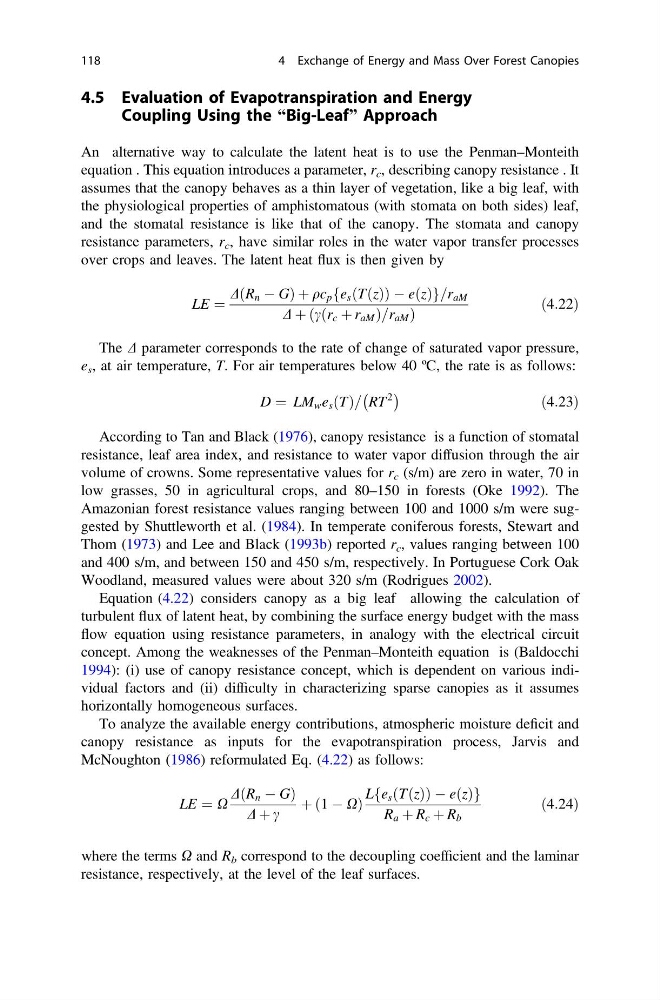
over crops and leaves. The latent heat flux is then given by
LE ¼
D R n À G
ð
Þþqc p e s ðTðzÞÞ À eðzÞ
f
g =r aM
D þ ðcðr c þ r aM Þ=r aM Þ
ð4:22Þ
The D parameter corresponds to the rate of change of saturated vapor pressure,
e s , at air temperature, T. For air temperatures below 40 ºC, the rate is as follows:
D ¼ LM w e s ðTÞ= RT
2
À
Á
ð4:23Þ
According to Tan and Black (1976), canopy resistance is a function of stomatal
resistance, leaf area index, and resistance to water vapor diffusion through the air
volume of crowns. Some representative values for r c (s/m) are zero in water, 70 in
low grasses, 50 in agricultural crops, and 80–150 in forests (Oke 1992). The
Amazonian forest resistance values ranging between 100 and 1000 s/m were suggested by Shuttleworth et al. (1984). In temperate coniferous forests, Stewart and
Thom (1973) and Lee and Black (1993b) reported r c , values ranging between 100
and 400 s/m, and between 150 and 450 s/m, respectively. In Portuguese Cork Oak
Woodland, measured values were about 320 s/m (Rodrigues 2002).
Equation (4.22) considers canopy as a big leaf allowing the calculation of
turbulent flux of latent heat, by combining the surface energy budget with the mass
flow equation using resistance parameters, in analogy with the electrical circuit
concept. Among the weaknesses of the Penman–Monteith equation is (Baldocchi
1994): (i) use of canopy resistance concept, which is dependent on various individual factors and (ii) difficulty in characterizing sparse canopies as it assumes
horizontally homogeneous surfaces.
To analyze the available energy contributions, atmospheric moisture deficit and
canopy resistance as inputs for the evapotranspiration process, Jarvis and
McNoughton (1986) reformulated Eq. (4.22) as follows:
LE ¼ X
D R n À G
ð
Þ
D þ c
þ 1 À X
ð
Þ
L e s ðTðzÞÞ À eðzÞ
f
g
R a þ R c þ R b
ð4:24Þ
where the terms X and R b correspond to the decoupling coefficient and the laminar
resistance, respectively, at the level of the leaf surfaces.
118
4 Exchange of Energy and Mass Over Forest Canopies
Coupling Using the “Big-Leaf” Approach
An alternative way to calculate the latent heat is to use the Penman–Monteith
equation . This equation introduces a parameter, r c , describing canopy resistance . It
assumes that the canopy behaves as a thin layer of vegetation, like a big leaf, with
the physiological properties of amphistomatous (with stomata on both sides) leaf,
and the stomatal resistance is like that of the canopy. The stomata and canopy
resistance parameters, r c , have similar roles in the water vapor transfer processes
over crops and leaves. The latent heat flux is then given by
LE ¼
D R n À G
ð
Þþqc p e s ðTðzÞÞ À eðzÞ
f
g =r aM
D þ ðcðr c þ r aM Þ=r aM Þ
ð4:22Þ
The D parameter corresponds to the rate of change of saturated vapor pressure,
e s , at air temperature, T. For air temperatures below 40 ºC, the rate is as follows:
D ¼ LM w e s ðTÞ= RT
2
À
Á
ð4:23Þ
According to Tan and Black (1976), canopy resistance is a function of stomatal
resistance, leaf area index, and resistance to water vapor diffusion through the air
volume of crowns. Some representative values for r c (s/m) are zero in water, 70 in
low grasses, 50 in agricultural crops, and 80–150 in forests (Oke 1992). The
Amazonian forest resistance values ranging between 100 and 1000 s/m were suggested by Shuttleworth et al. (1984). In temperate coniferous forests, Stewart and
Thom (1973) and Lee and Black (1993b) reported r c , values ranging between 100
and 400 s/m, and between 150 and 450 s/m, respectively. In Portuguese Cork Oak
Woodland, measured values were about 320 s/m (Rodrigues 2002).
Equation (4.22) considers canopy as a big leaf allowing the calculation of
turbulent flux of latent heat, by combining the surface energy budget with the mass
flow equation using resistance parameters, in analogy with the electrical circuit
concept. Among the weaknesses of the Penman–Monteith equation is (Baldocchi
1994): (i) use of canopy resistance concept, which is dependent on various individual factors and (ii) difficulty in characterizing sparse canopies as it assumes
horizontally homogeneous surfaces.
To analyze the available energy contributions, atmospheric moisture deficit and
canopy resistance as inputs for the evapotranspiration process, Jarvis and
McNoughton (1986) reformulated Eq. (4.22) as follows:
LE ¼ X
D R n À G
ð
Þ
D þ c
þ 1 À X
ð
Þ
L e s ðTðzÞÞ À eðzÞ
f
g
R a þ R c þ R b
ð4:24Þ
where the terms X and R b correspond to the decoupling coefficient and the laminar
resistance, respectively, at the level of the leaf surfaces.
118
4 Exchange of Energy and Mass Over Forest Canopies