

where c is the psychometric constant (equal to c p p/Le) and the ratio (@T=@eÞ is
obtained from temperature and vapor pressure data at various levels. The latent heat
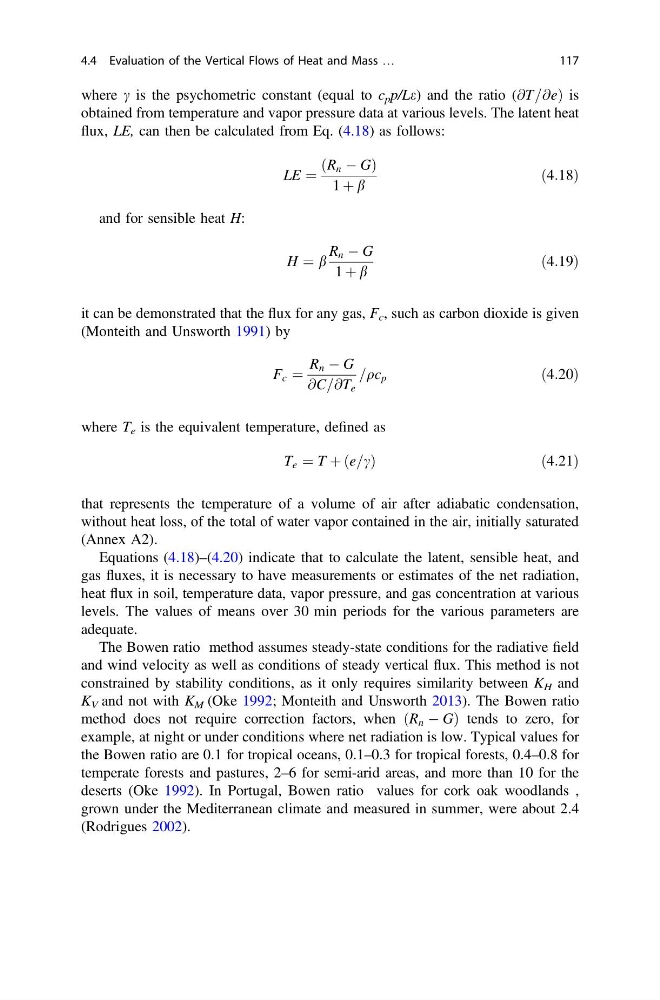
flux, LE, can then be calculated from Eq. (4.18) as follows:
LE ¼
R n À G
ð
Þ
1 þ b
ð4:18Þ
and for sensible heat H:
H ¼ b
R n À G
1 þ b
ð4:19Þ
it can be demonstrated that the flux for any gas, F c , such as carbon dioxide is given
(Monteith and Unsworth 1991) by
F c ¼
R n À G
@C=@T e
=qc p
ð4:20Þ
where T e is the equivalent temperature, defined as
T e ¼ T þ ðe=cÞ
ð 4:21Þ
that represents the temperature of a volume of air after adiabatic condensation,
without heat loss, of the total of water vapor contained in the air, initially saturated
(Annex A2).
Equations (4.18)–(4.20) indicate that to calculate the latent, sensible heat, and
gas fluxes, it is necessary to have measurements or estimates of the net radiation,
heat flux in soil, temperature data, vapor pressure, and gas concentration at various
levels. The values of means over 30 min periods for the various parameters are
adequate.
The Bowen ratio method assumes steady-state conditions for the radiative field
and wind velocity as well as conditions of steady vertical flux. This method is not
constrained by stability conditions, as it only requires similarity between K H and
K V and not with K M (Oke 1992; Monteith and Unsworth 2013). The Bowen ratio
method does not require correction factors, when R n À G
ð
Þ tends to zero, for
example, at night or under conditions where net radiation is low. Typical values for
the Bowen ratio are 0.1 for tropical oceans, 0.1–0.3 for tropical forests, 0.4–0.8 for
temperate forests and pastures, 2–6 for semi-arid areas, and more than 10 for the
deserts (Oke 1992). In Portugal, Bowen ratio values for cork oak woodlands ,
grown under the Mediterranean climate and measured in summer, were about 2.4
(Rodrigues 2002).
4.4 Evaluation of the Vertical Flows of Heat and Mass …
117
obtained from temperature and vapor pressure data at various levels. The latent heat
flux, LE, can then be calculated from Eq. (4.18) as follows:
LE ¼
R n À G
ð
Þ
1 þ b
ð4:18Þ
and for sensible heat H:
H ¼ b
R n À G
1 þ b
ð4:19Þ
it can be demonstrated that the flux for any gas, F c , such as carbon dioxide is given
(Monteith and Unsworth 1991) by
F c ¼
R n À G
@C=@T e
=qc p
ð4:20Þ
where T e is the equivalent temperature, defined as
T e ¼ T þ ðe=cÞ
ð 4:21Þ
that represents the temperature of a volume of air after adiabatic condensation,
without heat loss, of the total of water vapor contained in the air, initially saturated
(Annex A2).
Equations (4.18)–(4.20) indicate that to calculate the latent, sensible heat, and
gas fluxes, it is necessary to have measurements or estimates of the net radiation,
heat flux in soil, temperature data, vapor pressure, and gas concentration at various
levels. The values of means over 30 min periods for the various parameters are
adequate.
The Bowen ratio method assumes steady-state conditions for the radiative field
and wind velocity as well as conditions of steady vertical flux. This method is not
constrained by stability conditions, as it only requires similarity between K H and
K V and not with K M (Oke 1992; Monteith and Unsworth 2013). The Bowen ratio
method does not require correction factors, when R n À G
ð
Þ tends to zero, for
example, at night or under conditions where net radiation is low. Typical values for
the Bowen ratio are 0.1 for tropical oceans, 0.1–0.3 for tropical forests, 0.4–0.8 for
temperate forests and pastures, 2–6 for semi-arid areas, and more than 10 for the
deserts (Oke 1992). In Portugal, Bowen ratio values for cork oak woodlands ,
grown under the Mediterranean climate and measured in summer, were about 2.4
(Rodrigues 2002).
4.4 Evaluation of the Vertical Flows of Heat and Mass …
117