

linked to photosynthesis and evapotranspiration. The impact of this dynamic is very
strong in issues related, e.g., with agroforestry, carbon and nitrogen cycles, or
climate change, justifying the continuous development of efforts in research and
knowledge applications.
Over forest canopies, as opposed to low vegetation, turbulent transport is mainly
caused by instantaneous short-lived high-intensity phenomena (seconds to minutes). These are driven by large eddies, called coherent structures , which are
independent of the mean profiles. Such phenomena have a ramp or saw tooth
configurations and display some regularity over space and time.
These phenomena are designated as ascending or descending interactions,
ejections, and gusts. The predominant downward vertical transport of linear
momentum is mainly carried out by the ejection phenomena (u’ < 0 and w’ > 0)
and gusts (u’ > 0 and w’ < 0). Upward vertical transport is less representative and
mainly due to fast interactions.
Lee and Black’s (1993a) work on temperate coniferous forests indicated that
ejections and gusts accounted for 72% of the phenomena. Moreover, more than
half of the vertical flux momentum occurred during only 9.6% of the total measurement time. In softwood stands , Green et al. (1995) reported that 40% of the
total vertical–horizontal transfer of horizontal momentum took place during less
than 10% of the time measurements. For a softwood stand, Denmead and Bradley
(1985) indicated that the largest part of turbulent transport of heat and mass was due
to descending eddies from a height comparable to that of the trees, with an average
duration of 30 s, transporting cold, dry air that penetrated the canopy at 3 min
Logarithmic
region
Exponential
region
Canopy top
(h)
u
0
0 . 5
1.5
0.5
1.0
0
1.5
2.5
1.0
u / u hc
τ
2.0
Small negative
momentum flux
Secondary
wind
maximum
z/h
c
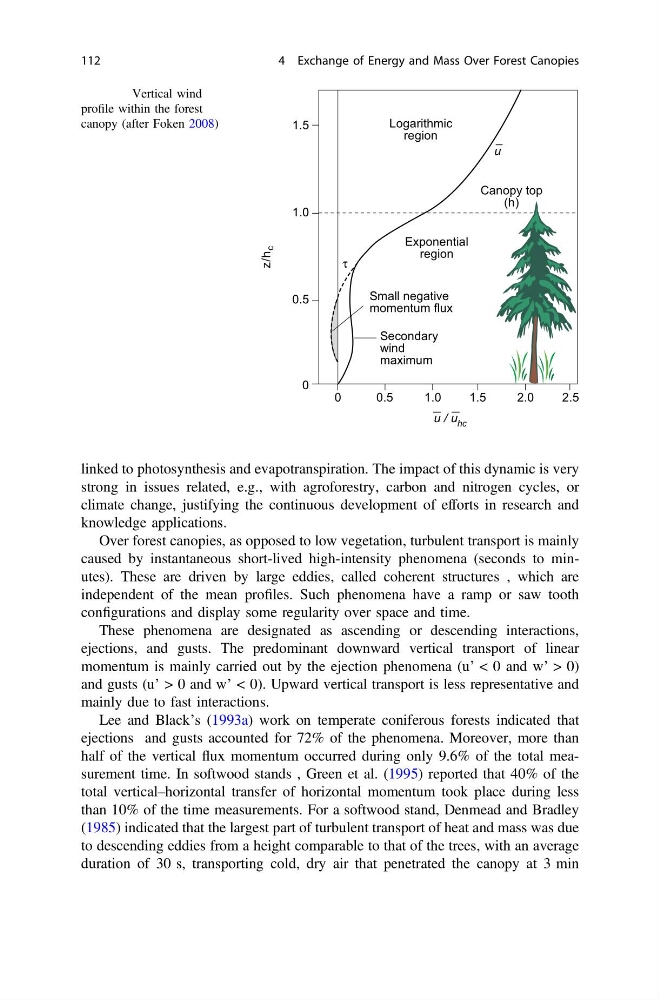
Fig. 4.2 Vertical wind
profile within the forest
canopy (after Foken 2008)
112
4 Exchange of Energy and Mass Over Forest Canopies
strong in issues related, e.g., with agroforestry, carbon and nitrogen cycles, or
climate change, justifying the continuous development of efforts in research and
knowledge applications.
Over forest canopies, as opposed to low vegetation, turbulent transport is mainly
caused by instantaneous short-lived high-intensity phenomena (seconds to minutes). These are driven by large eddies, called coherent structures , which are
independent of the mean profiles. Such phenomena have a ramp or saw tooth
configurations and display some regularity over space and time.
These phenomena are designated as ascending or descending interactions,
ejections, and gusts. The predominant downward vertical transport of linear
momentum is mainly carried out by the ejection phenomena (u’ < 0 and w’ > 0)
and gusts (u’ > 0 and w’ < 0). Upward vertical transport is less representative and
mainly due to fast interactions.
Lee and Black’s (1993a) work on temperate coniferous forests indicated that
ejections and gusts accounted for 72% of the phenomena. Moreover, more than
half of the vertical flux momentum occurred during only 9.6% of the total measurement time. In softwood stands , Green et al. (1995) reported that 40% of the
total vertical–horizontal transfer of horizontal momentum took place during less
than 10% of the time measurements. For a softwood stand, Denmead and Bradley
(1985) indicated that the largest part of turbulent transport of heat and mass was due
to descending eddies from a height comparable to that of the trees, with an average
duration of 30 s, transporting cold, dry air that penetrated the canopy at 3 min
Logarithmic
region
Exponential
region
Canopy top
(h)
u
0
0 . 5
1.5
0.5
1.0
0
1.5
2.5
1.0
u / u hc
τ
2.0
Small negative
momentum flux
Secondary
wind
maximum
z/h
c
Fig. 4.2 Vertical wind
profile within the forest
canopy (after Foken 2008)
112
4 Exchange of Energy and Mass Over Forest Canopies