

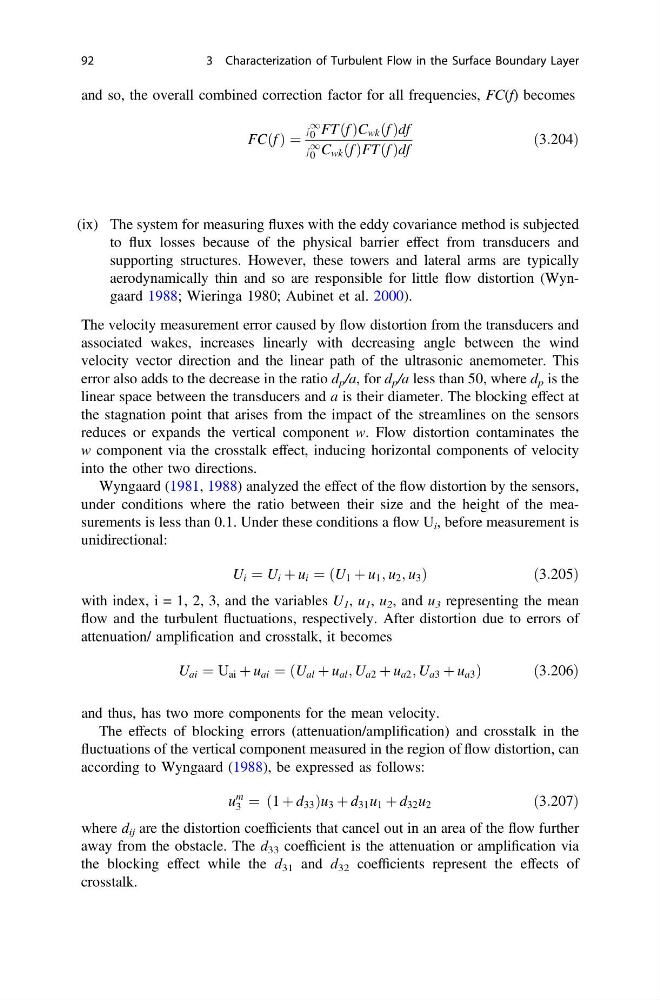
and so, the overall combined correction factor for all frequencies, FC(f) becomes
FCðf Þ ¼
R 1
0 FTðf ÞC wk ðf Þdf
R 1
0 C wk ðf ÞFTðf Þdf
ð3:204Þ
(ix) The system for measuring fluxes with the eddy covariance method is subjected
to flux losses because of the physical barrier effect from transducers and
supporting structures. However, these towers and lateral arms are typically
aerodynamically thin and so are responsible for little flow distortion (Wyngaard 1988; Wieringa 1980; Aubinet et al. 2000).
The velocity measurement error caused by flow distortion from the transducers and
associated wakes, increases linearly with decreasing angle between the wind
velocity vector direction and the linear path of the ultrasonic anemometer. This
error also adds to the decrease in the ratio d p /a, for d p /a less than 50, where d p is the
linear space between the transducers and a is their diameter. The blocking effect at
the stagnation point that arises from the impact of the streamlines on the sensors
reduces or expands the vertical component w. Flow distortion contaminates the
w component via the crosstalk effect, inducing horizontal components of velocity
into the other two directions.
Wyngaard (1981, 1988) analyzed the effect of the flow distortion by the sensors,
under conditions where the ratio between their size and the height of the measurements is less than 0.1. Under these conditions a flow U i , before measurement is
unidirectional:
U i ¼ U i þ u i ¼ U 1 þ u 1 ; u 2 ; u 3
ð
Þ
ð 3:205Þ
with index, i = 1, 2, 3, and the variables U 1 , u 1 , u 2 , and u 3 representing the mean
flow and the turbulent fluctuations, respectively. After distortion due to errors of
attenuation/ amplification and crosstalk, it becomes
U ai ¼ U ai þ u ai ¼ U al þ u al ; U a2 þ u a2 ; U a3 þ u a3
ð
Þ
ð 3:206Þ
and thus, has two more components for the mean velocity.
The effects of blocking errors (attenuation/amplification) and crosstalk in the
fluctuations of the vertical component measured in the region of flow distortion, can
according to Wyngaard (1988), be expressed as follows:
u
m
3 ¼ ð1 þ d 33 Þu 3 þ d 31 u 1 þ d 32 u 2
ð3:207Þ
where d ij are the distortion coefficients that cancel out in an area of the flow further
away from the obstacle. The d 33 coefficient is the attenuation or amplification via
the blocking effect while the d 31 and d 32 coefficients represent the effects of
crosstalk.
92
3 Characterization of Turbulent Flow in the Surface Boundary Layer
FCðf Þ ¼
R 1
0 FTðf ÞC wk ðf Þdf
R 1
0 C wk ðf ÞFTðf Þdf
ð3:204Þ
(ix) The system for measuring fluxes with the eddy covariance method is subjected
to flux losses because of the physical barrier effect from transducers and
supporting structures. However, these towers and lateral arms are typically
aerodynamically thin and so are responsible for little flow distortion (Wyngaard 1988; Wieringa 1980; Aubinet et al. 2000).
The velocity measurement error caused by flow distortion from the transducers and
associated wakes, increases linearly with decreasing angle between the wind
velocity vector direction and the linear path of the ultrasonic anemometer. This
error also adds to the decrease in the ratio d p /a, for d p /a less than 50, where d p is the
linear space between the transducers and a is their diameter. The blocking effect at
the stagnation point that arises from the impact of the streamlines on the sensors
reduces or expands the vertical component w. Flow distortion contaminates the
w component via the crosstalk effect, inducing horizontal components of velocity
into the other two directions.
Wyngaard (1981, 1988) analyzed the effect of the flow distortion by the sensors,
under conditions where the ratio between their size and the height of the measurements is less than 0.1. Under these conditions a flow U i , before measurement is
unidirectional:
U i ¼ U i þ u i ¼ U 1 þ u 1 ; u 2 ; u 3
ð
Þ
ð 3:205Þ
with index, i = 1, 2, 3, and the variables U 1 , u 1 , u 2 , and u 3 representing the mean
flow and the turbulent fluctuations, respectively. After distortion due to errors of
attenuation/ amplification and crosstalk, it becomes
U ai ¼ U ai þ u ai ¼ U al þ u al ; U a2 þ u a2 ; U a3 þ u a3
ð
Þ
ð 3:206Þ
and thus, has two more components for the mean velocity.
The effects of blocking errors (attenuation/amplification) and crosstalk in the
fluctuations of the vertical component measured in the region of flow distortion, can
according to Wyngaard (1988), be expressed as follows:
u
m
3 ¼ ð1 þ d 33 Þu 3 þ d 31 u 1 þ d 32 u 2
ð3:207Þ
where d ij are the distortion coefficients that cancel out in an area of the flow further
away from the obstacle. The d 33 coefficient is the attenuation or amplification via
the blocking effect while the d 31 and d 32 coefficients represent the effects of
crosstalk.
92
3 Characterization of Turbulent Flow in the Surface Boundary Layer