

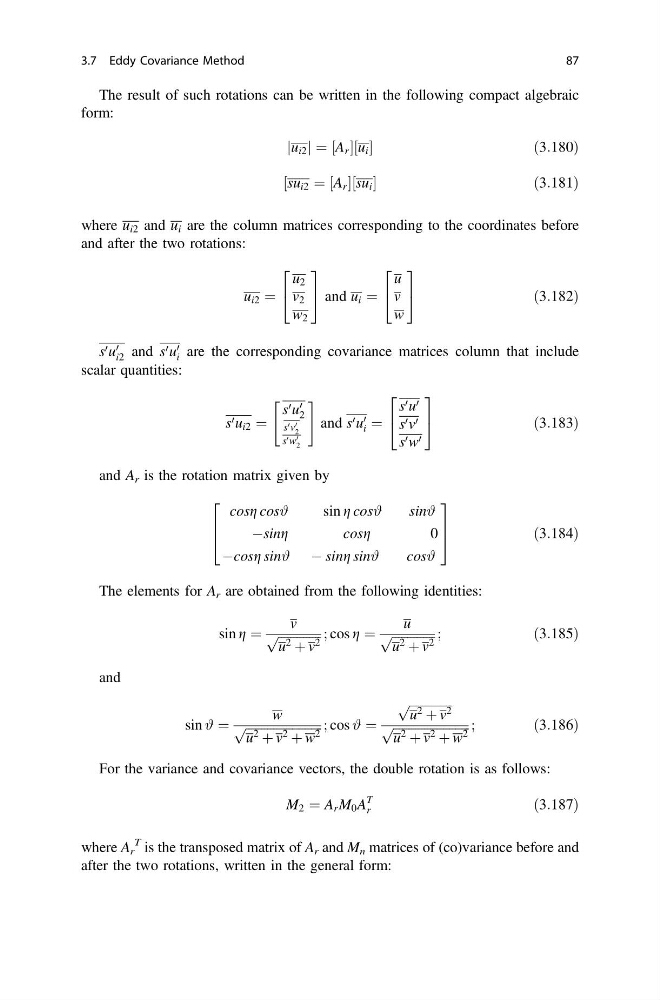
The result of such rotations can be written in the following compact algebraic
form:
u i2
j j ¼ A r
½ u i
½
ð3:180Þ
su i2
½
¼ A r
½ su i
½
ð3:181Þ
where u i2 and u i are the column matrices corresponding to the coordinates before
and after the two rotations:
u i2 ¼
u 2
v 2
w 2
2
4
3
5 and u i ¼
u
v
w
2
4
3
5
ð3:182Þ
s 0 u 0
i2 and s 0 u 0
i are the corresponding covariance matrices column that include
scalar quantities:
s 0 u i2 ¼
s 0 u 0
2
s 0 v 0
2
s 0 w 0
2
"
#
and s 0 u 0
i ¼
s 0 u 0
s 0 v 0
s 0 w 0
2
4
3
5
ð3:183Þ
and A r is the rotation matrix given by
cosg cos#
sin g cos#
sin#
Àsing
cosg
0
Àcosg sin# À sing sin#
cos#
2
6
4
3
7
5
ð3:184Þ
The elements for A r are obtained from the following identities:
sin g ¼
v
ffiffiffiffiffiffiffiffiffiffiffiffiffiffi
u
2
þ v
2
p
; cos g ¼
u
ffiffiffiffiffiffiffiffiffiffiffiffiffiffi
u
2
þ v
2
p
;
ð3:185Þ
and
sin # ¼
w
ffiffiffiffiffiffiffiffiffiffiffiffiffiffiffiffiffiffiffiffiffiffiffiffi ffi
u
2
þ v
2
þ w
2
p
; cos # ¼
ffiffiffiffiffiffiffiffiffiffiffiffiffiffi
u
2
þ v
2
p
ffiffiffiffiffiffiffiffiffiffiffiffiffiffiffiffiffiffiffiffiffiffiffiffi ffi
u
2
þ v
2
þ w
2
p
;
ð3:186Þ
For the variance and covariance vectors, the double rotation is as follows:
M 2 ¼ A r M 0 A
T
r
ð3:187Þ
where A r
T is the transposed matrix of A r and M n matrices of (co)variance before and
after the two rotations, written in the general form:
3.7 Eddy Covariance Method
87
form:
u i2
j j ¼ A r
½ u i
½
ð3:180Þ
su i2
½
¼ A r
½ su i
½
ð3:181Þ
where u i2 and u i are the column matrices corresponding to the coordinates before
and after the two rotations:
u i2 ¼
u 2
v 2
w 2
2
4
3
5 and u i ¼
u
v
w
2
4
3
5
ð3:182Þ
s 0 u 0
i2 and s 0 u 0
i are the corresponding covariance matrices column that include
scalar quantities:
s 0 u i2 ¼
s 0 u 0
2
s 0 v 0
2
s 0 w 0
2
"
#
and s 0 u 0
i ¼
s 0 u 0
s 0 v 0
s 0 w 0
2
4
3
5
ð3:183Þ
and A r is the rotation matrix given by
cosg cos#
sin g cos#
sin#
Àsing
cosg
0
Àcosg sin# À sing sin#
cos#
2
6
4
3
7
5
ð3:184Þ
The elements for A r are obtained from the following identities:
sin g ¼
v
ffiffiffiffiffiffiffiffiffiffiffiffiffiffi
u
2
þ v
2
p
; cos g ¼
u
ffiffiffiffiffiffiffiffiffiffiffiffiffiffi
u
2
þ v
2
p
;
ð3:185Þ
and
sin # ¼
w
ffiffiffiffiffiffiffiffiffiffiffiffiffiffiffiffiffiffiffiffiffiffiffiffi ffi
u
2
þ v
2
þ w
2
p
; cos # ¼
ffiffiffiffiffiffiffiffiffiffiffiffiffiffi
u
2
þ v
2
p
ffiffiffiffiffiffiffiffiffiffiffiffiffiffiffiffiffiffiffiffiffiffiffiffi ffi
u
2
þ v
2
þ w
2
p
;
ð3:186Þ
For the variance and covariance vectors, the double rotation is as follows:
M 2 ¼ A r M 0 A
T
r
ð3:187Þ
where A r
T is the transposed matrix of A r and M n matrices of (co)variance before and
after the two rotations, written in the general form:
3.7 Eddy Covariance Method
87