

69
supported the effort and used this shared dataset,
such as local hospitals, law enforcement agencies, educational institutions, and more. Indeed,
the CAP steering committee is large, reflecting
almost all community initiatives and
partnerships.
6.3
Community Conditions
Necessary for Applying
the UN’s SDGs
6.3.1 Condition 1: Commitment
to Wellbeing for All
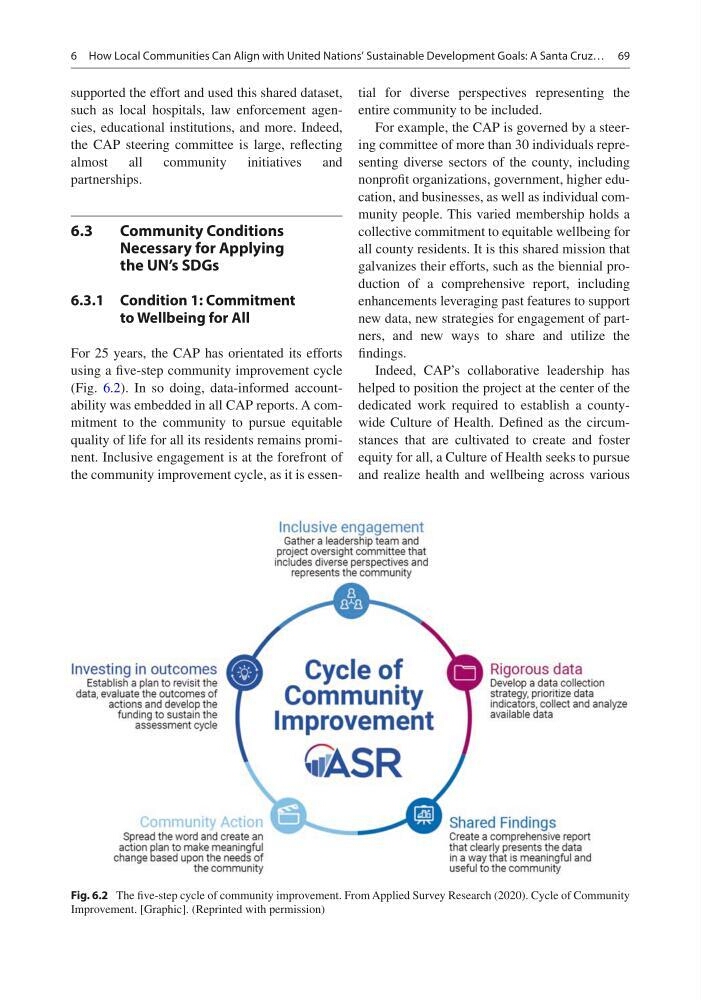
For 25 years, the CAP has orientated its efforts
using a five-step community improvement cycle
(Fig. 6.2). In so doing, data-informed accountability was embedded in all CAP reports. A commitment to the community to pursue equitable
quality of life for all its residents remains prominent. Inclusive engagement is at the forefront of
the community improvement cycle, as it is essential for diverse perspectives representing the
entire community to be included.
For example, the CAP is governed by a steering committee of more than 30 individuals representing diverse sectors of the county, including
nonprofit organizations, government, higher education, and businesses, as well as individual community people. This varied membership holds a
collective commitment to equitable wellbeing for
all county residents. It is this shared mission that
galvanizes their efforts, such as the biennial production of a comprehensive report, including
enhancements leveraging past features to support
new data, new strategies for engagement of partners, and new ways to share and utilize the
findings.
Indeed, CAP’s collaborative leadership has
helped to position the project at the center of the
dedicated work required to establish a countywide Culture of Health. Defined as the circumstances that are cultivated to create and foster
equity for all, a Culture of Health seeks to pursue
and realize health and wellbeing across various
Fig. 6.2 The five-step cycle of community improvement. From Applied Survey Research (2020). Cycle of Community
Improvement. [Graphic]. (Reprinted with permission)
6 How Local Communities Can Align with United Nations’ Sustainable Development Goals: A Santa Cruz…
supported the effort and used this shared dataset,
such as local hospitals, law enforcement agencies, educational institutions, and more. Indeed,
the CAP steering committee is large, reflecting
almost all community initiatives and
partnerships.
6.3
Community Conditions
Necessary for Applying
the UN’s SDGs
6.3.1 Condition 1: Commitment
to Wellbeing for All
For 25 years, the CAP has orientated its efforts
using a five-step community improvement cycle
(Fig. 6.2). In so doing, data-informed accountability was embedded in all CAP reports. A commitment to the community to pursue equitable
quality of life for all its residents remains prominent. Inclusive engagement is at the forefront of
the community improvement cycle, as it is essential for diverse perspectives representing the
entire community to be included.
For example, the CAP is governed by a steering committee of more than 30 individuals representing diverse sectors of the county, including
nonprofit organizations, government, higher education, and businesses, as well as individual community people. This varied membership holds a
collective commitment to equitable wellbeing for
all county residents. It is this shared mission that
galvanizes their efforts, such as the biennial production of a comprehensive report, including
enhancements leveraging past features to support
new data, new strategies for engagement of partners, and new ways to share and utilize the
findings.
Indeed, CAP’s collaborative leadership has
helped to position the project at the center of the
dedicated work required to establish a countywide Culture of Health. Defined as the circumstances that are cultivated to create and foster
equity for all, a Culture of Health seeks to pursue
and realize health and wellbeing across various
Fig. 6.2 The five-step cycle of community improvement. From Applied Survey Research (2020). Cycle of Community
Improvement. [Graphic]. (Reprinted with permission)
6 How Local Communities Can Align with United Nations’ Sustainable Development Goals: A Santa Cruz…