

76
R. Bruggemann et al.
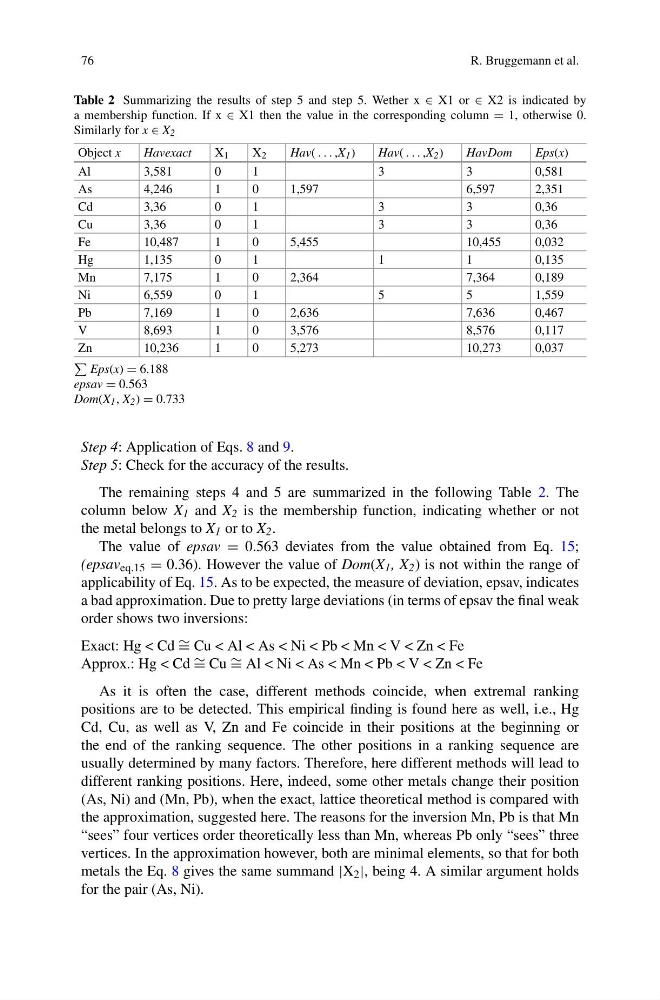
Table 2 Summarizing the results of step 5 and step 5. Wether x ∈ X1 or ∈ X2 is indicated by
a membership function. If x ∈ X1 then the value in the corresponding column = 1, otherwise 0.
Similarly for x ∈ X 2
Object x
Havexact
X 1
X 2
Hav( . . . ,X 1 )
Hav( . . . ,X 2 )
HavDom
Eps(x)
Al
3,581
0
1
3
3
0,581
As
4,246
1
0
1,597
6,597
2,351
Cd
3,36
0
1
3
3
0,36
Cu
3,36
0
1
3
3
0,36
Fe
10,487
1
0
5,455
10,455
0,032
Hg
1,135
0
1
1
1
0,135
Mn
7,175
1
0
2,364
7,364
0,189
Ni
6,559
0
1
5
5
1,559
Pb
7,169
1
0
2,636
7,636
0,467
V
8,693
1
0
3,576
8,576
0,117
Zn
10,236
1
0
5,273
10,273
0,037
Eps(x) = 6.188
epsav = 0.563
Dom(X 1 , X 2 ) = 0.733
Step 4: Application of Eqs. 8 and 9.
Step 5: Check for the accuracy of the results.
The remaining steps 4 and 5 are summarized in the following Table 2. The
column below X 1 and X 2 is the membership function, indicating whether or not
the metal belongs to X 1 or to X 2 .
The value of epsav = 0.563 deviates from the value obtained from Eq. 15;
(epsav eq.15 = 0.36). However the value of Dom(X 1 , X 2 ) is not within the range of
applicability of Eq. 15. As to be expected, the measure of deviation, epsav, indicates
a bad approximation. Due to pretty large deviations (in terms of epsav the final weak
order shows two inversions:
Exact: Hg < Cd ∼ = Cu < Al < As < Ni < Pb < Mn < V < Zn < Fe
Approx.: Hg < Cd ∼ = Cu ∼ = Al < Ni < As < Mn < Pb < V < Zn < Fe
As it is often the case, different methods coincide, when extremal ranking
positions are to be detected. This empirical finding is found here as well, i.e., Hg
Cd, Cu, as well as V, Zn and Fe coincide in their positions at the beginning or
the end of the ranking sequence. The other positions in a ranking sequence are
usually determined by many factors. Therefore, here different methods will lead to
different ranking positions. Here, indeed, some other metals change their position
(As, Ni) and (Mn, Pb), when the exact, lattice theoretical method is compared with
the approximation, suggested here. The reasons for the inversion Mn, Pb is that Mn
“sees” four vertices order theoretically less than Mn, whereas Pb only “sees” three
vertices. In the approximation however, both are minimal elements, so that for both
metals the Eq. 8 gives the same summand |X 2 |, being 4. A similar argument holds
for the pair (As, Ni).
R. Bruggemann et al.
Table 2 Summarizing the results of step 5 and step 5. Wether x ∈ X1 or ∈ X2 is indicated by
a membership function. If x ∈ X1 then the value in the corresponding column = 1, otherwise 0.
Similarly for x ∈ X 2
Object x
Havexact
X 1
X 2
Hav( . . . ,X 1 )
Hav( . . . ,X 2 )
HavDom
Eps(x)
Al
3,581
0
1
3
3
0,581
As
4,246
1
0
1,597
6,597
2,351
Cd
3,36
0
1
3
3
0,36
Cu
3,36
0
1
3
3
0,36
Fe
10,487
1
0
5,455
10,455
0,032
Hg
1,135
0
1
1
1
0,135
Mn
7,175
1
0
2,364
7,364
0,189
Ni
6,559
0
1
5
5
1,559
Pb
7,169
1
0
2,636
7,636
0,467
V
8,693
1
0
3,576
8,576
0,117
Zn
10,236
1
0
5,273
10,273
0,037
Eps(x) = 6.188
epsav = 0.563
Dom(X 1 , X 2 ) = 0.733
Step 4: Application of Eqs. 8 and 9.
Step 5: Check for the accuracy of the results.
The remaining steps 4 and 5 are summarized in the following Table 2. The
column below X 1 and X 2 is the membership function, indicating whether or not
the metal belongs to X 1 or to X 2 .
The value of epsav = 0.563 deviates from the value obtained from Eq. 15;
(epsav eq.15 = 0.36). However the value of Dom(X 1 , X 2 ) is not within the range of
applicability of Eq. 15. As to be expected, the measure of deviation, epsav, indicates
a bad approximation. Due to pretty large deviations (in terms of epsav the final weak
order shows two inversions:
Exact: Hg < Cd ∼ = Cu < Al < As < Ni < Pb < Mn < V < Zn < Fe
Approx.: Hg < Cd ∼ = Cu ∼ = Al < Ni < As < Mn < Pb < V < Zn < Fe
As it is often the case, different methods coincide, when extremal ranking
positions are to be detected. This empirical finding is found here as well, i.e., Hg
Cd, Cu, as well as V, Zn and Fe coincide in their positions at the beginning or
the end of the ranking sequence. The other positions in a ranking sequence are
usually determined by many factors. Therefore, here different methods will lead to
different ranking positions. Here, indeed, some other metals change their position
(As, Ni) and (Mn, Pb), when the exact, lattice theoretical method is compared with
the approximation, suggested here. The reasons for the inversion Mn, Pb is that Mn
“sees” four vertices order theoretically less than Mn, whereas Pb only “sees” three
vertices. In the approximation however, both are minimal elements, so that for both
metals the Eq. 8 gives the same summand |X 2 |, being 4. A similar argument holds
for the pair (As, Ni).