

46
R. Bruggemann and L. Carlsen
is its simplicity, i.e., its high potential for transparency if results are to be discussed
in, e.g., public meetings. This paper acknowlegdes that modeling or stakeholders’
knowledge by weights is a useful step in decision making, however – due to the often
vague nature of knowledge about weights – the uncertainty of finding weights must
be integrated in the analyses. This idea is already explained in several publications
(Bruggemann et al. 2008b, 2012, 2013, Bruggemann and Carlsen 2017, 2018).
The number of incomparabilities, U (see below), depending on the measure of
uncertainty degree, with respect to the numerical value of the weights plays a central
role in this connection. The measure of uncertainty is called s and will be explained
in detail below. Between U and s a very simple linear relation U(s) can be derived
(cf. Bruggemann et al. 2008b).
In this paper the origin of slight deviations from the predicted results of U(s)
is further investigated. To understand these deviations the most simple indicator
system is studied, namely consisting of two indicators only. The paper is organized
as follows. (1) where basic assumptions and equations are introduced, (2) discussing
the concept of “crucial weights”, (3) describing examples, initially some fictitious
examples, followed by an example taken from the field of sociology, and (4)
concluding with a critical discussion.
2 Materials and Method
2.1 Basic Concepts of Partial Order
Let X be a set of objects, labeled by x(i) (i = 1, . . . ,n). Objects could be but not
limited to
• chemical compounds
• nations, characterized by for example child well-being indicators
• strategies, characterized by performance indicators
• geographical units, characterized for example by pollution, or (as in another
contribution for this book described), by poverty indicators
To define an order relation among them, the relation “≤” has to obey the
following order axioms:
• reflexivity: the object can be compared with itself
• antisymmetry: if x ≤ y and y ≤ x ⇒ x = y
• transitivity: if x ≤ y and y ≤ z ⇒ x ≤ z
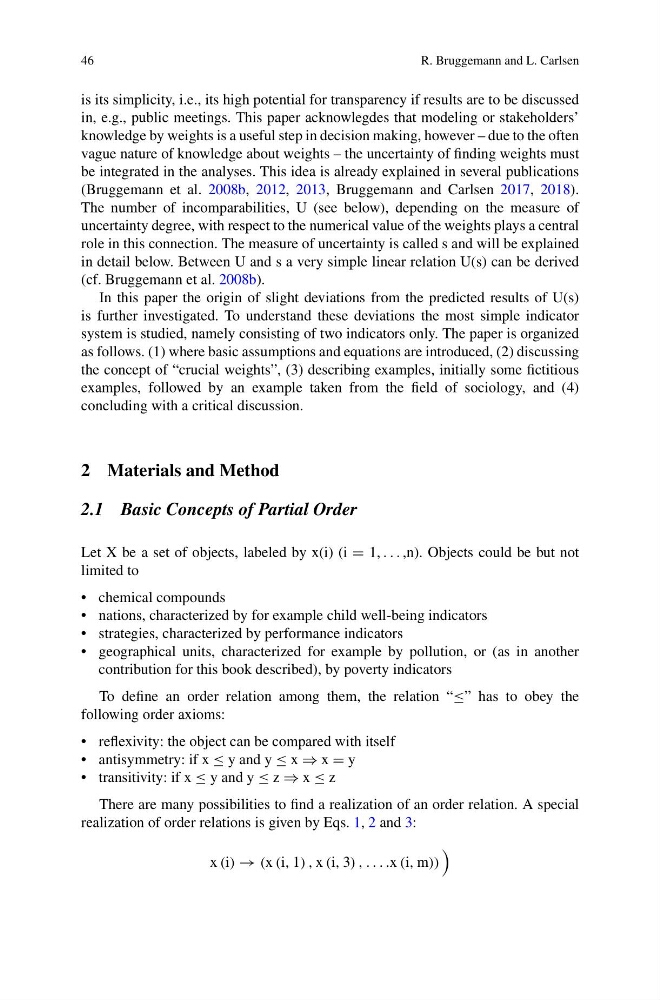
There are many possibilities to find a realization of an order relation. A special
realization of order relations is given by Eqs. 1, 2 and 3:
x (i) → (x (i, 1) , x (i, 3) , . . . .x (i, m))
R. Bruggemann and L. Carlsen
is its simplicity, i.e., its high potential for transparency if results are to be discussed
in, e.g., public meetings. This paper acknowlegdes that modeling or stakeholders’
knowledge by weights is a useful step in decision making, however – due to the often
vague nature of knowledge about weights – the uncertainty of finding weights must
be integrated in the analyses. This idea is already explained in several publications
(Bruggemann et al. 2008b, 2012, 2013, Bruggemann and Carlsen 2017, 2018).
The number of incomparabilities, U (see below), depending on the measure of
uncertainty degree, with respect to the numerical value of the weights plays a central
role in this connection. The measure of uncertainty is called s and will be explained
in detail below. Between U and s a very simple linear relation U(s) can be derived
(cf. Bruggemann et al. 2008b).
In this paper the origin of slight deviations from the predicted results of U(s)
is further investigated. To understand these deviations the most simple indicator
system is studied, namely consisting of two indicators only. The paper is organized
as follows. (1) where basic assumptions and equations are introduced, (2) discussing
the concept of “crucial weights”, (3) describing examples, initially some fictitious
examples, followed by an example taken from the field of sociology, and (4)
concluding with a critical discussion.
2 Materials and Method
2.1 Basic Concepts of Partial Order
Let X be a set of objects, labeled by x(i) (i = 1, . . . ,n). Objects could be but not
limited to
• chemical compounds
• nations, characterized by for example child well-being indicators
• strategies, characterized by performance indicators
• geographical units, characterized for example by pollution, or (as in another
contribution for this book described), by poverty indicators
To define an order relation among them, the relation “≤” has to obey the
following order axioms:
• reflexivity: the object can be compared with itself
• antisymmetry: if x ≤ y and y ≤ x ⇒ x = y
• transitivity: if x ≤ y and y ≤ z ⇒ x ≤ z
There are many possibilities to find a realization of an order relation. A special
realization of order relations is given by Eqs. 1, 2 and 3:
x (i) → (x (i, 1) , x (i, 3) , . . . .x (i, m))