

Deep Ranking Analysis by Power Eigenvectors (DRAPE): A Study. . .
277
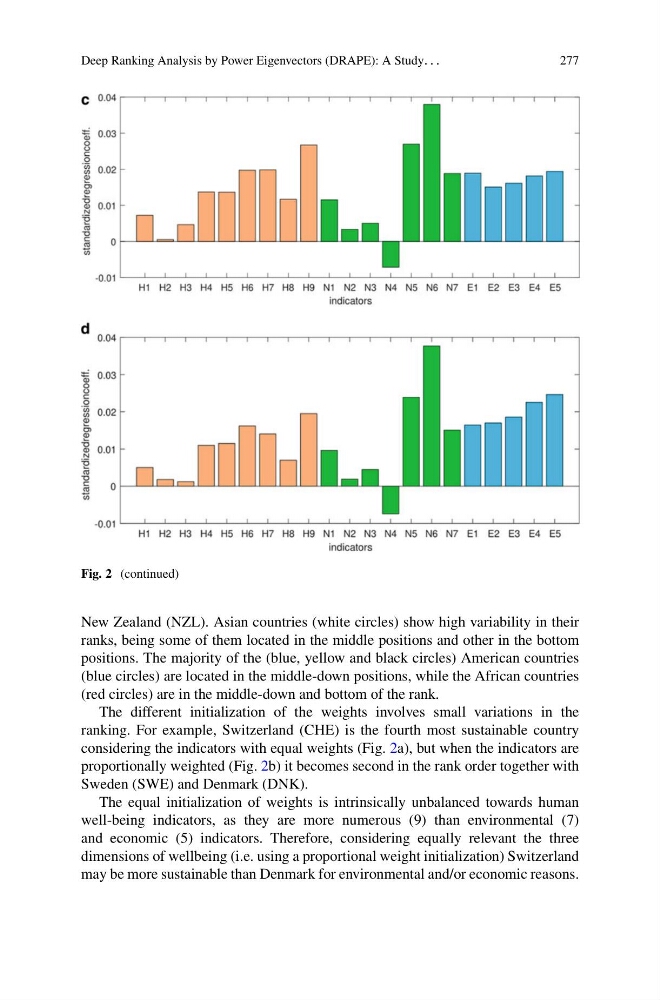
Fig. 2 (continued)
New Zealand (NZL). Asian countries (white circles) show high variability in their
ranks, being some of them located in the middle positions and other in the bottom
positions. The majority of the (blue, yellow and black circles) American countries
(blue circles) are located in the middle-down positions, while the African countries
(red circles) are in the middle-down and bottom of the rank.
The different initialization of the weights involves small variations in the
ranking. For example, Switzerland (CHE) is the fourth most sustainable country
considering the indicators with equal weights (Fig. 2a), but when the indicators are
proportionally weighted (Fig. 2b) it becomes second in the rank order together with
Sweden (SWE) and Denmark (DNK).
The equal initialization of weights is intrinsically unbalanced towards human
well-being indicators, as they are more numerous (9) than environmental (7)
and economic (5) indicators. Therefore, considering equally relevant the three
dimensions of wellbeing (i.e. using a proportional weight initialization) Switzerland
may be more sustainable than Denmark for environmental and/or economic reasons.
277
Fig. 2 (continued)
New Zealand (NZL). Asian countries (white circles) show high variability in their
ranks, being some of them located in the middle positions and other in the bottom
positions. The majority of the (blue, yellow and black circles) American countries
(blue circles) are located in the middle-down positions, while the African countries
(red circles) are in the middle-down and bottom of the rank.
The different initialization of the weights involves small variations in the
ranking. For example, Switzerland (CHE) is the fourth most sustainable country
considering the indicators with equal weights (Fig. 2a), but when the indicators are
proportionally weighted (Fig. 2b) it becomes second in the rank order together with
Sweden (SWE) and Denmark (DNK).
The equal initialization of weights is intrinsically unbalanced towards human
well-being indicators, as they are more numerous (9) than environmental (7)
and economic (5) indicators. Therefore, considering equally relevant the three
dimensions of wellbeing (i.e. using a proportional weight initialization) Switzerland
may be more sustainable than Denmark for environmental and/or economic reasons.