

268
C. Valsecchi and R. Todeschini
The DRAPE approach offers a sequential ranking procedure and allows a simple
interpretation of the obtained ranking in terms of the importance of the original
criteria.
Here the DRAPE approach is applied to study the sustainability of 154 countries,
expressed as a function of human, environmental and economic wellbeing indicators
(i.e. criteria) with the aim to highlight the potentiality of this multivariate ranking
approach.
This data set is only used as a case study to apply the new proposed ranking
method; a deep discussion and sociological analysis about sustainability as well as
the links between sustainability factors is out of the scope of this paper.
2 Theory
2.1 DRAPE
The Deep Ranking Analysis by Power Eigenvectors (DRAPE) approach (Todeschini
et al. 2019; Valsecchi et al. 2020) allows to rank objects described by multiple
criteria starting from the definition of tournament table and of Power-Weakness
Ratio (Ramanujacharyulu 1964). In addition, this approach provides a-posteriori
information about the contributions of the initial criteria to the ranking by means of
a retro-regression analysis. The method will be briefly described; further details are
available in (Todeschini et al. 2019).
2.1.1 The Tournament Table and Power-Weakness Ratio
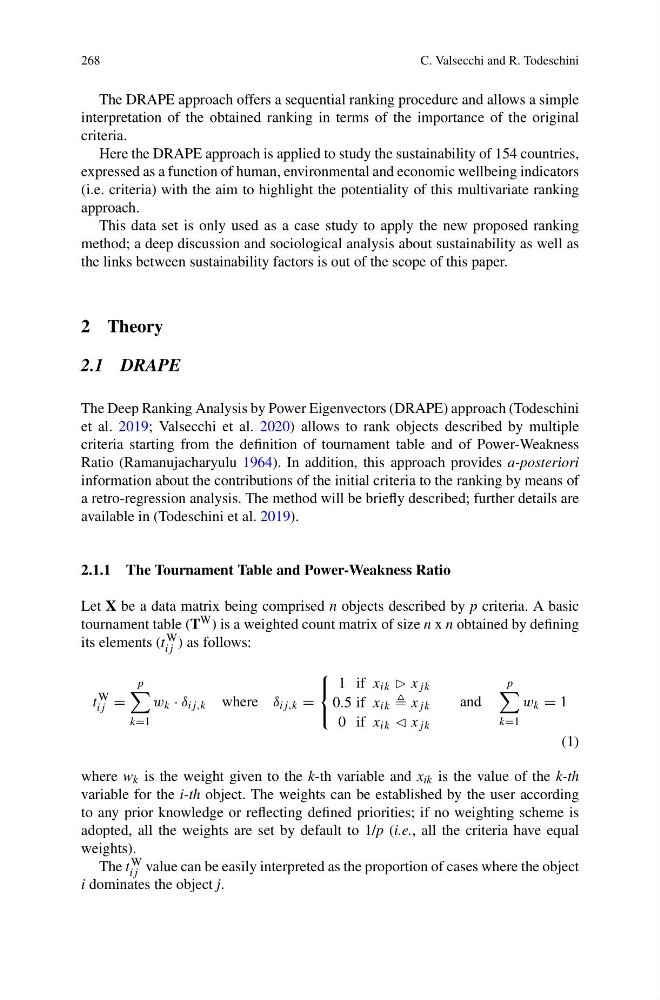
Let X be a data matrix being comprised n objects described by p criteria. A basic
tournament table (T W ) is a weighted count matrix of size n x n obtained by defining
its elements (t W
ij ) as follows:
t
W
ij =
p
k=1
w k · δ ij,k where δ ij,k =
⎧
⎨
⎩
1 if x ik x jk
0.5 if x ik x jk
0 if x ik x jk
and
p
k=1
w k = 1
(1)
where w k is the weight given to the k-th variable and x ik is the value of the k-th
variable for the i-th object. The weights can be established by the user according
to any prior knowledge or reflecting defined priorities; if no weighting scheme is
adopted, all the weights are set by default to 1/p (i.e., all the criteria have equal
weights).
The t W
ij value can be easily interpreted as the proportion of cases where the object
i dominates the object j.
C. Valsecchi and R. Todeschini
The DRAPE approach offers a sequential ranking procedure and allows a simple
interpretation of the obtained ranking in terms of the importance of the original
criteria.
Here the DRAPE approach is applied to study the sustainability of 154 countries,
expressed as a function of human, environmental and economic wellbeing indicators
(i.e. criteria) with the aim to highlight the potentiality of this multivariate ranking
approach.
This data set is only used as a case study to apply the new proposed ranking
method; a deep discussion and sociological analysis about sustainability as well as
the links between sustainability factors is out of the scope of this paper.
2 Theory
2.1 DRAPE
The Deep Ranking Analysis by Power Eigenvectors (DRAPE) approach (Todeschini
et al. 2019; Valsecchi et al. 2020) allows to rank objects described by multiple
criteria starting from the definition of tournament table and of Power-Weakness
Ratio (Ramanujacharyulu 1964). In addition, this approach provides a-posteriori
information about the contributions of the initial criteria to the ranking by means of
a retro-regression analysis. The method will be briefly described; further details are
available in (Todeschini et al. 2019).
2.1.1 The Tournament Table and Power-Weakness Ratio
Let X be a data matrix being comprised n objects described by p criteria. A basic
tournament table (T W ) is a weighted count matrix of size n x n obtained by defining
its elements (t W
ij ) as follows:
t
W
ij =
p
k=1
w k · δ ij,k where δ ij,k =
⎧
⎨
⎩
1 if x ik x jk
0.5 if x ik x jk
0 if x ik x jk
and
p
k=1
w k = 1
(1)
where w k is the weight given to the k-th variable and x ik is the value of the k-th
variable for the i-th object. The weights can be established by the user according
to any prior knowledge or reflecting defined priorities; if no weighting scheme is
adopted, all the weights are set by default to 1/p (i.e., all the criteria have equal
weights).
The t W
ij value can be easily interpreted as the proportion of cases where the object
i dominates the object j.