

Posetic Tools in the Social Sciences: A Tutorial Exposition
239
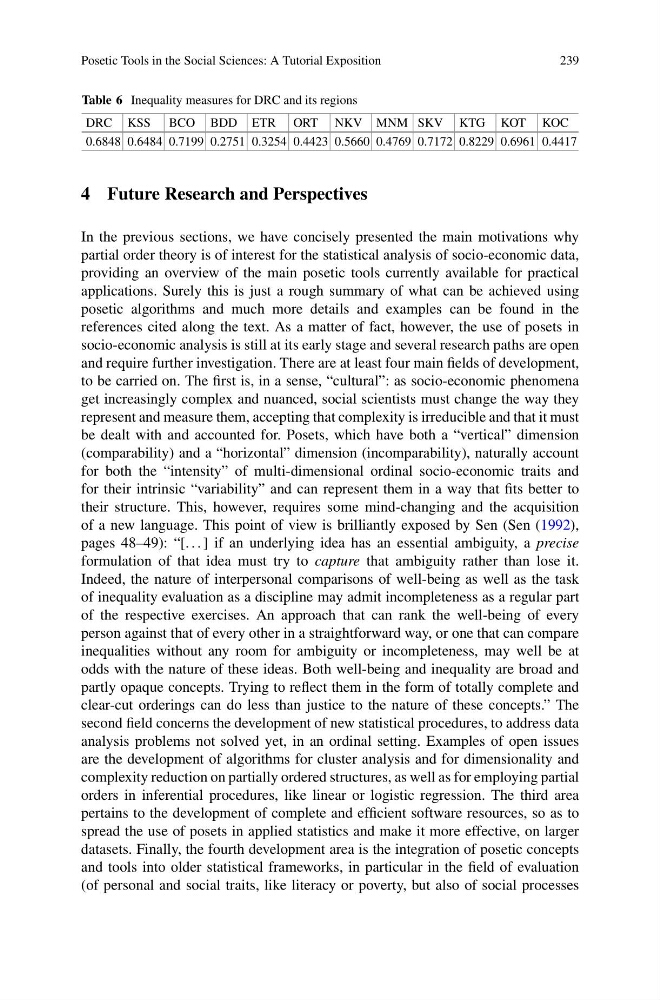
Table 6 Inequality measures for DRC and its regions
DRC KSS BCO BDD ETR ORT NKV MNM SKV KTG KOT KOC
0.6848 0.6484 0.7199 0.2751 0.3254 0.4423 0.5660 0.4769 0.7172 0.8229 0.6961 0.4417
4 Future Research and Perspectives
In the previous sections, we have concisely presented the main motivations why
partial order theory is of interest for the statistical analysis of socio-economic data,
providing an overview of the main posetic tools currently available for practical
applications. Surely this is just a rough summary of what can be achieved using
posetic algorithms and much more details and examples can be found in the
references cited along the text. As a matter of fact, however, the use of posets in
socio-economic analysis is still at its early stage and several research paths are open
and require further investigation. There are at least four main fields of development,
to be carried on. The first is, in a sense, “cultural”: as socio-economic phenomena
get increasingly complex and nuanced, social scientists must change the way they
represent and measure them, accepting that complexity is irreducible and that it must
be dealt with and accounted for. Posets, which have both a “vertical” dimension
(comparability) and a “horizontal” dimension (incomparability), naturally account
for both the “intensity” of multi-dimensional ordinal socio-economic traits and
for their intrinsic “variability” and can represent them in a way that fits better to
their structure. This, however, requires some mind-changing and the acquisition
of a new language. This point of view is brilliantly exposed by Sen (Sen (1992),
pages 48–49): “[. . . ] if an underlying idea has an essential ambiguity, a precise
formulation of that idea must try to capture that ambiguity rather than lose it.
Indeed, the nature of interpersonal comparisons of well-being as well as the task
of inequality evaluation as a discipline may admit incompleteness as a regular part
of the respective exercises. An approach that can rank the well-being of every
person against that of every other in a straightforward way, or one that can compare
inequalities without any room for ambiguity or incompleteness, may well be at
odds with the nature of these ideas. Both well-being and inequality are broad and
partly opaque concepts. Trying to reflect them in the form of totally complete and
clear-cut orderings can do less than justice to the nature of these concepts.” The
second field concerns the development of new statistical procedures, to address data
analysis problems not solved yet, in an ordinal setting. Examples of open issues
are the development of algorithms for cluster analysis and for dimensionality and
complexity reduction on partially ordered structures, as well as for employing partial
orders in inferential procedures, like linear or logistic regression. The third area
pertains to the development of complete and efficient software resources, so as to
spread the use of posets in applied statistics and make it more effective, on larger
datasets. Finally, the fourth development area is the integration of posetic concepts
and tools into older statistical frameworks, in particular in the field of evaluation
(of personal and social traits, like literacy or poverty, but also of social processes
239
Table 6 Inequality measures for DRC and its regions
DRC KSS BCO BDD ETR ORT NKV MNM SKV KTG KOT KOC
0.6848 0.6484 0.7199 0.2751 0.3254 0.4423 0.5660 0.4769 0.7172 0.8229 0.6961 0.4417
4 Future Research and Perspectives
In the previous sections, we have concisely presented the main motivations why
partial order theory is of interest for the statistical analysis of socio-economic data,
providing an overview of the main posetic tools currently available for practical
applications. Surely this is just a rough summary of what can be achieved using
posetic algorithms and much more details and examples can be found in the
references cited along the text. As a matter of fact, however, the use of posets in
socio-economic analysis is still at its early stage and several research paths are open
and require further investigation. There are at least four main fields of development,
to be carried on. The first is, in a sense, “cultural”: as socio-economic phenomena
get increasingly complex and nuanced, social scientists must change the way they
represent and measure them, accepting that complexity is irreducible and that it must
be dealt with and accounted for. Posets, which have both a “vertical” dimension
(comparability) and a “horizontal” dimension (incomparability), naturally account
for both the “intensity” of multi-dimensional ordinal socio-economic traits and
for their intrinsic “variability” and can represent them in a way that fits better to
their structure. This, however, requires some mind-changing and the acquisition
of a new language. This point of view is brilliantly exposed by Sen (Sen (1992),
pages 48–49): “[. . . ] if an underlying idea has an essential ambiguity, a precise
formulation of that idea must try to capture that ambiguity rather than lose it.
Indeed, the nature of interpersonal comparisons of well-being as well as the task
of inequality evaluation as a discipline may admit incompleteness as a regular part
of the respective exercises. An approach that can rank the well-being of every
person against that of every other in a straightforward way, or one that can compare
inequalities without any room for ambiguity or incompleteness, may well be at
odds with the nature of these ideas. Both well-being and inequality are broad and
partly opaque concepts. Trying to reflect them in the form of totally complete and
clear-cut orderings can do less than justice to the nature of these concepts.” The
second field concerns the development of new statistical procedures, to address data
analysis problems not solved yet, in an ordinal setting. Examples of open issues
are the development of algorithms for cluster analysis and for dimensionality and
complexity reduction on partially ordered structures, as well as for employing partial
orders in inferential procedures, like linear or logistic regression. The third area
pertains to the development of complete and efficient software resources, so as to
spread the use of posets in applied statistics and make it more effective, on larger
datasets. Finally, the fourth development area is the integration of posetic concepts
and tools into older statistical frameworks, in particular in the field of evaluation
(of personal and social traits, like literacy or poverty, but also of social processes